Biography
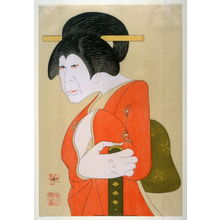
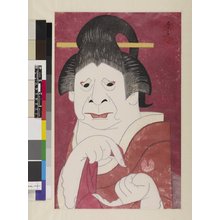
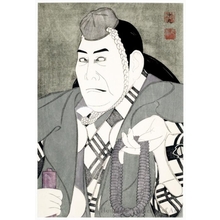
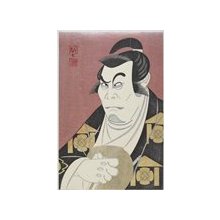
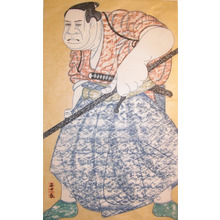
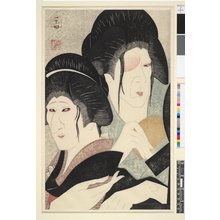
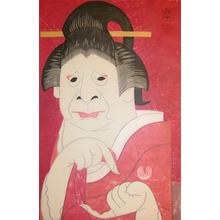
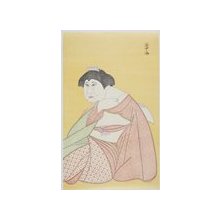
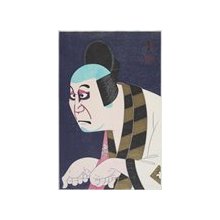
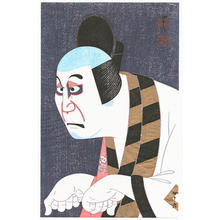
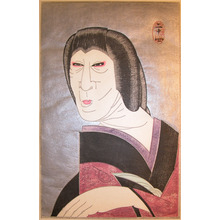
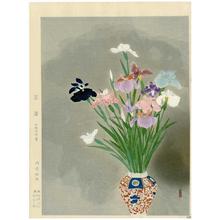
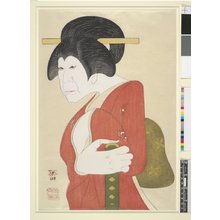
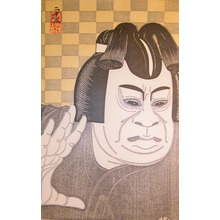
Tsuruya Kokei holds a singular place in the history of Japanese woodblock printing as the artist who revived the tradition of kabuki actor portraiture for the modern era, earning him the epithet 'the modern Sharaku' after the legendary Edo-period master of the genre. Born in 1946 as Gen Mitsu in Chigasaki City, Kanagawa Prefecture, into a family with a long artistic tradition, he nevertheless received no formal art training and did not begin making prints until age thirty-two.
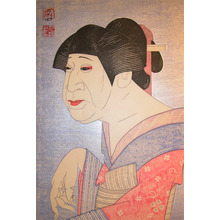
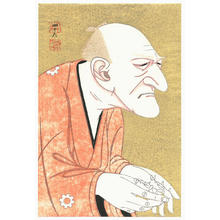
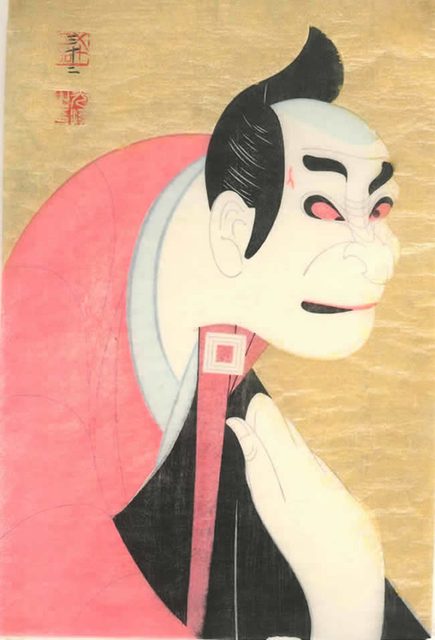
The catalyst came in 1978, when a kabuki performance at the National Theater in Tokyo so moved him that he resolved to capture the art form in woodblock prints. Unlike the ukiyo-e masters who employed teams of professional carvers and printers, Kokei followed the principles of sosaku hanga, designing, carving, and printing every work himself. Without formal instruction, he mastered each stage of the process to an extraordinary technical level, working with thin ganpi paper and embellishing his prints with mica and metallic pigments in a manner that honored the traditions of Sharaku, Toyokuni, and the great actor-print lineage.
From 1978 to 2000, Kokei served as a resident artist at the renowned Kabuki-za Theater in Tokyo, producing approximately twelve limited-edition designs per year. Each edition was restricted to seventy-two impressions, required approximately forty days to complete, and the blocks were destroyed afterward, ensuring the absolute finality of each edition. His prints capture specific actors in specific roles, blending the bold compositional drama of classical ukiyo-e with a contemporary psychological depth and subtle humor that is entirely his own.
In 2000, Kokei retired from printmaking, citing personal reasons. However, in 2017, he returned to the woodblock with his ongoing project Banzai Ukiyoe-ha Gosugata (Long Live the Five Figures of Ukiyo-e), breathing life into the ukiyo-e masters who inspired his passion. His work is held by the British Museum, the Minneapolis Institute of Art, the Pacific Asia Museum, the Yale University Art Gallery, and the Honolulu Museum of Art.
Key Facts
- Active Period
- 1946
- Nationality
- 🇯🇵Japan
- Movements
- Contemporary MokuhangaSōsaku-hanga
- Works Indexed
- 26
Frequently Asked Questions
Tsuruya Kokei holds a singular place in the history of Japanese woodblock printing as the artist who revived the tradition of kabuki actor portraiture for the modern era, earning him the epithet 'the modern Sharaku' after the legendary Edo-period master of the genre. Born in 1946 as Gen Mitsu in Chigasaki City, Kanagawa Prefecture, into a family with a long artistic tradition, he nevertheless received no formal art training and did not begin making prints until age thirty-two.
Tsuruya Kokei was active born in 1946. They were associated with the Contemporary Mokuhanga and Sōsaku-hanga movements.
Tsuruya Kokei's work was shaped by the Contemporary Mokuhanga and Sōsaku-hanga traditions in Japanese woodblock printmaking. Contemporary Mokuhanga: Contemporary mokuhanga (literally "wood-block print") encompasses artists working from approximately 1970 to the present who continue or reinvent traditional Japanese woodblock printing techniques. Sōsaku-hanga: ## What is sōsaku-hanga? Sōsaku-hanga (創作版画, "creative prints") was a twentieth-century Japanese print movement defined by a single commitment: the artist must design, carve, and print every work alone.
Original prints by Tsuruya Kokei can be found in collections including British Museum, Ronin Gallery, Japanese Art Open Database, Legion of Honor.
Tsuruya Kokei is one of the most distinctive contemporary Japanese printmakers, known for vivid kabuki actor portraits that continue the ukiyo-e yakusha-e tradition in a bold modern style. Most prints sell in the $1,500–$8,000 range, with major compositions reaching $10,000–$15,000. Smaller works are accessible at $500–$1,500. His work appeals to a crossover audience of kabuki enthusiasts, ukiyo-e collectors, and contemporary print collectors. His prints are held in the British Museum and Museum of Fine Arts, Boston.