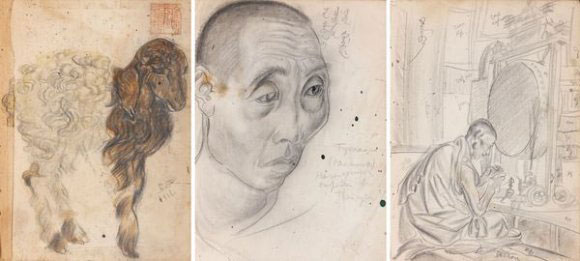
Alexandre Iacovleff
1887–1938
Japan
Biography
Alexandre Yevgenievich Iacovleff (Александр Евгеньевич Яковлев, 1887-1938) was a Russian neoclassicist painter, draughtsman, etcher and traveller whose two-year mission across Mongolia, China and Japan between 1917 and 1919 produced one of the most sustained and technically accomplished bodies of Western figurative work on the Japanese theatre and on the peoples of East Asia in the early twentieth century. Iacovleff is now best known to general audiences for the African and Asian portrait suites he produced as the official artist of the two Citroën expeditions of the 1920s and 1930s — the Croisière Noire across the Sahara and equatorial Africa in 1924-25 and the Croisière Jaune across western Asia, the Pamirs, Xinjiang and China in 1931-32 — but for collectors of Japanese subjects his earlier Far Eastern mission is the more significant achievement, and his series of sanguine, sepia and charcoal drawings of the kabuki actors of late Taishō Tokyo is one of the finest documents of the Japanese popular stage by a non-Japanese hand.
He was born on 25 June 1887 (13 June Old Style) in Saint Petersburg, the son of a naval officer. Between 1905 and 1913 he was enrolled at the Imperial Academy of Arts, where he studied painting under Dmitri Kardovsky, the rigorously academic teacher whose method — based on the Italian Renaissance, French neoclassicism and the linear discipline of Ingres — would mark Iacovleff's work for the rest of his life. While still a student he contributed illustrations and caricatures to the leading St Petersburg periodicals Apollon, Satirikon and Niva, and from 1912 he was affiliated with the late phase of the Mir Iskusstva (World of Art) circle, whose insistence on craft and on the recovery of historical styles aligned closely with his own neoclassical preferences. The same period saw the beginning of his lifelong artistic partnership with his fellow student Vasily Shukhaev, with whom he produced the celebrated double Self-Portrait as Harlequin and Pierrot during a joint Italian-Spanish study trip after 1913 and with whom he later founded the St Luke Guild of Painters together with Kardovsky and Nikolai Radlov. In 1913 his Academy diploma works Bathing and In a Banya earned him the title of Artist together with a foreign-travel scholarship.
In the summer of 1917, with Russia descending into revolution, the Academy of Arts awarded Iacovleff a separate scholarship for two years of study in the Far East. He left Petrograd at the end of the year — narrowly avoiding the upheaval that would prevent his return to Russia — and travelled across Siberia to Vladivostok, on to Mongolia and Beijing, and then to Japan, where he settled for the longest portion of the mission, working principally in Tokyo. The Far Eastern years (1917-1919) produced an enormous quantity of finished and study drawings, watercolours and a handful of oils, of which the most concentrated series is his cycle of portraits of the leading kabuki actors of the day. Iacovleff drew from life backstage and in the theatres themselves, working in sanguine and sepia and occasionally in charcoal on large sheets that he then mounted and signed. The cycle includes meticulous head-and-shoulders studies of the great onnagata Nakamura Utaemon V (1866-1940) in feminine costume and of other Meiji and Taishō-period stars in roles drawn from the standard repertoire, among them the chivalrous-robber hero Benten Kozō Kikunosuke from the Kawatake Mokuami play Aoto Zōshi Hana no Nishiki-e. He also produced a parallel set of full-figure drawings and oils of samurai imagery and of stage battle scenes, in which he absorbed the disciplined linearity of nineteenth-century shibai-e prints into his own neoclassical drawing.
Beyond the kabuki cycle, Iacovleff produced a substantial group of drawings of ordinary Japanese subjects — geisha and young women in everyday kimono, sketches of street life and shop fronts, multiple-figure compositional studies and travel notations — which together comprise one of the most comprehensive Russian artistic responses to Japan of the period. He celebrated the November 1918 Armistice at the Italian legation in Beijing with the Italian diplomat Daniele Varè before returning briefly to Japan, and the mission produced enough finished work that he was soon able to mount a large solo exhibition of his Far Eastern drawings in Shanghai. From Shanghai he travelled on to Paris, where he settled, took French citizenship and joined the active community of Russian émigré artists working between Paris and the Mediterranean. He competed (under the rules then in force for art at the Olympic Games) in the painting event of the 1924 Summer Olympics art competitions.
The Paris years brought Iacovleff to international attention through his association with André Citroën. In 1924-25 he served as the official artist of the Citroën Croisière Noire expedition, a half-tracked motorised crossing of the Sahara and equatorial Africa from Algeria to Madagascar that produced a celebrated suite of African portraits — including the imposing sanguine of Chef Manzinga, the Sultan de Birao, and a long series of head studies of the peoples of central Africa — and earned him the Legion of Honour from the French government in 1926. A major Moscow exhibition of his work followed in 1928. In 1931-32 he was again attached, this time as artistic adviser, to the Citroën Croisière Jaune, the more demanding crossing of Syria, Iran, Afghanistan, the Pamirs and Chinese Turkestan that traversed Xinjiang and ended in Beijing. The Yellow Cruise — interrupted by political tensions, fatal illness within the expedition party and the bivouac at Aksu — produced a second great cycle of expedition portraits, including studies of the peoples and rulers of Afghanistan, the Pamirs and Chinese Turkestan, that together with the African cycle established Iacovleff as the principal pictorial chronicler of the interwar French expeditions in Africa and Asia.
In 1934 he accepted the directorship of the Painting Department of the School of the Museum of Fine Arts, Boston, a position he held until 1937. At Boston he taught a generation of American figurative painters in the rigorous Kardovsky-derived neoclassical method that he had carried out of the Imperial Academy and shaped a small but lasting tradition of academically grounded American draughtsmanship. He continued to exhibit in Paris during these years and divided his time between the school and Capri, the southern Italian island where he produced some of his most relaxed and personal studies of Mediterranean light. He returned permanently to Paris in 1937 and died there on 12 May 1938, aged fifty, following an unsuccessful surgery.
Iacovleff's reputation in the West has long rested principally on the African Citroën suite — easily the most reproduced of his bodies of work — but the Japanese cycle is increasingly understood as the more original achievement. Where the African and Yellow Cruise drawings document populations who were largely strangers to European drawing conventions, the Japanese cycle places Iacovleff in dialogue with the great tradition of yakusha-e (actor prints) running from Sharaku and Toyokuni through Kunichika and on to the early twentieth-century shin-hanga interpreters Natori Shunsen and Yamamura Toyonari. Iacovleff's actor portraits draw consciously on the actor-print tradition — the close cropping, the concentrated frontal pose, the careful registration of stage make-up and costume detail — but translate them into the soft chalk-and-sanguine vocabulary of European academic life-drawing, producing a hybrid that has no precise analogue in either tradition. The Tokyo portraits also belong to a small group of European depictions of late Meiji and Taishō kabuki — alongside those of Helen Hyde, Charles Bartlett and Bertha Lum — that document the great onnagata of the period before the deaths of Utaemon V, Onoe Kikugorō VI and Nakamura Kichiemon I by mid-century closed the chapter of the immediately pre-war stage.
Major public holdings of Iacovleff's work are at the State Russian Museum and the State Tretyakov Gallery in Russia, the Musée Albert-Kahn and Musée Cernuschi in Paris, the Pushkin State Museum of Fine Arts in Moscow, the Museum of Fine Arts in Boston and a number of private foundations and family estates in France, Russia and the United States. For collectors of Japanese subjects he is best understood as the principal Russian witness to the Tokyo stage of the immediately post-Meiji decades and as a draughtsman whose Kardovsky-trained classical line gives his actor portraits a documentary precision unmatched by his contemporaries.
Key Facts
- Active Period
- 1887–1938
- Nationality
- 🇯🇵Japan
- Subjects
- Children
- Works Indexed
- 12
Frequently Asked Questions
Alexandre Yevgenievich Iacovleff (Александр Евгеньевич Яковлев, 1887-1938) was a Russian neoclassicist painter, draughtsman, etcher and traveller whose two-year mission across Mongolia, China and Japan between 1917 and 1919 produced one of the most sustained and technically accomplished bodies of Western figurative work on the Japanese theatre and on the peoples of East Asia in the early twentieth century. Iacovleff is now best known to general audiences for the African and Asian portrait suites he produced as the official artist of the two Citroën expeditions of the 1920s and 1930s — the Croisière Noire across the Sahara and equatorial Africa in 1924-25 and the Croisière Jaune across western Asia, the Pamirs, Xinjiang and China in 1931-32 — but for collectors of Japanese subjects his earlier Far Eastern mission is the more significant achievement, and his series of sanguine, sepia and charcoal drawings of the kabuki actors of late Taishō Tokyo is one of the finest documents of the Japanese popular stage by a non-Japanese hand.
Alexandre Iacovleff was active from 1887 to 1938.
Alexandre Iacovleff's prints frequently feature children.
Original prints by Alexandre Iacovleff can be found in collections including Private collection, Private collection (Sotheby's Russian Paintings, 2011), Private collection (Russian art market).
Woodblock Prints by Alexandre Iacovleff (12)
Three Sketches (from Japan)
1918
Pencil and ink on paper

Kabuki Actor (Study)
歌舞伎役者
c. 1918-1919
Sanguine and charcoal on paper

Geisha
芸者
c. 1919
Sanguine on paper

Street in Japan
1919
Sepia on paper

Nakamura Utaemon V
五代目中村歌右衛門
c. 1918-1919
Sanguine and charcoal on paper

Kabuki Actor in Role
歌舞伎役者の役
c. 1918-1919
Sanguine and charcoal on paper

Japanese Girl
1919
Sepia on paper

Eight Sketches from Japan
c. 1918-1919
Pencil and ink on paper

The Battle (Japanese Theatre)
戦い
c. 1918-1919
Oil on canvas

Samurai
侍
c. 1918-1919
Oil on canvas

Usaemon
1920
Sanguine on paper

Benten Kozō Kikunosuke
弁天小僧菊之助
1929
Sepia on paper