Japanese Print Movements
Japanese woodblock printmaking evolved through several distinct artistic movements, each with its own philosophy, techniques, and masters. Explore the movements that shaped this art form, from traditional ukiyo-e to modern shin-hanga and sosaku-hanga.
Traditional Mokuhanga
c. 1600–present
Traditional mokuhanga (木版画) is the family of Japanese water-based woodblock printing techniques whose lineage stretches from the eighth century to the present and which underlies, in turn, the Buddhist printed text, the multi-colored Edo ukiyo-e print, the early-twentieth-century shin-hanga revival, and the international contemporary mokuhanga community of the twenty-first century. The earliest documented Japanese woodblock printing belongs to the Hyakumantō Darani ("One Million Pagoda Charms"), commissioned by the Empress Shōtoku between 764 and 770 and completed around 770: roughly a million miniature wooden pagodas were filled with woodblock-printed Buddhist dhāraṇī (prayer-spells) on washi paper and distributed to temples across Japan, making the project the earliest reliably dateable printed text to survive anywhere in the world, predating Gutenberg's movable type by some seven centuries (https://en.wikipedia.org/wiki/Hyakumant%C5%8D_Darani). For most of the next eight hundred years woodblock printing in Japan remained the medium of Buddhist sutras, mandalas, and didactic religious images produced inside temples, and only in the late sixteenth and seventeenth centuries did it spread to secular publishing — first to illustrated books and then, with the urbanization of Edo (modern Tokyo) into a city of more than a million people, to the single-sheet ukiyo-e ("pictures of the floating world") prints that the rest of the world now most associates with the technique (https://en.wikipedia.org/wiki/Woodblock_printing_in_Japan). The mature Edo system codified what is still known as the traditional mokuhanga workflow. Production was rigorously divided among four roles: the artist (eshi), who supplied a design drawing; the carver (horishi), who cut a separate cherrywood block (often planks of yamazakura) for the keyline and for each color area; the printer (surishi), who hand-pressed dampened washi paper onto inked blocks; and the publisher (hanmoto), who commissioned, financed, and distributed the editions and who legally owned the blocks (https://en.wikipedia.org/wiki/Woodblock_printing_in_Japan). The materials and tools that distinguish the tradition are likewise specific: water-based pigments mixed with rice paste (nori) for body, allowing colors to soak into and not just sit on top of the paper; absorbent kōzo-based washi (mulberry-fiber Japanese paper); registration marks called kentō, carved as a corner and edge guide into each block to align successive impressions in perfect register; the baren, a round hand-burnisher built around a coiled cord of twisted bamboo leaves enclosed in a paper disk and wrapped in a single dampened bamboo sheath, which the printer rubs across the back of the paper to transfer ink; and the gradient-shading technique known as bokashi, in which pigment is applied unevenly to the block and wiped or feathered before printing to produce graded skies, water, and atmospheric effects (https://en.wikipedia.org/wiki/Woodblock_printing_in_Japan). The Edo system reached its color-printing apex in the multi-block nishiki-e ("brocade pictures") of the late eighteenth century, developed by artists including Suzuki Harunobu, and remained the dominant Japanese print mode through the careers of Hokusai, Hiroshige, and Kuniyoshi. Although ukiyo-e workshop production declined sharply after the Meiji Restoration of 1868 in the face of photography and Western printing technologies, the traditional studio system never disappeared: in the early twentieth century the publisher Watanabe Shōzaburō self-consciously revived it under the banner of shin-hanga ("new prints"), commissioning designs from artists such as Kawase Hasui and Hiroshi Yoshida and routing them through teams of carvers and printers trained in the Edo manner (https://en.wikipedia.org/wiki/Woodblock_printing_in_Japan). In the postwar period this artisan lineage has been preserved by Tokyo workshops including the Adachi Institute of Woodblock Prints and the Kyoto-based Takezasado, which continue to print using historical materials and methods (https://en.wikipedia.org/wiki/Woodblock_printing_in_Japan). Since the 2010s an international contemporary mokuhanga revival has carried the technique well beyond Japan: the triennial International Mokuhanga Conference, inaugurated in 2011 in Kyoto and Awaji, gathers artists and researchers from dozens of countries who learn directly from Japanese craftspeople, study washi-making at the Awagami mills in Tokushima, and explore both traditional applications and new directions for water-based woodblock practice in a global contemporary context (https://mokuhanga.jp/en/).

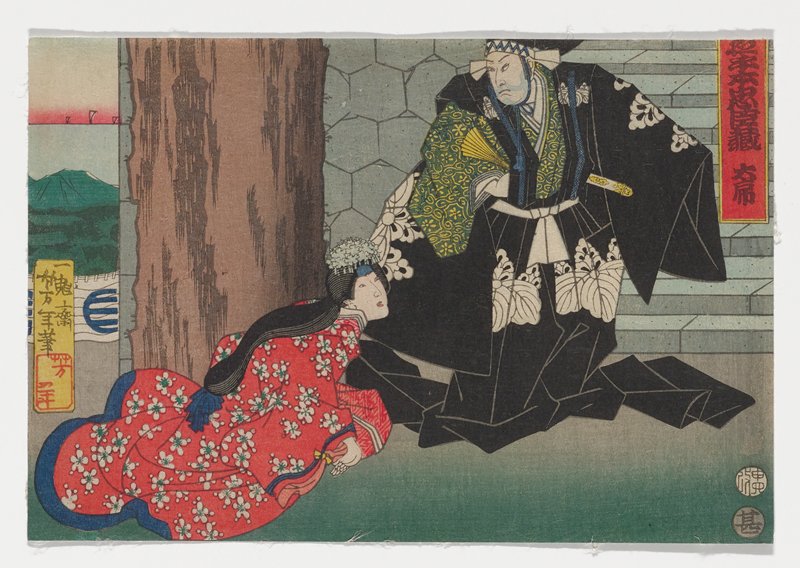
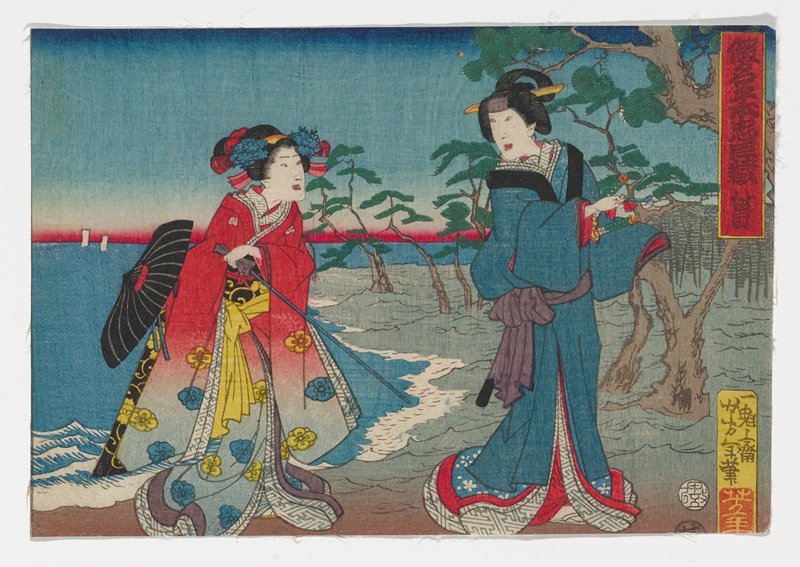
Meiji/Taishō Prints
c. 1868–1926
Meiji and Taishō era prints (1868–1926) bridge the transition from traditional ukiyo-e to the modern shin-hanga and sosaku-hanga movements. During this period, Japan underwent rapid modernization and Westernization, profoundly affecting the visual arts. Artists working in this transitional era experimented with Western techniques such as perspective, shading, and oil painting while often maintaining connections to traditional woodblock printmaking. Key figures include Tsukioka Yoshitoshi, who brought ukiyo-e to its dramatic culmination; Kobayashi Kiyochika, who pioneered light-and-shadow effects in prints; and Uemura Shoen, whose refined bijin-ga paintings influenced generations of later printmakers. The era also saw the emergence of the sōsaku-hanga ideal through Kanae Yamamoto''s 1904 "Fisherman," widely considered the first modern creative print.


Sōsaku-hanga
c. 1905–1980
## What is sōsaku-hanga? Sōsaku-hanga (創作版画, "creative prints") was a twentieth-century Japanese print movement defined by a single commitment: the artist must design, carve, and print every work alone. Beginning with [Kanae Yamamoto](/artists/kanae-yamamoto)'s 1904 self-cut block *Gyofu* (Fisherman) and continuing through the post-war decades, it rejected the publisher-driven [ukiyo-e](/glossary/ukiyo-e) workshop — in which separate [eshi](/glossary/eshi), [horishi](/glossary/horishi), and [surishi](/glossary/surishi) divided the labor of designing, carving, and printing — in favor of the [moku-hanga](/glossary/moku-hanga) print as the unmediated expression of one hand. The result was a body of work closer in spirit to mid-century painting than to the Edo commercial tradition that preceded it. ## Historical context The usual origin point is 1904, when [Kanae Yamamoto](/artists/kanae-yamamoto) — a woodblock-trained illustrator who had also studied Western oil painting at the Tokyo School of Fine Arts — published *Gyofu* in the literary journal *Myōjō*. The print, a small fisherman with the artist's distinctive self-carved line, is conventionally treated as the first Japanese print in which the designer also held the knife and the [baren](/glossary/baren). It was a deliberate inversion of the [ukiyo-e](/movements/ukiyo-e) division of labor, aligning Japanese woodblock practice with the European etching tradition Yamamoto encountered through reproductions of Käthe Kollwitz, Edvard Munch, and the French Nabis. Yamamoto travelled to France from 1912 to 1916, absorbed the Parisian avant-garde, and on his return co-founded the Nihon Sōsaku-Hanga Kyōkai (Japanese Creative Print Association) in 1918 with [Onchi Kōshirō](/artists/onchi-koshiro), fixing the term *sōsaku-hanga* and the *jiga jikoku jizuri* principle as the movement's banner. Where the contemporaneous [shin-hanga](/movements/shin-hanga) movement led by publisher Watanabe Shōzaburō revived a refined Edo aesthetic for foreign collectors, sōsaku-hanga positioned itself as the modernist counter-current, more interested in Munch than in Hokusai. Pre-war reception was modest. The international breakthrough came after 1945: at the 1951 São Paulo Biennale, [Saitō Kiyoshi](/artists/saito-kiyoshi) shared the print prize — the first major international award to a Japanese printmaker — and in 1956 [Shikō Munakata](/artists/shiko-munakata) won the Grand Prize for prints at the Venice Biennale. Munakata received the Order of Culture in 1970. American officials, expatriate dealers, and collectors such as James Michener carried the work to the United States, where the Smithsonian, the Library of Congress, and the Museum of Fine Arts, Boston built the holdings that anchor the scholarship today. ## The *jiga jikoku jizuri* principle The movement's ideology reduces to four characters and three verbs. *Jiga jikoku jizuri* (自画自刻自摺) — self-drawn, self-carved, self-printed — meant the printmaker was responsible for every stage from the [hanshita-e](/glossary/hanshita-e) (the carving guide) through the cutting of the key and color blocks to the final impression on [washi](/glossary/washi). The publisher ([hanmoto](/glossary/hanmoto)), professional carver, and printer were all eliminated. What remained was the artist alone in front of the block. The consequences were significant. Editions shrank from the thousands typical of commercial [nishiki-e](/glossary/nishiki-e) to fifty, one hundred, or two hundred impressions. Surfaces grew more individual: knife marks were left visible, the [mokume](/glossary/mokume) grain of the [sakura](/glossary/sakura) plank (or plywood and shina) was deliberately exposed, and printing pressure varied in ways a workshop [surishi](/glossary/surishi) would have corrected. The principle was always more programmatic than absolute. [Onchi Kōshirō](/artists/onchi-koshiro) had assistants pull his layered prints after his eyesight failed; [Saitō Kiyoshi](/artists/saito-kiyoshi)'s later *Winter in Aizu* editions involved studio printers. But the moral framework remained: a sōsaku-hanga print, even with workshop assistance, was the artist's authored act, not a publisher's commission. ## Key artists The movement's center of gravity sits with figures who matured between the wars and reached fullest expression after 1945. [Kanae Yamamoto](/artists/kanae-yamamoto), the originator, also drove the Farmers' Art Movement of the 1920s. [Onchi Kōshirō](/artists/onchi-koshiro), trained as a graphic designer and book illustrator, became the movement's most theoretically ambitious member: his abstract prints of the 1930s and 1940s — some assembled from found objects pressed alongside carved blocks — anticipate Western post-war abstraction by a decade. [](/artworks/hashiguchi-goyo-bust-of-a-woman) [Hiratsuka Un'ichi](/artists/unichi-hiratsuka) — who studied carving with the traditional [horishi](/glossary/horishi) Igami Bonkotsu — became the movement's pedagogue, teaching at the Tokyo Fine Arts School from 1935 and living in Washington, DC, from 1962 until 1994. His black-line landscapes, often printed only with [sumi](/glossary/sumi) on heavy [hōshō](/glossary/hosho), are among the most-collected sōsaku-hanga works in American museums. [Shikō Munakata](/artists/shiko-munakata) sits slightly apart: self-taught and devout, he treated the woodblock as a Buddhist medium and signed himself *hangaman* ("print-doer") rather than artist. The 1956 Venice Grand Prize made him the most internationally visible Japanese printmaker of his generation. [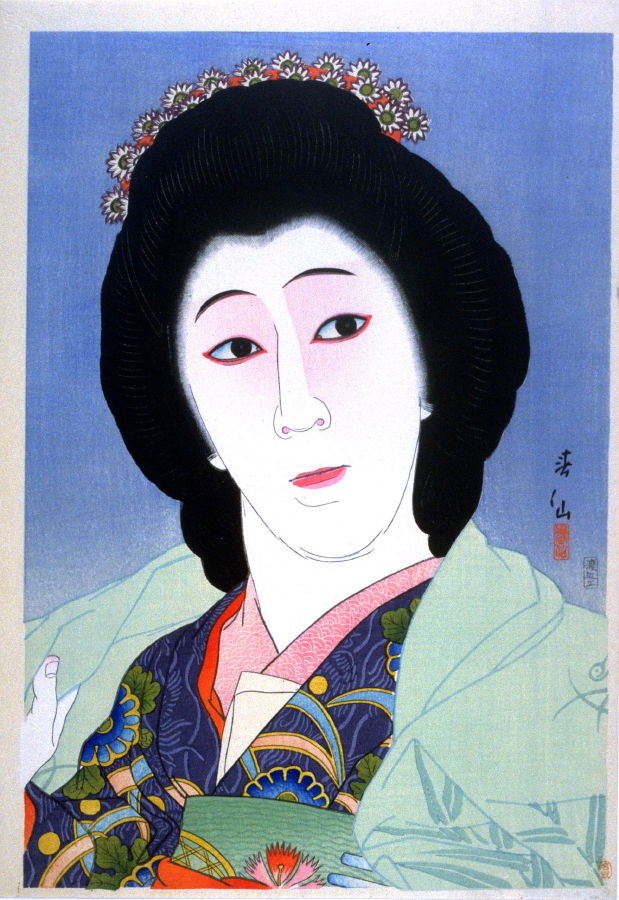](/artworks/natori-shunsen-onoe-baiko-vii-as-shiranui) [Saitō Kiyoshi](/artists/saito-kiyoshi)'s *Winter in Aizu* series presents thatched farmhouses under snow in nearly graphic-design simplifications; he was the first international prizewinner and the figure whose work most decisively crossed into the post-war American market. [Umetarō Azechi](/artists/umetaro-azechi) brought a folk-art idiom and a lifelong subject in mountaineering; [Jun'ichirō Sekino](/artists/junichiro-sekino) produced portrait series and a *Fifty-Three Stations of the Tōkaidō* in dialogue with Hiroshige; [Hagiwara Hideo](/artists/hagiwara-hideo) and [Hodaka Yoshida](/artists/hodaka-yoshida) — the latter a son of the [Hiroshi Yoshida](/artists/hiroshi-yoshida) atelier — pushed the medium toward photomechanical and collaged techniques that mark the bridge into [contemporary mokuhanga](/movements/contemporary-mokuhanga). [Fumio Kitaoka](/artists/fumio-kitaoka), [Oda Kazuma](/artists/kazuma-oda), and [Tomikichirō Tokuriki](/artists/tomikichiro-tokuriki) round out the central group. [](/artworks/hiroshi-yoshida-sailing-boats-night-hansen-yoru-from-the-series-seto-inland-sea-seto-naikai-shu) ## Subject matter and aesthetic No single subject defines sōsaku-hanga, itself a meaningful difference from [ukiyo-e](/movements/ukiyo-e). The Edo movement organized itself around legible genres — [bijin-ga](/glossary/bijin-ga), [yakusha-e](/glossary/yakusha-e), [musha-e](/glossary/musha-e), [meisho-e](/glossary/meisho-e), [shunga](/glossary/shunga) — that publishers used to segment a commercial market. Sōsaku-hanga, freed from those pressures, ranged across abstraction, folk subjects, religious iconography, urban modernism, and pure landscape. Four tendencies recur. The first is the Western-influenced modernism of [Onchi Kōshirō](/artists/onchi-koshiro)'s abstract compositions, in which carved wood, found objects, and layered color produce surfaces without pictorial reference. The second is folk and regional subject matter — [Saitō Kiyoshi](/artists/saito-kiyoshi)'s Aizu villages, [Umetarō Azechi](/artists/umetaro-azechi)'s mountaineers — treating vernacular Japan as a counter to both Tokyo cosmopolitanism and Edo nostalgia. The third is Buddhist and shamanic iconography, the territory of [Shikō Munakata](/artists/shiko-munakata). The fourth, dominant after 1945, is graphic experimentation: collage, etched zinc plates alongside wood, photographic transfer, plywood substrates in place of [sakura](/glossary/sakura). [](/artworks/hiroshi-yoshida-kumoi-cherry-trees-kumoi-sakura) ## Techniques and materials Materially, sōsaku-hanga remained within the [moku-hanga](/glossary/moku-hanga) tradition: the same [sakura](/glossary/sakura) blocks (or, by the 1950s, katsura, shina, plywood); the same [kentō](/glossary/kento) registration notches; the same horsehair-and-bamboo [baren](/glossary/baren); the same [washi](/glossary/washi) papers — [kōzo](/glossary/kozo), [gampi](/glossary/gampi), and [mitsumata](/glossary/mitsumata) sheets sized with [dōsa-biki](/glossary/dosabiki) to control ink absorption. The break was conceptual. Where the [shin-hanga](/movements/shin-hanga) workshop refined the inherited [nishiki-e](/glossary/nishiki-e) palette and pushed [bokashi](/glossary/bokashi) gradation, [karazuri](/glossary/karazuri) blind embossing, and [kirazuri](/glossary/kirazuri) mica printing to new levels of finish, sōsaku-hanga artists deliberately roughened the surface. [Mokume](/glossary/mokume) was exposed rather than sanded out; [sumi](/glossary/sumi) was used at full strength rather than thinned for atmospheric effect. [Hagiwara Hideo](/artists/hagiwara-hideo) pioneered burning, sanding, and abrading of blocks to produce textures no professional [horishi](/glossary/horishi) would have allowed. Onchi's later work incorporated [nunomezuri](/glossary/nunomezuri) cloth-impression and pressed lace, leaf, and string textures alongside conventional block printing. [Kappazuri](/glossary/kappazuri) stencil, etching, lithography, and silkscreen all appear in mid-century output, especially after 1955. ## The Ichimoku-kai and other clubs The movement's social form was the print club. [Onchi Kōshirō](/artists/onchi-koshiro)'s Ichimoku-kai (First Thursday Society), founded in 1939 and active until his death in 1955, met weekly at his Tokyo studio. Members — [Saitō Kiyoshi](/artists/saito-kiyoshi), [Sekino Jun'ichirō](/artists/junichiro-sekino), [Azechi Umetarō](/artists/umetaro-azechi), [Kitaoka Fumio](/artists/fumio-kitaoka), and a rotating cast — brought new prints for criticism, exchanged blocks and pigments, and assembled hand-bound subscription portfolios distributing each member's annual output. The wartime portfolios, produced under paper rationing and air-raid blackouts, remain among the most-prized sōsaku-hanga objects. Other clubs — the Yōfū Hanga Kyōkai, the Zōkei Hanga Kyōkai, and regional groups in Kyoto, Osaka, and Nagoya — followed similar patterns; the subscription portfolio was the principal sales channel through the 1940s. ## How to identify a sōsaku-hanga print Four features distinguish a sōsaku-hanga print from its [shin-hanga](/movements/shin-hanga) and [ukiyo-e](/movements/ukiyo-e) counterparts. First, the signature: a single penciled signature in the lower margin, usually in Romanized form alongside the title, rather than the multiple seal marks (artist, publisher, censor) of an Edo [ichimai-e](/glossary/ichimai-e). A red [hanko](/glossary/hanko) seal often accompanies it, but the publisher's [hanmoto](/glossary/hanmoto) cartouche is absent. Second, the edition number: most prints are penciled with a fraction (e.g., 23/100) within a fixed edition, typically fifty to two hundred. Shin-hanga prints were almost never numbered, and Edo [nishiki-e](/glossary/nishiki-e) editions were open-ended. Third, the paper and surface: sheets are often larger than Edo [ōban](/glossary/oban) standard, frequently on heavy [hōshō](/glossary/hosho), and show visible [mokume](/glossary/mokume) wood-grain; the verso typically shows pigment offsetting from baren pressure. Fourth, the iconography: a 1950s Aizu farmhouse, an abstract composition, or a Buddhist figure in sweeping black-line carving — none of these subjects existed in the Edo or shin-hanga catalogues. [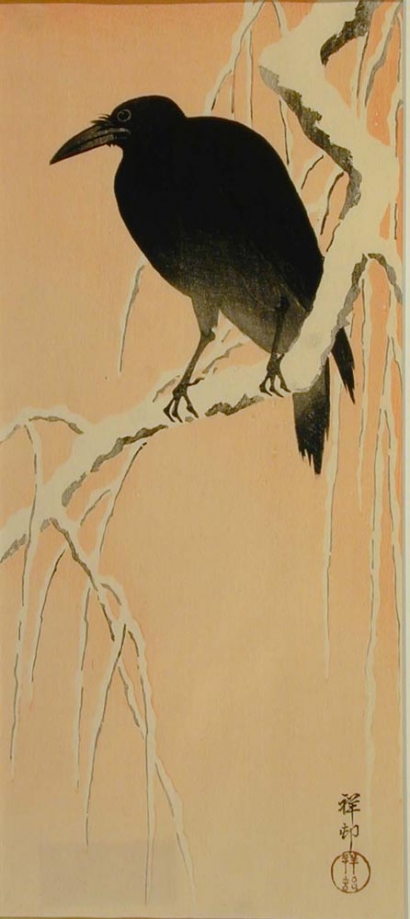](/artworks/ohara-koson-crow-in-moonlight) ## Buying and collecting Editions are smaller than [shin-hanga](/movements/shin-hanga) — fifty to two hundred against shin-hanga's two hundred to several hundred — so per-print rarity is higher. The movement's lower profile against [ukiyo-e](/movements/ukiyo-e) name recognition and the polished surfaces of [Kawase Hasui](/artists/kawase-hasui) and [Hashiguchi Goyō](/artists/hashiguchi-goyo) keeps prices for second-tier artists accessible. A signed Saitō Kiyoshi *Winter in Aizu* sells for several thousand dollars at auction; a comparable Hagiwara Hideo or Sekino Jun'ichirō can be acquired for several hundred. Munakata's Buddhist subjects and Onchi's abstract portraits reach five figures. Prefer impressions penciled, numbered, and sealed in the artist's lifetime — posthumous restrikes trade at substantial discounts. Examine [mokume](/glossary/mokume) and the verso for evidence of hand-printing; offset reproductions are identifiable by flat, even ink coverage. Christie's, Bonhams, and the Japanese houses Mainichi, Shinwa, and Kanazawa hold dedicated sōsaku-hanga sales twice a year; Sebastian Izzard, the Egenolf Gallery, and the Ronin Gallery handle most of the American secondary trade. ## Sōsaku-hanga vs. shin-hanga and ukiyo-e The three traditions overlap in materials but differ in authorship. [Ukiyo-e](/movements/ukiyo-e), the Edo commercial tradition from roughly 1660 to 1868, organized production around a publisher who commissioned an [eshi](/glossary/eshi) (designer), employed a [horishi](/glossary/horishi) (carver) and [surishi](/glossary/surishi) (printer), and sold to a mass urban audience — [Hokusai](/artists/katsushika-hokusai), [Hiroshige](/artists/utagawa-hiroshige), and [Utamaro](/artists/kitagawa-utamaro) all worked this way. [Shin-hanga](/movements/shin-hanga), the early-twentieth-century revival led by publisher Watanabe Shōzaburō from about 1915, preserved the four-role workshop for a new audience: refined Edo techniques applied to landscapes for [Kawase Hasui](/artists/kawase-hasui) and [Hiroshi Yoshida](/artists/hiroshi-yoshida), [bijin-ga](/glossary/bijin-ga) for [Itō Shinsui](/artists/ito-shinsui), kabuki portraits for [Natori Shunsen](/artists/natori-shunsen). Editions were larger, prints unnumbered, surfaces highly polished. The [What is shin-hanga?](/blog/what-is-shin-hanga) post sets out an extended comparison. [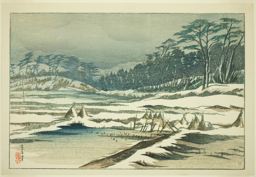](/artworks/ito-shinsui-after-the-snow-yuki-no-ato) Sōsaku-hanga eliminated the publisher entirely. The artist took on all four roles. Editions were small, surfaces rougher, subjects unconstrained. The practical effect for a collector is that one visual impression — *this is a Japanese woodblock print of a snowy village* — can be the product of three different production systems and three price tiers. For broader background, see the [Beginner's Guide to Ukiyo-e](/blog/beginners-guide-to-ukiyo-e). ## Where to see sōsaku-hanga today The principal Japanese collection is the National Museum of Modern Art, Tokyo, which holds Onchi's working blocks and the largest body of his prints. The Munakata Shikō Memorial Hall in Aomori preserves the artist's studio archive; the Hiratsuka Un'ichi Print Museum in Suzaka, Nagano — opened by the artist before his return from Washington — holds his complete catalogue. American holdings are unusually deep. The Smithsonian American Art Museum's Robert O. Muller collection — formed by the Connecticut collector who travelled to Japan repeatedly in the 1950s and 1960s — anchored the museum's 2021 exhibition *Cut + Paste: Works on Paper from the Robert O. Muller Collection*, the canonical recent survey. The Library of Congress holds Hiratsuka materials tied to his Washington residence. The Museum of Fine Arts, Boston, and the Art Institute of Chicago hold strong general collections; the Metropolitan Museum holds Onchi and Munakata in depth; Honolulu Museum of Art and the Achenbach Foundation at the de Young round out the major American repositories. ## Frequently asked questions ### When did the sōsaku-hanga movement begin and end? The conventional starting point is 1904, when [Kanae Yamamoto](/artists/kanae-yamamoto) published *Gyofu* — the small fisherman generally treated as the first self-carved, self-printed Japanese modern print. The Nihon Sōsaku-Hanga Kyōkai's 1918 founding is sometimes used as an alternative origin. The movement has no clean end date; the original generation's deaths run from Onchi in 1955 through Hiratsuka in 1997, and the [contemporary mokuhanga](/movements/contemporary-mokuhanga) practice that succeeds it inherits the *jiga jikoku jizuri* principle without using the *sōsaku-hanga* label. Most scholarship treats 1904–1980 as the movement proper. ### How is sōsaku-hanga different from shin-hanga? The two were contemporaries — both took shape in the 1910s and matured in the 1920s — but understood the print medium in opposite ways. [Shin-hanga](/movements/shin-hanga), led by publisher Watanabe Shōzaburō, preserved the four-role [ukiyo-e](/movements/ukiyo-e) workshop ([eshi](/glossary/eshi), [horishi](/glossary/horishi), [surishi](/glossary/surishi), [hanmoto](/glossary/hanmoto)) and applied it to modernized subjects for a foreign export market. Sōsaku-hanga eliminated every role except the artist's. Visually, shin-hanga prints are polished, atmospheric, and unnumbered; sōsaku-hanga prints are rougher, more graphic, and editioned. Hasui and Yoshida are the archetypal shin-hanga names; Onchi, Munakata, and Saitō the archetypal sōsaku-hanga ones. ### Who is the most important sōsaku-hanga artist? The two strongest candidates are [Onchi Kōshirō](/artists/onchi-koshiro) and [Shikō Munakata](/artists/shiko-munakata), for different reasons. Onchi is the movement's central theorist and most formally ambitious figure; his abstract compositions of the 1930s and 1940s anticipate post-war Western abstraction. Munakata is the most internationally visible, recipient of the 1956 Venice Grand Prize and the 1970 Order of Culture, and the artist whose Buddhist iconography most decisively expanded the medium beyond secular subjects. A serious collection would begin with both, then add [Saitō Kiyoshi](/artists/saito-kiyoshi) and [Hiratsuka Un'ichi](/artists/unichi-hiratsuka). ### How can I tell an original sōsaku-hanga print from a reproduction? Originals are hand-pulled and carry several physical tells: a penciled signature and edition number in the margin, an artist's red [hanko](/glossary/hanko) seal, visible [mokume](/glossary/mokume) wood-grain texture in the printed areas, and pigment offsetting visible on the verso from [baren](/glossary/baren) pressure. Reproductions — offset lithographs and photomechanical prints sold by museums and book publishers — show flat, mechanically even ink coverage, no grain transfer, no offset on the verso, and a printed (not penciled) signature or none at all. For high-value attributions, specialists at Mainichi, Christie's, and Bonhams examine [washi](/glossary/washi) fiber composition and [kentō](/glossary/kento) registration marks. ### What should a beginning collector buy first? The accessible entry point is a signed, numbered, lifetime impression by a second-tier artist — [Tomikichirō Tokuriki](/artists/tomikichiro-tokuriki), [Umetarō Azechi](/artists/umetaro-azechi), [Fumio Kitaoka](/artists/fumio-kitaoka), or a small [Hiratsuka Un'ichi](/artists/unichi-hiratsuka) — typically acquirable for a few hundred dollars from the major auction houses or established American dealers. The natural progression is into [Saitō Kiyoshi](/artists/saito-kiyoshi)'s *Winter in Aizu*, [Sekino Jun'ichirō](/artists/junichiro-sekino)'s portraits, and eventually a small Onchi or Munakata. Buy from sellers who guarantee lifetime status in writing, examine the verso for offset and the paper for [mokume](/glossary/mokume), and prefer prints with intact margins — trimmed sheets lose substantial value.


Shin-hanga
c. 1915–1960
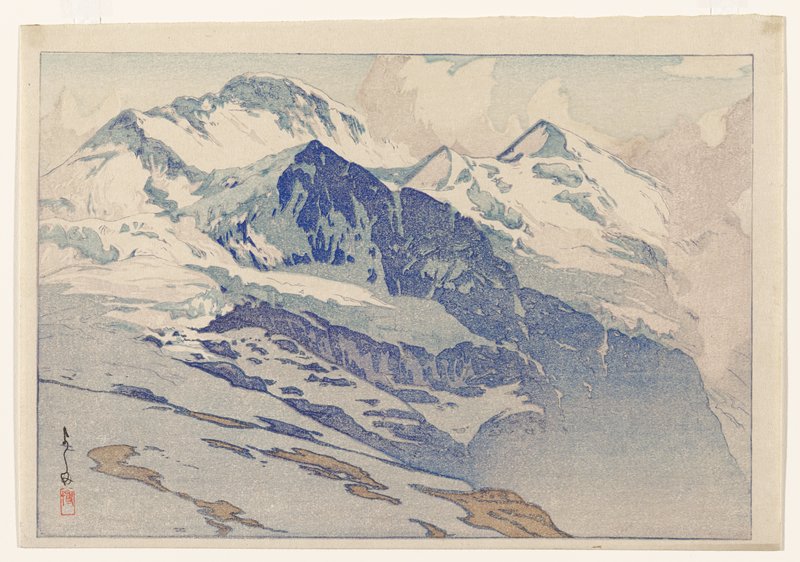
## What is Shin-hanga? Shin-hanga (新版画), literally "new prints," is the early twentieth-century revival of the collaborative Japanese woodblock workshop, organized between roughly 1915 and 1960 by the Tokyo publisher Watanabe Shōzaburō (1885–1962) and a handful of competing houses. The movement reassembled the four-role production chain inherited from Edo-period [ukiyo-e](/movements/ukiyo-e) — designer, carver, printer, publisher — for designs aimed at modern Japanese audiences and a Western export market. Its prints — atmospheric [landscape](/glossary/fukeiga), beauties, bird-and-flower images, actor portraits — kept the technical vocabulary of the Edo trade alive through near-extinction in the Meiji era and into the postwar reconstruction. ## Historical context The collapse shin-hanga set out to reverse began in the 1870s. After the Meiji Restoration of 1868, Japan's print trade lost its captive audience: photography, lithography, and imported magazines absorbed demand for the cheap urban imagery that had supported Edo workshops. By the 1890s the network of carvers and printers had thinned to a few aging specialists, and serious painters worked in oil or Nihonga rather than on woodblocks. Watanabe Shōzaburō began his career inside that decline. Trained as an apprentice exporter under Kobayashi Bunshichi, he founded his own publishing house in 1909, selling reprints of Hiroshige and Hokusai to foreign collectors. Around 1915 he began commissioning new designs from contemporary painters — starting with [Itō Shinsui](/artists/ito-shinsui) and his teacher Kaburaki Kiyokata, then expanding to [Kawase Hasui](/artists/kawase-hasui), [Hashiguchi Goyō](/artists/hashiguchi-goyo), [Ohara Koson](/artists/ohara-koson) (signing as Shōson), and [Natori Shunsen](/artists/natori-shunsen). Watanabe coined the term shin-hanga in 1915 to distinguish these designs from reprint stock and from the contemporaneous [sōsaku-hanga](/movements/sosaku-hanga) movement. Two disasters reshaped the trade. The Great Kantō Earthquake of September 1923 destroyed Watanabe's shop, stock, and most of his cherrywood blocks; surviving "first edition pre-earthquake" sheets are now the rarest shin-hanga objects in the market. Watanabe rebuilt, and the late 1920s and 1930s became peak production years. The Pacific War curtailed publication after 1939; the 1945 firebombings of Tokyo destroyed many remaining blocks, and Hasui's house and archive burned. A reduced industry resumed under Allied occupation; Hasui was named a Living National Treasure in 1956 and died in 1957, and the movement effectively ended around 1960. ## The Watanabe workshop system Shin-hanga is defined less by a visual style than by a production model. A single sheet required four specialists under the publisher's coordination. The designer ([eshi](/glossary/eshi)) supplied a finished brush drawing — a [hanshita-e](/glossary/hanshita-e) — which the block-carver ([horishi](/glossary/horishi)) pasted face-down onto a planked block of mountain cherry ([sakura](/glossary/sakura)) and cut as a key-block, then carved separate blocks for each color, registering them with [kentō](/glossary/kento) corner-marks. The printer ([surishi](/glossary/surishi)) hand-rubbed each impression with a [baren](/glossary/baren) over dampened [washi](/glossary/washi), often layering twenty to forty runs per image. The publisher ([hanmoto](/glossary/hanmoto)) selected the designer, financed the blocks, paid the workshops, distributed editions, and stamped each sheet with his seal. This model inverts the parallel [sōsaku-hanga](/movements/sosaku-hanga) movement, which insisted that a "modern" print be designed, carved, and printed by a single artist. Watanabe's defense of the division of labor was pragmatic: a great printer could produce gradations and overprints a painter could not match. The shin-hanga designers often agreed — [Hiroshi Yoshida](/artists/hiroshi-yoshida) described carving and printing as crafts he had no intention of learning, though he later supervised his own workshop more directly than Hasui ever did. ## Key artists The canon centers on a small group whose designs Watanabe and his rivals issued in repeating series for decades. [Kawase Hasui](/artists/kawase-hasui) produced roughly 620 designs over forty years, almost all atmospheric landscapes of Japanese villages, temples, and harbors observed in snow, rain, dusk, or moonlight. [Hiroshi Yoshida](/artists/hiroshi-yoshida), a Western-style painter who ran his own workshop semi-independently after 1925, designed roughly 260 prints including Japanese landscapes, Indian and Himalayan subjects, and the famous Alpine series produced after a 1925 European tour. [Itō Shinsui](/artists/ito-shinsui), Watanabe's first commissioned designer, produced roughly 200 prints — most slender modern beauties at the bath, mirror, and window. [](/artworks/hiroshi-yoshida-sailing-boats-night-hansen-yoru-from-the-series-seto-inland-sea-seto-naikai-shu) [Hashiguchi Goyō](/artists/hashiguchi-goyo) is the great outlier: a designer who completed exactly fourteen prints before his death from meningitis in 1921. His paper and printing standards became the benchmark by which later shin-hanga beauties were judged. [Ohara Koson](/artists/ohara-koson), who also signed as Shōson and Hōson under different publishers, designed roughly 500 bird-and-flower prints — the largest single oeuvre in the movement. [Natori Shunsen](/artists/natori-shunsen) revived the actor portrait, producing closely observed kabuki likenesses in the late 1920s and again postwar. Around them sit [Torii Kotondo](/artists/torii-kotondo), [Shirō Kasamatsu](/artists/shiro-kasamatsu), [Tsuchiya Kōitsu](/artists/tsuchiya-koitsu), [Takahashi Shōtei](/artists/takahashi-shotei), and [Yamamura Kōka](/artists/yamamura-koka); the foreign-born designers [Elizabeth Keith](/artists/elizabeth-keith) and [Paul Jacoulet](/artists/paul-jacoulet) applied the workshop method to Korean, Chinese, and Micronesian subjects. ## Subject matter and genres Shin-hanga inherited the Edo genres almost intact but recast each through early-twentieth-century pictorial conventions: atmospheric perspective, cast shadows, Western tonal modeling. Landscape is the dominant genre, and Hasui its defining practitioner. His designs follow a recognizable formula — a known location, a specific weather event, a twilight light source, and a single small human figure for scale — updating the [meisho-e](/glossary/meisho-e) tradition for an era of railway travel and tourist guidebooks. [](/artworks/kawase-hasui-the-inokashira-benten-shrine-in-snow-shato-no-yuki) [Bijin-ga](/glossary/bijin-ga) shed the courtesan iconography of Edo prints for the contemporary domestic interior. Goyō, Shinsui, and Kotondo depicted modern women alone — combing hair, applying makeup, stepping from a bath — in compositions owing as much to European genre painting as to Edo models. [](/artworks/hashiguchi-goyo-bust-of-a-woman) [Kacho-e](/glossary/kacho-e), or bird-and-flower prints, became Koson's specialty; his silhouetted crow against a moonlit sky is among the most reproduced of any shin-hanga design. [](/artworks/ohara-koson-crow-in-moonlight) [Yakusha-e](/glossary/yakusha-e) under Shunsen returned the actor portrait to the close-cropped bust format of the 1790s, with modern pigment and heightened psychological focus. [](/artworks/natori-shunsen-onoe-baiko-vii-as-shiranui) ## Techniques and materials A shin-hanga sheet is recognizable in part because its workshop preserved the full Edo technical vocabulary at the moment sōsaku-hanga artists were abandoning much of it. Watanabe's printers worked on [hōshō](/glossary/hosho) paper milled from [kōzo](/glossary/kozo) fiber, sized with [dōsabiki](/glossary/dosabiki) — a glue-and-alum coating that prevented pigment bleed. Most sheets were printed at the standard [ōban](/glossary/oban) format; Goyō and the bijin-ga designers also used larger vertical sheets. The defining technique is [bokashi](/glossary/bokashi), the hand-graded color wash applied by wiping a damp brush across the wet block before each impression. Hasui's twilight skies and Shinsui's diffused interior light depend on a printer's ability to lay down twenty or more gradations in register. Other Edo techniques revived selectively include karazuri blind embossing, kirazuri mica-dusted backgrounds, and gomazuri sesame-seed under-inking. The full-color outcome of these layered processes is what the Edo trade called [nishiki-e](/glossary/nishiki-e), "brocade prints" — a term Watanabe's marketing revived. ## Iconic series Hasui worked in numbered series nearly his entire career, and the series titles form the spine of his catalogue raisonné. [Souvenirs of Travel, First Series](/series/souvenirs-of-travel-first-series) (1919–1920) was his early breakthrough, drawn from sketching trips through Shiobara and northern Honshu; early impressions were among the prints destroyed in 1923. [Twenty Views of Tokyo](/series/twenty-views-of-tokyo) (1925–1930) reasserted his presence in the rebuilt city. The two [Collection of Scenic Views of Japan](/series/scenic-views-of-japan-eastern-japan) editions — Eastern Japan and [Kansai](/series/scenic-views-of-japan-kansai-edition) — and the late [Selection of Views of Japan](/series/selection-of-views-of-japan) ran from the mid-1930s through the war years. Outside Hasui, [Natori Shunsen's Creative Prints: Collection of Portraits of Actors](/series/shunsen-creative-prints-collection-of-portraits-of-actors) (1925–1929) is the canonical actor series, 36 prints over four years. [](/artworks/hiroshi-yoshida-kumoi-cherry-trees-kumoi-sakura) ## How to identify a shin-hanga print The most useful identification tool for a Watanabe sheet is the publisher's seal on the verso or lower margin. Six seal periods are commonly distinguished, corresponding to workshop rebuilds: - **Seal A** — pre-September 1923; almost all stock destroyed in the Kantō Earthquake. - **Seal B** — c. 1923–1929, the immediate post-earthquake rebuild. - **Seal C** — c. 1929–1942, the long pre-war seal covering peak production years. - **Seal D** — c. 1953–1957, post-occupation lifetime seal for Hasui. - **Seal E** — c. 1957–1962, posthumous seal applied to Hasui prints after his death. - **Seal F** — c. 1962 onward, used by Watanabe's successors for posthumous editions from surviving blocks. The seal periods do not date the design — popular sheets were reprinted across multiple periods — but they date the impression, which drives value. A C-seal pre-war impression from original blocks trades at a substantial premium to an E or F posthumous strike. Other diagnostic features include the paper (heavier and cream-toned earlier, brighter and thinner later), the crispness of the bokashi, and additional seals from the carver, printer, or artist. Yoshida self-published much of his work after 1925; his "jizuri" (self-printed) seal marks impressions made under his direct supervision. For a longer walkthrough see [how to identify a genuine Japanese woodblock print](/blog/how-to-identify-genuine-japanese-woodblock-print). ## Buying and collecting The shin-hanga market spans a wide range and is among the more accessible entry points to serious Japanese print collecting. Common posthumous Hasui and Koson impressions trade in the $300–$1,200 range at auction; mid-tier lifetime impressions run $1,500–$5,000; rare C-seal pre-war Hasui sheets in good condition routinely exceed $10,000; Goyō's fourteen designs in their Goyō-printed states sit at the top, the best examples crossing six figures. The dominant value driver is impression state, not design rarity. Pre-war sheets show sharper carving, deeper tonal gradations, and unbleached paper; late posthumous sheets are often printed from worn blocks on whitened postwar paper. The gap between a strong lifetime impression and a weak posthumous one of the same design is regularly 5× or more. Established dealers — Castle Fine Arts, Hara Shobō, Ronin Gallery, Egenolf Gallery — provide the safest path for entering buyers; auction houses (Bonhams, Christie's, Heritage; Mainichi and Shinwa in Japan) offer the deepest selection but demand self-education. For the lower end see [collecting Japanese woodblock prints under $200](/blog/collecting-japanese-woodblock-prints-under-200); for the two best-known landscape designers compared see [Hiroshi Yoshida vs. Kawase Hasui](/blog/hiroshi-yoshida-vs-kawase-hasui). ## Shin-hanga vs. sōsaku-hanga and ukiyo-e Shin-hanga is best understood by triangulating against its two reference movements. Against [ukiyo-e](/movements/ukiyo-e), shin-hanga shares production methods — the four-role workshop, the cherrywood blocks, the baren and washi — but updates subject matter and pictorial language for the early twentieth century. Edo ukiyo-e served a domestic urban consumer market with mass-produced images of the floating world; shin-hanga served a hybrid Japanese-and-Western market with limited editions of a Japan self-consciously preserved against modernization. Against sōsaku-hanga the contrast is sharper. The creative-print movement emerged at roughly the same moment from a different argument: that a "modern" print should be designed, carved, and printed by a single artist alone. Where shin-hanga restored the publisher and the workshop, sōsaku-hanga eliminated them; where shin-hanga sought continuity with the Edo trade and a foreign export market, sōsaku-hanga sought continuity with European modernism. The essay [What is shin-hanga?](/blog/what-is-shin-hanga) covers the rivalry, and the workshop tradition itself continues today through the [contemporary mokuhanga](/movements/contemporary-mokuhanga) movement. ## Where to see shin-hanga today The major Western collections are at the Museum of Fine Arts in Boston (the largest single Hasui holding outside Japan, from the Bigelow and Paine bequests), the Art Institute of Chicago (extensive Hasui, Shinsui, and Goyō), the Library of Congress (strong Yoshida coverage), and the British Museum (a deep Watanabe set including pre-earthquake impressions). In Japan, the Watanabe Woodblock Print Shop and gallery still operates in Ginza, Tokyo, selling new strikes from surviving blocks and exhibiting historic impressions; the Edo-Tokyo Museum and the National Museum of Modern Art Tokyo hold reference collections. ## Frequently asked questions ### What is the difference between shin-hanga and ukiyo-e? Ukiyo-e refers to the Edo-period (roughly 1670–1868) print trade producing imagery of the urban "floating world" — courtesans, kabuki actors, sumo, famous places — for a domestic mass market. Shin-hanga refers to the early twentieth-century revival of that same workshop method by Watanabe Shōzaburō for a hybrid Japanese and foreign export market. Production technique is largely shared: cherrywood blocks, washi paper, hand-printing, four-role workshop. What changed is subject matter, the use of bokashi for atmospheric tonal effects, the limited-edition publishing model, and the framing of the workshop as a preservation project rather than a commercial trade. ### Are shin-hanga prints original artworks? Yes, in the same sense any limited-edition multiple is original. Each impression is hand-pulled from the carved blocks by a trained printer and signed or sealed by the publisher and often the artist. The collector question is not whether a print is "original" but which impression state it represents — determined by publisher seal, paper, and carving condition. A C-seal pre-war Hasui and an F-seal posthumous Hasui of the same design are both original impressions, but they are not equivalent objects in the market. ### How many designs did Kawase Hasui produce? Roughly 620 designs over a four-decade career from 1918 to 1957, organized into named series including the Souvenirs of Travel groups, Twenty Views of Tokyo, and the Collection of Scenic Views of Japan volumes. The number is approximate: Hasui issued some designs in multiple sizes and reissued earlier subjects with revised palettes, and the standard Narazaki catalogue and the Watanabe shop list differ by several dozen entries depending on how variants are tallied. The pre-earthquake portion of the oeuvre is the smallest and rarest, since most early blocks burned in 1923. ### Why are some Hashiguchi Goyō prints so much more expensive than others? Goyō completed only fourteen designs before his death in 1921, and the original printings of those fourteen were produced under his personal supervision with exceptional carving, hand-mixed pigments, and unusual sheet sizes. Posthumous strikes from his blocks, made by his estate at a different workshop, lack his supervisory touch and trade at a fraction of the price. A documented Goyō-supervised impression of a beauty such as "Woman at the Bath" can cross six figures at auction. Provenance documentation — exhibition labels, dealer invoices, museum deaccessions — substantially affects price within the Goyō-supervised tier. ### Can I still buy new shin-hanga prints today? Yes. The Watanabe shop in Tokyo continues to issue new strikes from surviving blocks, including many Hasui and Yoshida designs, sold as identified posthumous editions with current seals — honest objects, but not equivalent to lifetime impressions. A living woodblock tradition descended from shin-hanga also continues in the contemporary mokuhanga movement, where artists in dialogue with the shin-hanga lineage issue limited editions through small workshops in Japan and abroad. Some second-generation Watanabe artists' estates also issue authorized new printings from preserved blocks at a slower cadence.

Contemporary Mokuhanga
c. 1970–present
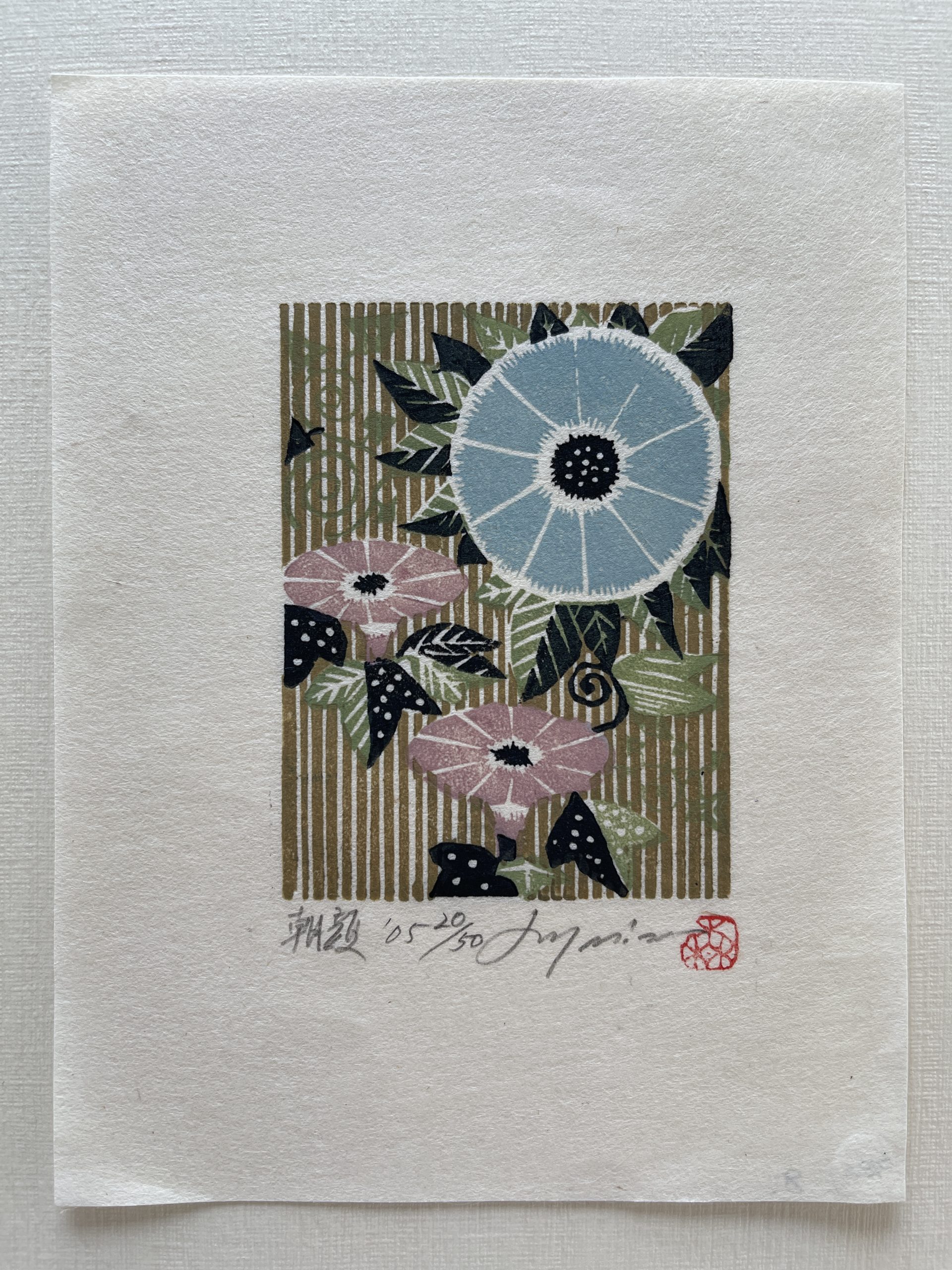
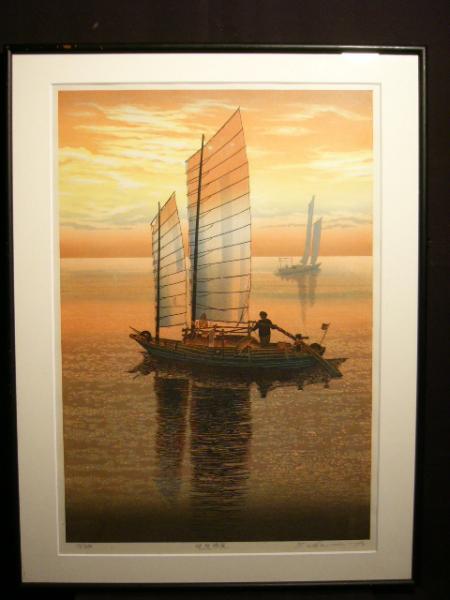
Contemporary mokuhanga (literally "wood-block print") encompasses artists working from approximately 1970 to the present who continue or reinvent traditional Japanese woodblock printing techniques. Unlike the earlier shin-hanga movement''s collaborative publisher model or sosaku-hanga''s insistence on artist-as-sole-creator, contemporary mokuhanga practitioners freely combine approaches — some carve and print their own blocks, others collaborate with master printers, and many integrate digital tools into their design process while maintaining hand-carved, hand-printed production. The movement is notable for its international character, with significant practitioners from Japan, the United States, the United Kingdom, Australia, and elsewhere, united by shared techniques and the International Mokuhanga Association founded in 2011.
Experimental Print
c. 1980–present
Experimental print is the loose movement-category used to describe the strand of postwar Japanese printmaking that broke decisively with the inherited conventions of sōsaku-hanga to pursue abstraction, mixed media, photographic and material experimentation, and conceptual approaches — a strand that took root in the late 1940s and 1950s, peaked in the 1960s and 1970s, and continues in contemporary Japanese print practice. Its prehistory lies in the late work of Onchi Kōshirō (1891-1955), the founding theorist of sōsaku-hanga, who had produced what is conventionally identified as the first abstract print in any tradition in 1915 and who, after the war, used the First Thursday Society (Ichimoku-kai) and the Modern Print Study Society to encourage artists around him to move beyond representational landscape and into self-expressive abstraction influenced by Wassily Kandinsky, Edvard Munch, and the European avant-garde (https://www.seegreatart.art/how-onchi-koshiro-popularized-abstract-art-in-japan/). The widely cited inflection point for the movement is the 1954 turn of the oil painter Hagiwara Hideo (1913-2007) toward woodblock during a long convalescence from tuberculosis; almost immediately his prints went abstract, and he proceeded over the following decades to invent techniques unique to his practice — among them ura-zuri (double-sided printing in which pigment is pushed through the paper from behind, in 1959); inked driftwood pressed into the sheet to register relief patterns; and custom-built pads that scored the paper as they pressed it onto the block (https://www.orientations.com.hk/highlights/the-abstract-prints-of-hagiwara-hideo). Rather than work from sketches, Hagiwara visualized the image whole and carved it directly into plywood, producing a more spontaneous and tactile result; he was invited to the first International Triennial of Coloured Graphic Prints at Grenchen, Switzerland, in 1958 and later served as chief director of the Nihon Hanga Kyōkai (Japan Print Association) from 1979 to 1990, in effect institutionalizing the experimental wing of the field (https://www.orientations.com.hk/highlights/the-abstract-prints-of-hagiwara-hideo). By the mid-1950s some three hundred Japanese print artists were working in abstract idioms, and the field had splintered into a series of distinct experimental practices: Haku Maki built blocks from cement and cardboard run through etching presses, treating the woodblock as a hybrid relief object; Masaji Yoshida cut jigsaw-puzzle-like blocks from single boards and printed on unsized paper for softened color edges; Reika Iwami, Chizuko Yoshida, and others used embossing (blind printing) to introduce three-dimensional incident into otherwise minimal compositions; and a number of artists incorporated the natural grain and knots of the block as expressive elements rather than concealing them (https://www.asianartscollection.com/id/Abstraction-in-Postwar-Japanese-Printmaking/39). A further turn came in the late 1960s and 1970s, when the social and political upheavals around the renewal of the U.S.-Japan Security Treaty (Anpo), rapid urbanization, and the rise of conceptual art prompted a generation of printmakers to dismantle the boundaries between print, photography, and sculpture. Artists chemically transferred printed type and photographic images onto blocks or screens and recombined them with woodgrain and ink; in 1974 the printmaker Kimura was awarded a prize at the 9th International Biennial of Prints in Tokyo for a silkscreen depicting a photographic image of a hand holding a pencil printed on graph paper, an emblematic work of the period's interest in image-as-matter (https://artsandculture.google.com/story/photographic-images-and-matter-japanese-prints-of-the-1970s-gyeonggi-museum-of-modern-art/YQXxuq9EJhRiLA). The 1970s trend toward prints "with an extremely strong materiality, in which the image was transformed into a material," significantly expanded the field and pushed it into contact with conceptual art and the broader international print biennale circuit (https://artsandculture.google.com/story/photographic-images-and-matter-japanese-prints-of-the-1970s-gyeonggi-museum-of-modern-art/YQXxuq9EJhRiLA). Contemporary practitioners — represented in institutions such as the Smithsonian's National Museum of Asian Art exhibition Cut + Paste: Experimental Japanese Prints and Photographs — continue this experimental lineage, working at the boundaries of relief, intaglio, silkscreen, photographic transfer, and digital media (https://asia.si.edu/accessibility/accessible-exhibition-text-cut-paste-experimental-japanese-prints-and-photographs/). As a movement category, experimental print is therefore best understood not as a single school but as the postwar Japanese print field's running critical edge: an inheritance from late Onchi and Hagiwara of the idea that the print is a site of personal invention, material experimentation, and conceptual risk rather than a transmissible craft.
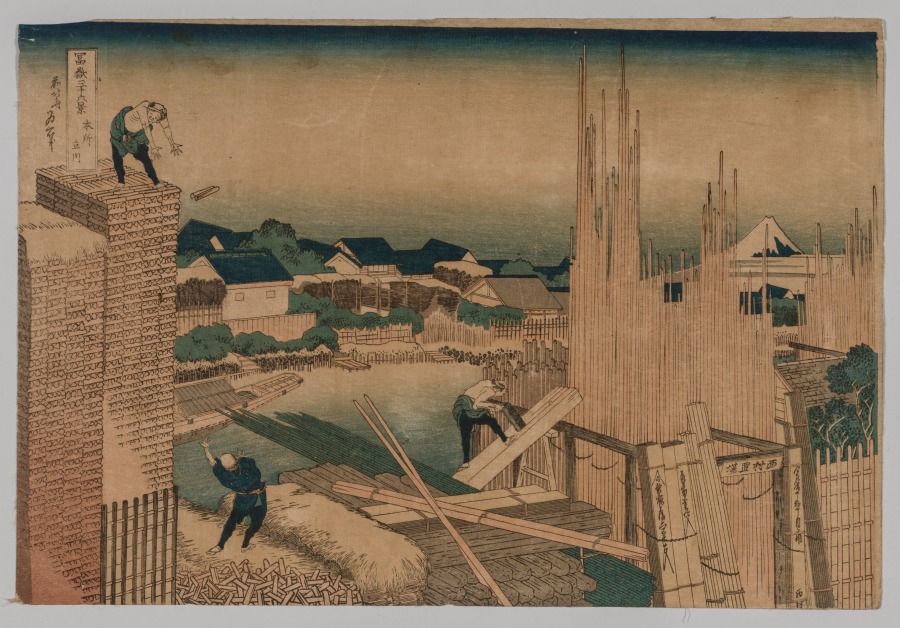
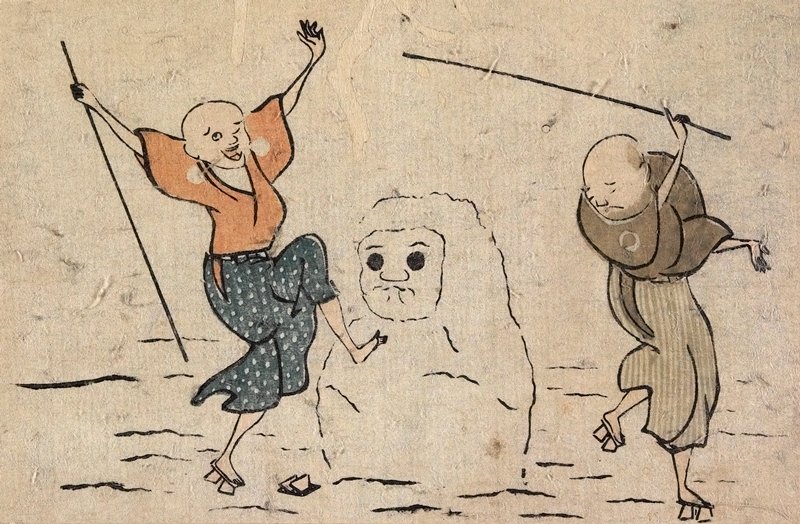
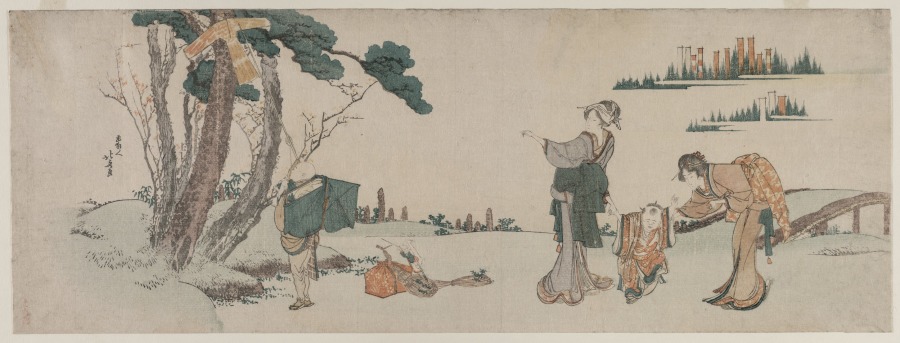
Ukiyo-e
## What is ukiyo-e? Ukiyo-e ([浮世絵](/glossary/ukiyo-e)) — literally "pictures of the floating world" — is the Edo-period Japanese print and painting tradition that flourished from roughly 1660 to 1868, depicting the pleasures of urban life in Edo (modern Tokyo): courtesans, kabuki actors, sumo wrestlers, famous landscapes, and seasonal beauties. The name itself contains a deliberate pun. The medieval Buddhist term *ukiyo* (憂き世) meant the "sorrowful world" of transient suffering; Edo writers and artists swapped a single character to produce a homophone, 浮き世, the "floating world" of fleeting pleasure. The shift in characters captured an entire worldview — embrace the moment, because nothing lasts. ## Historical context Ukiyo-e cannot be understood apart from the city that produced it. In 1603 Tokugawa Ieyasu established the shogunate at Edo, and over two centuries the village swelled into one of the largest cities on Earth — roughly a million people by 1720, more than London or Paris. The samurai nominally ruled; the merchants who supplied them grew steadily richer despite being near the bottom of the Confucian social order. Forbidden from displaying their wealth conventionally, they spent it on entertainment — kabuki theatres, the Yoshiwara pleasure quarter, sumo, and the inexpensive printed images that celebrated all of it. The Tokugawa *sankin-kōdai* policy required regional lords to alternate residence between their domains and the capital, feeding a continuous flow of travelers along the Tōkaidō linking Edo to Kyoto. By the early nineteenth century domestic tourism had become a craze, and prints of the road's fifty-three post stations sold by the hundreds of thousands. Ukiyo-e was a commercial product, consumed the way later generations would consume magazines. ## The 1765 nishiki-e revolution For the first century of its existence ukiyo-e was monochrome or hand-tinted. Early prints were [sumi](/glossary/sumi)-ink black-and-white images; by the 1740s publishers were producing *benizuri-e* with one or two color blocks added. The medium was still essentially a colored drawing. In 1765 the situation changed overnight. [Suzuki Harunobu](/artists/suzuki-harunobu) produced the first full-color prints using registration marks — the [kentō](/glossary/kento) — carved into each block so that successive impressions of five, ten, or twenty colors could be aligned with near-perfect precision. The new prints were called [nishiki-e](/glossary/nishiki-e), "brocade pictures," because their dense coloration recalled woven silk. Harunobu's innovation depended on skilled [horishi](/glossary/horishi) and [surishi](/glossary/surishi) already in Edo, willing publishers ([hanmoto](/glossary/hanmoto)), and wealthy [surimono](/glossary/surimono) and [egoyomi](/glossary/egoyomi) commissions that funded experimentation. Within a year or two the entire industry had converted. Every ukiyo-e print most readers will ever see — every Hokusai, Hiroshige, Utamaro — is a [nishiki-e](/glossary/nishiki-e). ## The three pillars Ukiyo-e organized around three subjects: beautiful women ([bijin-ga](/glossary/bijin-ga)), kabuki actors ([yakusha-e](/glossary/yakusha-e)), and landscapes ([fukei-ga](/glossary/fukeiga)). All three appear from the beginning, but each had its great period and defining masters. [Bijin-ga](/glossary/bijin-ga) — courtesans, geisha, idealized beauties — launched the medium. [Suzuki Harunobu](/artists/suzuki-harunobu)'s willowy figures defined its 1760s style; [Torii Kiyonaga](/artists/torii-kiyonaga) brought stately monumentality to his 1780s beauties; [Kitagawa Utamaro](/artists/kitagawa-utamaro) achieved in the 1790s a psychological intimacy unmatched in the tradition, particularly in his close-cropped *ōkubi-e* (large-head) portraits. [](/artworks/kitagawa-utamaro-three-beauties-of-the-present-day) [Yakusha-e](/glossary/yakusha-e) emerged from kabuki; prints served as souvenirs, advertisements, and fan portraiture. The genre's most famous practitioner — [Tōshūsai Sharaku](/artists/toshusai-sharaku) — was active for only ten months between 1794 and 1795, produced about 140 designs published by Tsutaya Jūzaburō, and vanished. Later, [Utagawa Kunisada](/artists/utagawa-kunisada) became the most commercially successful actor-print designer of all time, with output above twenty thousand designs. [](/artworks/toshusai-sharaku-otani-oniji-in-the-role-of-the-servant-edohei) [Fukei-ga](/glossary/fukeiga), the landscape print, was the last pillar to mature. Landscape had appeared in earlier prints chiefly as a setting for figures; the idea of a series devoted to scenery emerged only around 1830, when [Katsushika Hokusai](/artists/katsushika-hokusai) published *[Thirty-Six Views of Mount Fuji](/series/hokusai-thirty-six-views-of-mount-fuji)*. [Utagawa Hiroshige](/artists/utagawa-hiroshige) answered within a year. [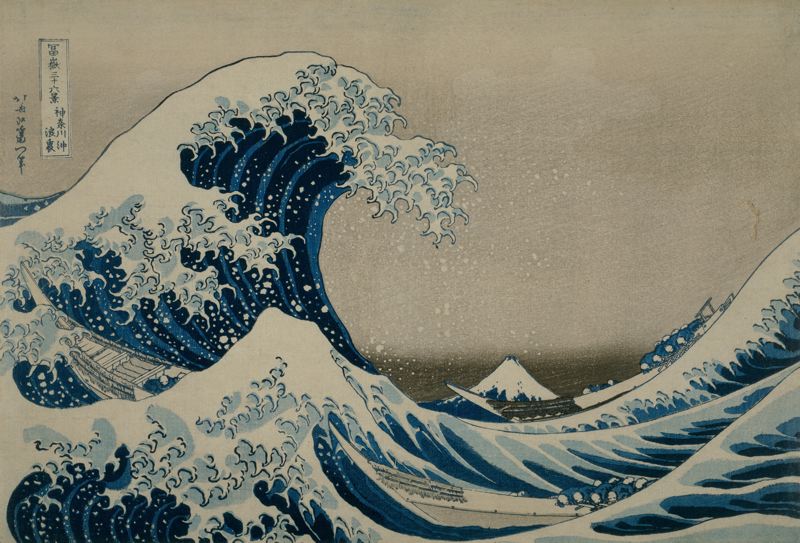](/artworks/katsushika-hokusai-the-great-wave-off-kanagawa) [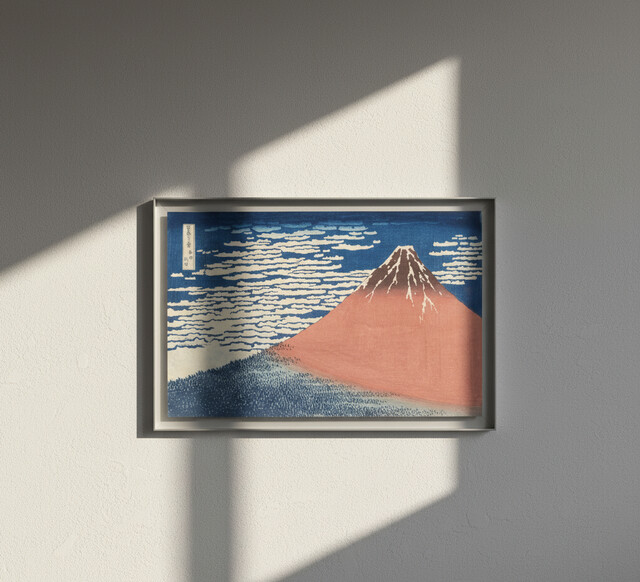](/artworks/katsushika-hokusai-fine-wind-clear-morning-red-fuji) ## Other genres Beyond the three pillars, ukiyo-e supported subordinate genres. [Musha-e](/glossary/musha-e), the warrior print, depicted samurai heroes from history and legend; [Utagawa Kuniyoshi](/artists/utagawa-kuniyoshi) raised it to a peak in his 1827–30 series *[One Hundred and Eight Heroes of the Popular Suikoden](/series/kuniyoshi-suikoden)*, which sparked a fashion for tattoo-covered protagonists. [Kacho-e](/glossary/kacho-e), bird-and-flower prints, drew on Chinese painting tradition. [Shunga](/glossary/shunga), explicit erotic prints, were technically forbidden but circulated openly and were produced by virtually every major designer, often as their finest work. [Surimono](/glossary/surimono) — privately commissioned prints with luxurious techniques for poetry societies and New Year gifts — supported some of the most refined craftsmanship in the tradition. ## Key artists The canonical lineage runs through designers who each defined a phase. [Suzuki Harunobu](/artists/suzuki-harunobu) (1725–1770) inaugurated the polychrome era and created the willow-figured beauties that dominated for a generation. [Torii Kiyonaga](/artists/torii-kiyonaga) (1752–1815) succeeded him with tall idealized women in spacious compositions. [Kitagawa Utamaro](/artists/kitagawa-utamaro) (1753–1806) refined [bijin-ga](/glossary/bijin-ga) into psychologically charged half-length portraits and dominated the 1790s before being briefly imprisoned in 1804 for a print of Hideyoshi judged offensive to the shogunate. [](/artworks/suzuki-harunobu-lovers-dressing-beside-a-window) [](/artworks/torii-kiyonaga-two-women-viewing-cherry-blossoms) [Tōshūsai Sharaku](/artists/toshusai-sharaku) appeared in May 1794, produced his stark actor portraits, and disappeared in early 1795 — his identity still debated. [Katsushika Hokusai](/artists/katsushika-hokusai) (1760–1849) had the longest career in the medium, producing roughly thirty thousand designs over seventy years and publishing *[Thirty-Six Views of Mount Fuji](/series/hokusai-thirty-six-views-of-mount-fuji)* around 1830–32 when he was past seventy. [Utagawa Hiroshige](/artists/utagawa-hiroshige) (1797–1858) responded with *[The Fifty-Three Stations of the Tōkaidō](/series/hiroshige-fifty-three-stations-of-the-tokaido)* in 1833–34 and closed his career with *[One Hundred Famous Views of Edo](/series/hiroshige-one-hundred-famous-views-of-edo)* (1856–58), completed after his death. [Utagawa Kuniyoshi](/artists/utagawa-kuniyoshi) (1798–1861) made the warrior print into a vehicle for political satire under Tenpō censorship. [Tsukioka Yoshitoshi](/artists/tsukioka-yoshitoshi) (1839–1892), Kuniyoshi's pupil, is the last great ukiyo-e master; his *[One Hundred Aspects of the Moon](/series/yoshitoshi-one-hundred-aspects-of-the-moon)* (1885–92) closed the tradition. [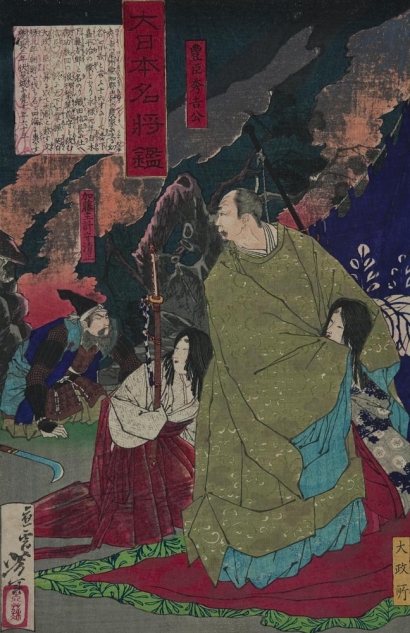](/artworks/tsukioka-yoshitoshi-toyotomi-hideyoshi) ## Techniques and materials A ukiyo-e print is a collaboration. The designer ([eshi](/glossary/eshi)) produced a finished drawing — the [hanshita-e](/glossary/hanshita-e) — which the block-cutter ([horishi](/glossary/horishi)) glued face-down onto a plank of mountain cherry ([sakura](/glossary/sakura)) wood and carved away to leave the key lines in relief. The printer ([surishi](/glossary/surishi)) printed the key block in [sumi](/glossary/sumi) ink; the carver cut a separate block for each color. Impressions were pulled by hand with a [baren](/glossary/baren) — a circular pad of twisted bamboo fiber — registered against the [kentōbori](/glossary/kentobori) cuts. A full polychrome print might require ten to fifteen impressions on one sheet of [washi](/glossary/washi). The printer's repertoire included a remarkable range of effects. [Bokashi](/glossary/bokashi), the graded color wash, was achieved by brushing pigment unevenly onto the block; the trademark twilight skies of late Hiroshige are pure [bokashi](/glossary/bokashi). [Karazuri](/glossary/karazuri) — blind printing — produced embossed patterns by pressing the [baren](/glossary/baren) onto an uninked block, used for white kimono patterns, snow, and feathers. [Kirazuri](/glossary/kirazuri) added mica dust for metallic shimmer; [gomazuri](/glossary/gomazuri) created mottled effects; [nunomezuri](/glossary/nunomezuri) impressed textile texture. The paper — [hōsho](/glossary/hosho), thick handmade [washi](/glossary/washi) of [kōzo](/glossary/kozo) mulberry fiber sized with the [dōsabiki](/glossary/dosabiki) gelatin-and-alum solution — was integral to the medium. ## Print sizes and formats Ukiyo-e prints were sold in standardized formats determined by the *minogami* paper sheet. The common adult-figure format was [ōban](/glossary/oban), roughly 25 × 38 cm — the format of nearly all major Hokusai and Hiroshige landscapes. The smaller [chūban](/glossary/chuban) (roughly 19 × 26 cm) was Harunobu's preferred size; the still-smaller [koban](/glossary/koban) was used for poetry-album illustrations and small calendars. Vertical pillar prints — [hashira-e](/glossary/hashira-e), roughly 13 × 73 cm — were designed to hang on the wooden pillars of merchant-house interiors. Some of Kiyonaga's and Kunisada's most ambitious pieces are full [triptych](/glossary/triptych)s. [Surimono](/glossary/surimono) used the small square [shikishiban](/glossary/shikishiban) format on heavyweight paper for private circulation. ## Iconic series Five multi-print series stand at the canonical core. Hokusai's *[Thirty-Six Views of Mount Fuji](/series/hokusai-thirty-six-views-of-mount-fuji)* (c.1830–32) was so popular the publisher added ten more designs before closing the run; *The Great Wave* and *Fine Wind, Clear Morning* (Red Fuji) belong to it. Hiroshige's *[Fifty-Three Stations of the Tōkaidō](/series/hiroshige-fifty-three-stations-of-the-tokaido)* (1833–34, the Hōeidō edition) followed the road from Edo to Kyoto, one image per station plus terminals. [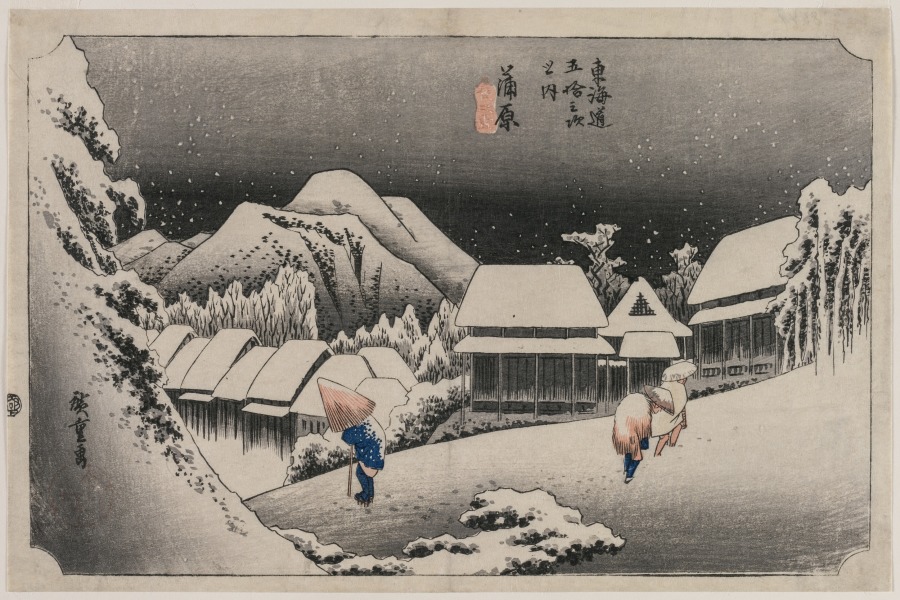](/artworks/utagawa-hiroshige-evening-snow-at-kambara-number-sixteen-of-the-series-fifty-three-stations-of-the-tokaido) Kuniyoshi's *[One Hundred and Eight Heroes of the Popular Suikoden](/series/kuniyoshi-suikoden)* (1827–30) adapted a Chinese novel into operatic warrior portraits and triggered Japan's nineteenth-century tattoo revival. Hiroshige's *[One Hundred Famous Views of Edo](/series/hiroshige-one-hundred-famous-views-of-edo)* (1856–58) closed his career with 119 prints across the seasons, several copied directly by Van Gogh. Yoshitoshi's *[One Hundred Aspects of the Moon](/series/yoshitoshi-one-hundred-aspects-of-the-moon)* (1885–92) frames one hundred Chinese and Japanese stories around the moon and is widely considered the last masterpiece of the tradition. [](/artworks/utagawa-hiroshige-plum-garden-at-kameido-kameido-umeyashiki-from-the-series-one-hundred-famous-views-of-edo-meisho-edo-hyakkei) ## How to identify a genuine ukiyo-e print "Genuine" does several jobs in the ukiyo-e market. A *genuine Edo-period impression* — pulled from the original blocks during the artist's lifetime or shortly after — is the most desirable and rarest category. Edo impressions show reliable indicators: a censor seal (the round *kiwame* from c.1790–1842, later *aratame* and date cartouches) carved into the key block; a publisher's mark also part of the block; rich, slightly mottled coloration from natural pigments; paper aged to a warm cream tone with visible mulberry fibers. *Meiji-era reprints* ([atozuri](/glossary/atozuri)) were pulled from the same blocks decades later, often after wear or recutting. They show coarser linework, brighter aniline-dye color (entered Japan after 1864), and flatter paper — genuine woodblock prints at much lower prices. *Twentieth-century reprints* (particularly Watanabe and Adachi editions) were re-carved from scratch using traditional methods — recognized restrikes, not forgeries. *Modern offset and digital reproductions* are photomechanical and identifiable under magnification. The [beginner's guide](/blog/beginners-guide-to-ukiyo-e) and [identification guide](/blog/how-to-identify-genuine-japanese-woodblock-print) cover these distinctions in detail. ## Buying and collecting The ukiyo-e market has a wider price band than almost any other area of Japanese art. A first-strike Edo *Great Wave* sells at auction in the high six figures; a fine Meiji [atozuri](/glossary/atozuri) is available in the low thousands; a 1950s Adachi restrike sits in the high hundreds. For collectors entering the market, Meiji reprints of major Hiroshige and Hokusai landscapes — produced in the 1880s and 1890s while the original blocks remained serviceable — are the most accessible authentic option, typically $300–$1,500. Mid-century Watanabe and Adachi restrikes are recognized fine objects from $400 upward. Whole-sheet examples from Kuniyoshi and Kunisada circles can be found under $500. The [process explainer](/blog/how-japanese-woodblock-prints-are-made) covers what is happening under the [baren](/glossary/baren) at each price tier. ## Ukiyo-e vs. shin-hanga and sōsaku-hanga Ukiyo-e ended in fact rather than in declaration. The Meiji Restoration of 1868 swept away the Edo social order; lithography and photomechanical reproduction undercut the commercial niche; and by the 1890s the publisher-designer-carver-printer system had largely collapsed. Two twentieth-century movements revived woodblock printmaking on different premises. [Shin-hanga](/movements/shin-hanga) — "new prints," organized from 1915 by Watanabe Shōzaburō — preserved the four-handed collaborative system but updated subjects for early-twentieth-century taste and Western collectors. [Sōsaku-hanga](/movements/sosaku-hanga) — "creative prints" — rejected the division of labor entirely and insisted the artist design, carve, and print the work themselves. The broader transition is treated in [Meiji and Taishō prints](/movements/meiji-taisho-prints). ## Japonisme and Western influence The export trade accelerated after Japan's opening in 1854, and Edo prints began appearing in Paris, London, and Boston by the 1860s. Their effect on European art was immediate and structural. Manet borrowed flattened picture planes and asymmetrical compositions; Whistler painted nocturnes in response to Hiroshige; Degas studied ukiyo-e cropping; Cassatt printed color etchings in the manner of Utamaro. Vincent van Gogh copied several Hiroshige prints in oil — including *Plum Garden at Kameido* and *Sudden Shower over Shin-Ōhashi Bridge* — and wrote that he wanted to live as a Japanese print designer. Claude Monet hung roughly two hundred prints at Giverny and built the famous Japanese bridge across the water-lily pond in deliberate quotation. The European enthusiasm for Japanese visual culture in the 1870s and 1880s was named *japonisme*, and ukiyo-e was its most consequential ingredient; the trajectory from impressionism through Art Nouveau to early modernism would not have taken the form it did without it. ## Where to see ukiyo-e today Major public collections are distributed across Japan, the United States, and Europe. In Tokyo, the Sumida Hokusai Museum is dedicated to Hokusai; the Tokyo National Museum holds the largest comprehensive Japanese collection. The Museum of Fine Arts, Boston houses roughly fifty thousand prints assembled chiefly by Ernest Fenollosa and William Sturgis Bigelow. The Art Institute of Chicago holds the Clarence Buckingham collection; the British Museum's holdings include the Arthur Morrison material; the Honolulu Museum of Art houses the James Michener collection. Boston, Chicago, and London digitize extensively; Honolulu and Sumida mount frequent rotating exhibitions. The [history of the *Great Wave*](/blog/hokusais-great-wave-history-and-meaning) is a useful primer on how a single image moves through these collections. ## Frequently asked questions ### What does ukiyo-e mean in English? Ukiyo-e translates literally as "pictures of the floating world." The phrase is a deliberate pun: the medieval Buddhist term *ukiyo* (憂き世) described the sorrowful, transient world of human suffering, while Edo writers swapped a character to produce a homophone, *ukiyo* (浮き世), the "floating world" of fleeting pleasure. The new phrase captured the Edo merchant class's embrace of urban entertainment — kabuki, Yoshiwara, fashionable teahouses. Asai Ryōi's 1665 *Tales of the Floating World* fixed the meaning. ### When did ukiyo-e begin and end? The medium emerged in the late seventeenth century, with Hishikawa Moronobu as its first major figure in the 1670s–80s, and is conventionally treated as ending with the Meiji Restoration of 1868. The picture is messier in practice: painted *ukiyo* scenes existed earlier, and print production continued into the late Meiji period; [Tsukioka Yoshitoshi](/artists/tsukioka-yoshitoshi) is the tradition's last great master and worked until his death in 1892. After 1900 the surviving woodblock market was absorbed by [shin-hanga](/movements/shin-hanga) and [sōsaku-hanga](/movements/sosaku-hanga). ### Who actually made an ukiyo-e print? Four people. The designer ([eshi](/glossary/eshi)) — the named artist — produced a finished drawing, the [hanshita-e](/glossary/hanshita-e). The block-cutter ([horishi](/glossary/horishi)) carved it into mountain cherry ([sakura](/glossary/sakura)) wood and cut a separate block for each color. The printer ([surishi](/glossary/surishi)) pulled each impression by hand using a [baren](/glossary/baren), aligned against the [kentō](/glossary/kento) registration marks. The publisher ([hanmoto](/glossary/hanmoto)) financed the project and distributed the result. The designer received credit; the others almost never did. ### Is *The Great Wave* the most famous ukiyo-e print? Yes, by a significant margin. *The Great Wave off Kanagawa* — the opening print of Hokusai's *[Thirty-Six Views of Mount Fuji](/series/hokusai-thirty-six-views-of-mount-fuji)*, published around 1830–32 — is reproduced more widely than any other Japanese image and arguably more widely than any other single artwork. Hokusai designed it when he was about seventy; the publisher Nishimuraya printed several thousand impressions from the original blocks, of which perhaps a few hundred survive in collectible condition. The print's [history and meaning](/blog/hokusais-great-wave-history-and-meaning) is treated separately. ### What's the difference between ukiyo-e and shin-hanga? The medium is the same; the period and framing differ. Both are color woodblock prints made through the four-handed collaborative system using [washi](/glossary/washi), mountain cherry blocks, water pigments, and the [baren](/glossary/baren). Ukiyo-e is a commercial Edo-period medium for urban Japanese consumers; [shin-hanga](/movements/shin-hanga) is an early-twentieth-century revival organized from 1915 by Watanabe Shōzaburō and aimed substantially at Western collectors. Shin-hanga subjects continue ukiyo-e categories but treat them with the conventions of early-twentieth-century atmospheric painting, integrating Western perspective and chiaroscuro. [Sōsaku-hanga](/movements/sosaku-hanga) broke from the collaborative system entirely. ### Are old ukiyo-e prints expensive? The market has an unusually wide price band. A genuine Edo first-strike of *The Great Wave* sold at Christie's in 2023 for $2.78 million; a fine Meiji [atozuri](/glossary/atozuri) of the same composition trades $2,000–$8,000; a 1950s Adachi workshop restrike — hand-pulled from new blocks — sells $400–$1,200. Fine Meiji reprints of major Hiroshige and Hokusai landscapes are typically available $300–$1,500; minor designers from Kunisada's and Kuniyoshi's circles can be found under $500. The [collector's guide](/blog/beginners-guide-to-ukiyo-e) discusses where to buy and what most affects price.