Locations in Japanese Prints
Japanese woodblock prints often depict iconic locations across Japan and beyond. Browse the places that inspired generations of printmakers, from sacred mountains and ancient temples to bustling urban scenes.

Arashiyama
嵐山
15 prints
Arashiyama is a district on the western edge of Kyoto, in the foothills of the mountains that close off the Kyoto basin on the west, where the Hozu River emerges from its gorge and is renamed the Katsura River as it flows toward the city center, in present-day Ukyo Ward. The area takes its name, which means storm mountain, from the wooded slopes that rise above the river, and it has been a celebrated retreat and pleasure ground of the Kyoto aristocracy since at least the Heian period, when the area was the location of imperial detached palaces and the villas of the Fujiwara and Saionji families. The Togetsukyo bridge that spans the river, whose name means moon-crossing bridge and is attributed to a remark by the retired emperor Kameyama in the late thirteenth century, was first constructed in the ninth century during the early Heian period and has been rebuilt many times, with the present wooden-railed concrete-and-steel span dating to the twentieth century. The slopes above the bridge are renowned for cherry blossom in spring, when more than a thousand trees of various varieties bloom across the mountainside, and for vivid red maple in autumn, when the area becomes one of the most heavily visited destinations in the Kyoto basin. The surrounding district contains major Zen monasteries including Tenryu-ji, founded in 1339 by the shogun Ashikaga Takauji on the site of the Heian-period Kameyama detached palace as one of the great Rinzai institutions of Kyoto and now a UNESCO World Heritage Site, and Hogon-in, Daikaku-ji, and the smaller temples that extend north into the Sagano district. The Hozu-gawa boat ride from Kameoka to Arashiyama, descending the river through the gorge above the bridge, has been a popular excursion since at least the Edo period. For Japanese printmaking, Arashiyama belongs to the canonical roster of Kyoto meisho, and it appears in Utagawa Hiroshige's Famous Views of Kyoto issued around 1834, which depicts the river, the bridge, and the blossoming cherries on the slopes above. Hokusai treated Arashiyama in his depictions of the Kyoto approach to the Tokaido and in passages of his printed books, and Hasegawa Sadanobu and other Kansai-region late ukiyo-e artists produced individual sheets of the bridge and the surrounding river. With the shin-hanga revival, the district became a major subject for Kawase Hasui, Yoshida Hiroshi, Tsuchiya Koitsu, and Asano Takeji, each of whom produced one or more compositions of the bridge, the river, and the seasonal foliage, with Hasui's evening and snow Arashiyama prints among the most reproduced of his Kyoto subjects. Tokuriki Tomikichiro, a Kyoto-based sosaku-hanga artist, included Arashiyama prominently in his Eight Views of Kyoto and other Kyoto-centered series, and the postwar Kyoto sosaku-hanga circle treated the district in various seasonal compositions. The visual character of Arashiyama in prints is built on the curve of the river beneath the bridge, the foreground reeds and reflective water, the steep wooded slope behind, the seasonal blossoms or maple foliage, the boats of fishermen or pleasure parties on the river, and frequently the diffused atmospheric conditions of the western Kyoto setting. The adjacent Sagano district, treated under its own entry, continues this western Kyoto landscape into the bamboo groves and rural temples north and west of the bridge. Modern Arashiyama remains one of the most heavily visited districts of Kyoto, with the Togetsukyo bridge, the Tenryu-ji garden, the bamboo grove path, and the Kameyama Park overlook preserving the broad outlines of the meisho geography that the printmakers recorded, reached via the JR Sagano Line to Saga-Arashiyama Station, the Hankyu Arashiyama Line, or the Keifuku Randen tram.

Asakusa
浅草
35 prints
Asakusa is a district in northeastern Tokyo, on the western bank of the Sumida River within present-day Taito Ward, organized around the great Buddhist temple of Senso-ji and its principal deity Kannon. The temple, whose foundation legend dating to 628 tells of two fishermen brothers, the Hinokuma brothers, finding a small golden image of Kannon in their nets in the Sumida River, was the most popular pilgrimage destination in Edo throughout the Tokugawa period, drawing constant traffic of worshippers, vendors, and entertainers, and it served as the cultic anchor of an extensive entertainment quarter that developed around its precincts. By the late Edo period Asakusa contained the largest concentration of theaters, teahouses, archery galleries, storytellers, peep-show booths, kabuki performance halls, and street performers in the city, with the Yoshiwara licensed pleasure quarter situated approximately two kilometers to the north along the Nihon-zutsumi embankment and reached by the riverboat services from Asakusa quay. The district was destroyed in the 1923 Great Kanto Earthquake and again in the firebombing of 1945, and its present form is largely a postwar reconstruction, though the temple compound preserves the historical plan with the great Kaminarimon thunder gate hung with its giant red paper lantern, the Nakamise vendor street running 250 meters north from the gate, the inner Hozomon gate, the five-story pagoda on the west side, and the main hall facing south, all rebuilt in the late 1950s and 1960s in faithful reproduction of the destroyed Edo-period predecessors. For Japanese printmaking, Asakusa figures throughout the meisho-e tradition. Utagawa Hiroshige treated Asakusa repeatedly in his Famous Places in the Eastern Capital and again in One Hundred Famous Views of Edo (Meisho Edo hyakkei, 1856-1858), including the celebrated winter sheet Kinryuzan Temple at Asakusa, in which the great paper lantern of the Kaminarimon is seen from inside the gate against a snow-blanketed approach to the inner temple, and other Asakusa sheets treating the festival of Sanja Matsuri, the Sumida-side dock, the Yoshiwara approach, and the surrounding entertainment quarter. Hokusai included Asakusa in his Thirty-Six Views of Mount Fuji in compositions in which the distant peak is glimpsed across the temple precinct, and Utagawa Kunisada and Kuniyoshi produced theatrical and bijin sheets set in the surrounding entertainment district. The Meiji-period kaika-e of Kobayashi Kiyochika and Inoue Yasuji recorded the district's transformation under gas lamps and modernized architecture, with Kiyochika's celebrated Asakusa night views figuring as some of the finest examples of his kosenga (light-ray pictures) atmospheric practice. The shin-hanga revival returned to Asakusa repeatedly in the work of Kawase Hasui, Tsuchiya Koitsu, Ito Shinsui, and Yoshida Hiroshi, with snow, rain, and night views of the Kaminarimon and the inner precincts forming a recurrent motif, including Hasui's celebrated Snow at Kinryuzan, Asakusa and Koitsu's evening views of the same gate. Yokoyama Taikan and other Nihonga painters of the early twentieth century treated Asakusa in painting traditions that fed back into print idioms. The visual character of Asakusa in prints centers on the great red gate with its massive paper lantern, the crowded Nakamise approach, the five-story pagoda, the temple roofs against the sky, the figures of pilgrims and entertainers, and seasonal phenomena ranging from cherry blossoms and the Sanja festival to fireworks over the nearby Sumida and snowfall on the gate and pagoda. Contemporary visitors find Senso-ji and its approach among the most heavily visited temple complexes in Japan, reached most directly via the Asakusa Line to Asakusa Station, the Tokyo Metro Ginza Line, or the Tobu Skytree Line, and the surrounding district preserves traces of the older entertainment quarter in its remaining theaters, restaurants, and shotengai, with the new Tokyo Skytree visible across the Sumida providing the principal contemporary skyline counterpoint to the temple silhouette.
Benares
ベナレス
1 print
Benares, the present-day Varanasi, is the historic Sanskrit-named city on the western bank of the Ganges River in Uttar Pradesh in north-central India, traditionally considered one of the holiest cities in Hinduism and the principal pilgrimage destination for ritual cremation along the river. The city is organized along a long curving stretch of approximately eighty ghats, the broad stone-stepped landings that descend to the river and serve as the sites of daily bathing, ritual ablution, and cremation, and along the temple-dense alleys behind, with the silhouette of palaces, towers, and temple shikharas rising directly above the water. The city is sacred in the Hindu tradition as the dwelling place of Shiva, with the Vishwanath temple at its center, and is also a major site of Buddhist heritage as the location of nearby Sarnath, where the historical Buddha is traditionally said to have delivered his first sermon after attaining enlightenment. The ghats include Dashashwamedh, the principal ghat for the daily evening aarti ceremony, Manikarnika and Harishchandra, the principal cremation ghats, and Assi Ghat at the southern end of the stretch. For Japanese printmaking the city is the central subject of the India sheets produced by Yoshida Hiroshi during and after his 1930-1931 travel to South Asia. Yoshida Hiroshi (1876-1950) had trained originally as a Western-style oil painter at the Fudosha private studio of Koyama Shotaro in Tokyo and at the Asai Chu studio, before turning to woodblock as his principal medium in the mid-1920s in collaboration with the publisher Watanabe Shozaburo and then independently from his own studio at his home in Sugamo. His shin-hanga landscape practice was distinguished from that of his contemporaries by the inclusion of foreign subjects observed during extensive travel through the United States, Western Europe, North Africa, and South and Southeast Asia. The 1930-1931 South and Southwest Asian trip, which included Singapore, India, Pakistan, Egypt, and the Middle East, produced a coordinated set of designs including Ghat in Benares, Evening in Benares (Yoru no Benaresu), Morning Mist in Benares, and Bishenu Temple at Benares, in which the artist treats the ghats at different hours, the temple buildings on the bluff above, and the boats and bathers on the river. These prints, issued through Yoshida's own studio over the following years from 1931 onward, are among the canonical examples of Japanese shin-hanga engagement with non-Japanese subjects, alongside his Egypt, Switzerland, Grand Canyon, Niagara Falls, and Mexico designs. They function in the print history as an unusual late-shin-hanga incorporation of non-Japanese landscape into a Japanese woodblock idiom, executed by a Japanese carver and printer at the artist's studio in Tokyo from Yoshida's own observation drawings made on location. The visual character of Benares in Yoshida's prints is built on the receding line of stone ghats along the curving riverbank, the towers and roof lines of the temple and palace district behind, the boats and bathers in the foreground, and frequently the diffused light of dawn or evening that the artist exploited for atmospheric effect, often producing variant impressions of the same design under different color and light conditions to capture morning fog, midday sun, evening pink, and moonlight. The city remains today, under its present official name Varanasi, the most heavily visited Hindu pilgrimage city in India, and the ghats Yoshida depicted are still in active religious and daily use along the river, with the early morning boat tours from Dashashwamedh providing the principal contemporary access to the viewpoints from which his prints were composed.

Chion-in
知恩院
4 prints
Chion-in is a major Buddhist temple complex situated on the foothills of the eastern range of Kyoto in the Higashiyama district, just east of the Yasaka shrine and Maruyama Park, in present-day Higashiyama Ward. The temple was founded in 1234 on the site where the priest Honen (1133-1212) had lived and taught in the late twelfth century, and it serves as the head temple of the Jodo (Pure Land) sect of Japanese Buddhism, one of the largest Buddhist denominations in Japan with millions of adherents across the country. The principal buildings include the enormous Sanmon main gate constructed in 1621 by the second Tokugawa shogun Hidetada in commemoration of the temple's role in his family's religious devotion, standing approximately 24 meters tall and 50 meters wide and one of the largest wooden gates in Japan, the Mieido (Founder's Hall) housing an image of Honen and rebuilt in 1639, the great bell of 1633 weighing approximately seventy tons and one of the largest temple bells in Japan, the Hojo abbot's quarters, the Amida-do, and the smaller Yuzen-en and Hojo gardens. The complex was patronized intensively by the Tokugawa shogunate from the early seventeenth century, when the third shogun Iemitsu provided the resources for the great Sanmon and the renewed main hall, and the temple accumulated significant landholdings and architectural projects across the Edo period. The Mieido was undergoing major reconstruction from 2012 to 2020 and reopened to visitors in stages thereafter. For Japanese printmaking Chion-in appears as one of the canonical Kyoto meisho. Utagawa Hiroshige treated the Sanmon gate and the temple precincts within his Famous Views of Kyoto issued around 1834, including a composition of the gate viewed from the western avenue with figures of pilgrims at its base, and the temple figures in Edo-period guidebook illustrations and printed travel literature on the city. The shin-hanga revival brought renewed treatment, with Kawase Hasui, Tsuchiya Koitsu, and Asano Takeji producing snow, rain, and twilight views of the Sanmon and the approach to the main hall, including memorable Hasui evening compositions in which the great proportions of the gate dominate against a softly modulated sky. Tokuriki Tomikichiro included the temple in his Kyoto-centered creative-print series across several decades, and the postwar Kyoto sosaku-hanga circle treated the temple precincts in various seasonal compositions. The visual character of Chion-in in prints is anchored by the massive proportion of the Sanmon, the steep approach from the western avenue, the temple roofs rising into the wooded slope behind, the bell tower with its great bronze bell, the foreground figures of pilgrims, and the seasonal phenomena of cherry blossom, autumn maple, and snow that frame the structures. The temple is closely associated visually and processionally with the adjacent Maruyama Park and Yasaka Shrine, which form a continuous walking circuit along the Higashiyama base. Contemporary visitors find Chion-in along the standard Higashiyama walking circuit between Maruyama Park and the Heian Shrine, with the great bell still rung in the famous New Year's Eve ceremony of joya no kane in which seventeen monks pull the rope in sequence to strike the bell 108 times to remove worldly desires, an annual broadcast event in Japan that connects the contemporary observance to the long temple tradition.

Daimonji
大文字
1 print
Daimonji refers to the practice of writing the character dai (大), meaning great, in enormous form on the slope of Mount Nyoigatake (also called Mount Daimonji) on the eastern edge of Kyoto and igniting the laid-out beds of brush at nightfall on the sixteenth day of August. The character is the largest and most famous of the five mountainside characters that together form the Gozan no Okuribi, the lighting of fires on five mountains, a Bon Festival observance dating in its present form to at least the late Muromachi or Edo period and possibly older. The other four characters and shapes, lit in sequence after the great dai on Nyoigatake, include a second dai on Mount Hidaridaimonji (Left Daimonji) to the northwest above the Kamigamo district, the characters myo (妙) and ho (法), meaning the law of the Buddha, on adjacent slopes north of the city above the Matsugasaki district, the form of a boat (船) on Mount Funayama north of Kinkakuji, and the form of a torii gate (鳥居) on Mount Mandara above the western suburbs near Saga. The ceremony marks the close of the Obon period in mid-August in which the spirits of ancestors are believed to return to their families, with the fires understood as okuribi, or send-off fires, that guide the souls of the dead back to the other world after their brief annual visit. The historical origin of the practice is uncertain, with traditional attributions variously to Kobo Daishi Kukai in the early Heian period, to the Heian poet Onono Takamura, or to the Muromachi shogun Ashikaga Yoshimasa in connection with the Obon observances of the late fifteenth century; modern scholarly consensus is that the present form likely consolidated in the Edo period. For Japanese printmaking the Daimonji functions both as a specific calendrical motif and as a recognizable feature of the Kyoto skyline. The form of the great character appears in late Edo and Meiji prints of Kyoto and recurs in twentieth-century shin-hanga and sosaku-hanga sheets. Kawase Hasui treated the Daimonji slope in views of the Kamogawa River with the burning character visible on the mountain above, and Tokuriki Tomikichiro and other Kyoto-based artists incorporated the motif into their Kyoto-centered creative-print series, including treatments of the night sky with the burning character against the dark cone of the mountain. Asano Takeji and Tsuchiya Koitsu also produced compositions in which Mount Daimonji figures as part of the eastern Kyoto skyline. The visual character of Daimonji in prints is built on the dark cone of Nyoigatake against the night sky, the lines of fire arranged in the form of the great character with its three principal strokes laid out as broad beds of pine brush and pine logs ignited by the local hozenkai association, and frequently the foreground river, bridge, and rooftops of the city below, often with figures of viewers gathered to watch. Contemporary observers gather along the Kamogawa River, on rooftops in the Higashiyama district, on the platforms of major buildings in central Kyoto, and at hilltop sites west of the city to view the lighting on August 16, with the ceremony remaining one of the most heavily attended seasonal observances in Kyoto and one of the principal events of the Kyoto summer calendar alongside the Gion Matsuri.
Fushimi Inari
伏見稲荷大社
3 prints
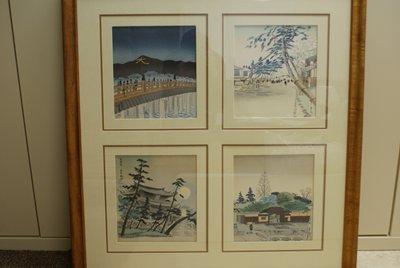
Fushimi Inari, formally Fushimi Inari Taisha, is the head shrine of the Inari cult, one of the most widespread Shinto traditions in Japan with more than thirty thousand affiliated subsidiary shrines across the country, located on the lower slopes of Mount Inari in Fushimi Ward in southern Kyoto. The shrine was founded according to tradition in 711 during the early Nara period, and the deity Inari is associated with rice, agriculture, prosperity, commerce, sake brewing, and success in worldly endeavors, with the fox (kitsune) figured as the messenger of the kami rather than the deity itself. The complex is celebrated for the dense rows of vermilion-painted torii gates (senbon torii, literally a thousand torii) that ascend the mountain in tunnel-like passages, donated by individuals, families, and businesses across centuries beginning seriously in the Edo period and continuing to the present day, with several thousand gates lining the principal pilgrimage route to the summit and tens of thousands of smaller gates along the secondary paths. Each torii bears the name of the donor and the date of donation on its rear face, and the gates are continually replaced as the older painted wood deteriorates. The lower precinct includes the romon front gate of 1589 reconstructed during the Momoyama period at the order of Toyotomi Hideyoshi after the recovery of his mother from illness, the haiden worship hall, the honden main hall in Inari-zukuri architectural style, and subsidiary shrines and stone fox statues distributed along the mountain path. The full circuit ascending Mount Inari and returning takes approximately two to three hours. For Japanese printmaking Fushimi Inari appears as one of the canonical Kyoto meisho. The shrine is included in Edo-period printed guidebooks to Kyoto and in individual sheets of the late Edo period, with Hiroshige and other Edo-school landscape artists treating the approach and the torii passages, and Hasegawa Sadanobu and the Osaka kamigata school producing Kansai-region sheets that include Fushimi subjects. The shin-hanga revival treated the torii passages and the precinct under varied seasonal conditions in the work of Kawase Hasui, Tsuchiya Koitsu, Asano Takeji, and Tokuriki Tomikichiro, the last of whom produced multiple Fushimi Inari sheets across his Kyoto-centered creative-print series. The shrine also figures in folk-art and sosaku-hanga prints as a recurrent emblem of Kyoto religious practice, and in modern Japanese photography and graphic arts the torii tunnels have become one of the most internationally recognized images of Japanese religious architecture. The visual character of Fushimi Inari in prints is built on the alternating vermilion and black-lacquered uprights of the torii series, the diffused light filtering through the gate tunnels, the stone fox figures bearing keys or sheaves of rice in their mouths and wearing red votive bibs, the small subsidiary shrines distributed along the mountain path, and frequently the seasonal phenomena of snow, autumn foliage, or summer green on the surrounding mountain. Contemporary visitors approach the shrine directly from the JR Inari Station on the Nara Line or the Keihan Fushimi-Inari Station, and the full pilgrimage circuit up Mount Inari, returning by the same or alternative paths, remains one of the most heavily walked sacred routes in the Kyoto basin, open continuously around the clock without admission fee, with the morning and evening hours providing the most atmospheric viewing.

Ginza
銀座
12 prints
Ginza is a district in central Tokyo, lying between the Tsukiji area to the east, the Yurakucho and Shimbashi districts to the west, and the Kyobashi district to the north, in present-day Chuo Ward. The neighborhood takes its name from the silver coin mint, gin-za, that the Tokugawa shogunate established in the area in 1612, relocated from Sunpu under the early shogunate's monetary consolidation, and it served through the Edo period as one of the principal mercantile districts of the city, with major drapers, merchants, and craft workshops occupying the streets between Kyobashi and Shinbashi. The defining transformation came after the Great Ginza Fire of 1872, which destroyed the wooden Edo-period district, when the Meiji government, under the direction of the British engineer and architect Thomas Waters, commissioned the rebuilding of the district in brick in a Western neoclassical idiom, creating what was called Ginza Renga-gai, or Ginza Brick Town, the first large-scale planned Western-style urban district in Japan. The brick buildings, gas lamps, raised sidewalks, willow trees along the avenues, and horse-drawn streetcars of late nineteenth-century Ginza made the district a primary subject of the kaika-e enlightenment-picture genre and a symbol of the Meiji program of bunmei kaika (civilization and enlightenment). The Ginza brick avenues were among the first Tokyo addresses to be lit by gas in 1874 and electrically lit in 1882. For Japanese printmaking Ginza is most closely associated with the Meiji-period kaika-e of Utagawa Hiroshige III, Hashimoto Chikanobu, Inoue Yasuji, Kobayashi Kiyochika, and the broader Utagawa school working in the 1870s and 1880s. These prints record the new architectural and infrastructural forms of the modernizing capital, with the Ginza brick avenues figuring prominently alongside Nihonbashi, Tsukiji foreign settlement, and the new railway stations including Shinbashi. Hiroshige III in particular produced multiple Ginza sheets in his enlightenment-print series including views of the streetcars and gas lamps, and Kiyochika treated the district in his early career night views before turning to the broader Tokyo subject matter of his Tokyo meisho sets, with the celebrated Kiyochika compositions of Ginza by night under gaslight figuring among the finest examples of his kosenga (light-ray pictures) atmospheric practice. Inoue Yasuji and Hashimoto Chikanobu produced further Ginza views in the late Meiji decades. Most of the original Renga-gai brick buildings were destroyed in the 1923 Great Kanto Earthquake and the firebombing of 1945, but Ginza retained its identity as the city's principal shopping and entertainment district through the twentieth century, with the Wako department store, the Matsuya, the Mitsukoshi, and the Hattori Clock Tower (now the Wako clock tower) serving as landmarks of the rebuilt district. Shin-hanga and sosaku-hanga artists treated the district in their Tokyo sets, with Kawase Hasui producing rain and night views of the streets, including evening compositions in which streetcars and pedestrians move across rain-slick avenues, and the One Hundred Views of New Tokyo (Shin Tokyo hyakkei) project of 1928-1932 included Ginza compositions in its survey of the reconstructed metropolis. Tsuchiya Koitsu produced his own Ginza night views in the 1930s. The visual character of Ginza in prints is built on long perspectival avenues, gas or electric lamps, streetcars on the central rails, pedestrians in mixed Western and Japanese dress in the Meiji period, willow trees along the central boulevard, and rain-slick or snow-covered pavement in the shin-hanga period. Contemporary Ginza preserves no visible trace of the brick avenues, but the district remains one of the principal commercial centers of Tokyo, with the Wako department store and the Sukiyabashi crossings continuing to function as landmarks, reached via the Ginza, Marunouchi, and Hibiya lines of the Tokyo Metro.

Gion
祇園
4 prints
Gion is the principal historic entertainment district of Kyoto, situated on the eastern side of the Kamogawa River along the approach to Yasaka Shrine in present-day Higashiyama Ward. The district developed across the medieval and early Edo periods as a temple-and-shrine support town serving Yasaka and the surrounding Higashiyama temples, and by the seventeenth century it had become one of the principal licensed pleasure quarters of Japan, organized around teahouses (ochaya) and theaters serving Kyoto, traveling merchants, and visiting samurai. Gion functioned as the western counterpart to Edo's Yoshiwara in the cultural geography of the licensed quarters, distinguished by its association with the geiko and maiko professional entertainers trained in classical music, dance, conversation, and the tea ceremony, and by the close integration of the quarter into the surrounding temple and theater district. Gion proper today consists of two main subdivisions, Gion Higashi (Higashi-shinchi) and Gion Kobu, which together constitute one of the five remaining hanamachi (flower-and-willow districts) of Kyoto, alongside Pontocho, Kamishichiken, Miyagawa-cho, and Gion Higashi. The Gion Matsuri, held annually in July and centered on Yasaka Shrine, is one of the oldest and most elaborate festivals in Japan, with documented continuous observance from the late ninth century and including the famous Yamaboko Junko parade of decorated floats. The Hanami-koji street and the surrounding Gion district have been preserved through the Kyoto Preservation District for Groups of Traditional Buildings designation, and the wooden machiya facades, tile roofs, and dark-stained timbers of the historic teahouses remain visible along the principal streets. For Japanese printmaking Gion appears across the meisho-e and bijinga traditions. Utagawa Hiroshige treated the district in his Famous Views of Kyoto issued around 1834, including views of the Gion approach to Yasaka Shrine and the festival, and the bijinga of the late Edo period treated Kyoto teahouse women as a counterpart to the Yoshiwara subjects of Utamaro and Eishi. Hasegawa Sadanobu I and II of the Osaka kamigata school produced Kansai-region sheets that include Gion subjects, and the Meiji-period kaika-e treated the modernizing Gion district under gas lamps and the new electrical infrastructure. The shin-hanga revival brought a sustained engagement with the district, with Kawase Hasui producing celebrated night and snow views of the Gion lanterns, the Hanami-koji street, the Shirakawa stream that runs through the quarter, the Tatsumi Bridge, and the small Tatsumi Daimyojin shrine of the maiko district, and Tsuchiya Koitsu, Asano Takeji, Yoshida Hiroshi, and Tokuriki Tomikichiro contributing further Gion compositions. The bijinga of Ito Shinsui, Kawase Hasui's portraits, and the maiko sheets of Yamakawa Shuho and Iwata Sentaro included Kyoto maiko alongside Tokyo subjects. The visual character of Gion in prints is built on lantern-lit wooden machiya facades, dark willow trees over the Shirakawa, the silhouettes of maiko in seasonal kimono with their distinctive hairstyles and hairpins, the dark wooden lattices and curtained entrances of the teahouses, and frequently rain, snow, or lit windows at dusk providing atmospheric depth. Contemporary Gion preserves substantial portions of its historic streetscape in the Hanami-koji and Shirakawa areas, designated as a Preservation District, with the Yasaka Shrine, the Minamiza kabuki theater, and the Gion Corner cultural performance hall anchoring the district, the Gion Matsuri continuing each July, and the maiko and geiko of the surviving okiya houses appearing on the streets at dusk for engagements at the local teahouses.

Hakone
箱根
20 prints
Hakone is a mountainous district in southwestern Kanagawa Prefecture, situated within the caldera of an ancient volcano and on the principal route between Edo and Kyoto along the historic Tokaido road. The area is centered on Lake Ashi (Ashi-no-ko), a long crescent-shaped caldera lake formed approximately three thousand years ago after the collapse of a side cone of the central Hakone volcanic system, with the surrounding peaks of Komagatake, Kamiyama, and Sounzan defining the caldera rim and the more distant Mount Fuji visible from the lake's southern shore on clear days. Hakone became politically significant during the Tokugawa period as the location of the Hakone barrier (Hakone sekisho), a checkpoint established in 1619 to control movement of persons and weapons between the eastern and western provinces, especially watching for armaments leaving Edo and women of the daimyo households leaving the capital, and the post-station town of Hakone-juku at the lake's southern end served travelers on the Tokaido between Odawara and Mishima as the tenth of the fifty-three stations. The district was also noted from the medieval period for its hot springs, with traditional onsen settlements developing in the valleys around Hakone-Yumoto, Tonosawa, Miyanoshita, and Kowakidani, and the Fujiya Hotel at Miyanoshita, founded in 1878, becoming one of the earliest Western-style mountain hotels in Japan and a destination for foreign visitors throughout the late Meiji and Taisho periods. For Japanese printmaking Hakone is most closely associated with the Tokaido road series. Utagawa Hiroshige's Fifty-Three Stations of the Tokaido (Tokaido gojusan tsugi), issued around 1833-1834 by Hoeido and Eikodo and known as the Hoeido Tokaido, includes the celebrated Hakone print, the eleventh sheet of the series, depicting travelers crossing the mountainous pass above Lake Ashi with the lake and a distant Mount Fuji visible beyond, a composition that became one of the most reproduced sheets of the series and is generally considered one of Hiroshige's most striking landscape designs through its dramatic juxtaposition of foreground rock mass and distant lake. Hiroshige treated the station again in his Vertical Tokaido of 1855 (issued by Tsutaya Kichizo), in the Reisho Tokaido of 1849-1852, and in other Tokaido sets, and Hokusai included Hakone in his Thirty-Six Views of Mount Fuji and in passages of the One Hundred Views of Mount Fuji. The Meiji-period print tradition continued the treatment of Hakone, and with the shin-hanga revival, the district became a major subject for Kawase Hasui, Yoshida Hiroshi, and Tsuchiya Koitsu, each of whom treated Lake Ashi, Mount Fuji from the lake shore, the red torii of Hakone Shrine standing in the lake, the small lakeside settlements, and the seasonal phenomena of cherry blossom and autumn maple in the surrounding hills. Yoshida Hiroshi's Hakone subjects include the well-known Cherry Blossoms at Hakone and Hakone Lake views. The visual character of Hakone in prints is built on the steep mountainsides of the caldera rim, the lake surface with its reflections of the surrounding peaks and the distant Mount Fuji, the red gate of Hakone Shrine that stands directly in the lake offshore from the shrine grounds on the eastern side, the small craft on the lake, the wooded slopes of the surrounding mountains, and frequently the seasonal mists and snow of the mountain environment. Modern Hakone is a major weekend and short-stay destination from Tokyo, reached via the Odakyu Line's Romance Car to Hakone-Yumoto, with the Hakone Tozan switchback railway, the Hakone Ropeway over the Owakudani volcanic valley, and the boats on Lake Ashi providing access to the principal viewpoints depicted in the prints, and the Hakone Open Air Museum and the Pola Museum holding significant art collections in the district.
Heian Shrine
平安神宮
3 prints
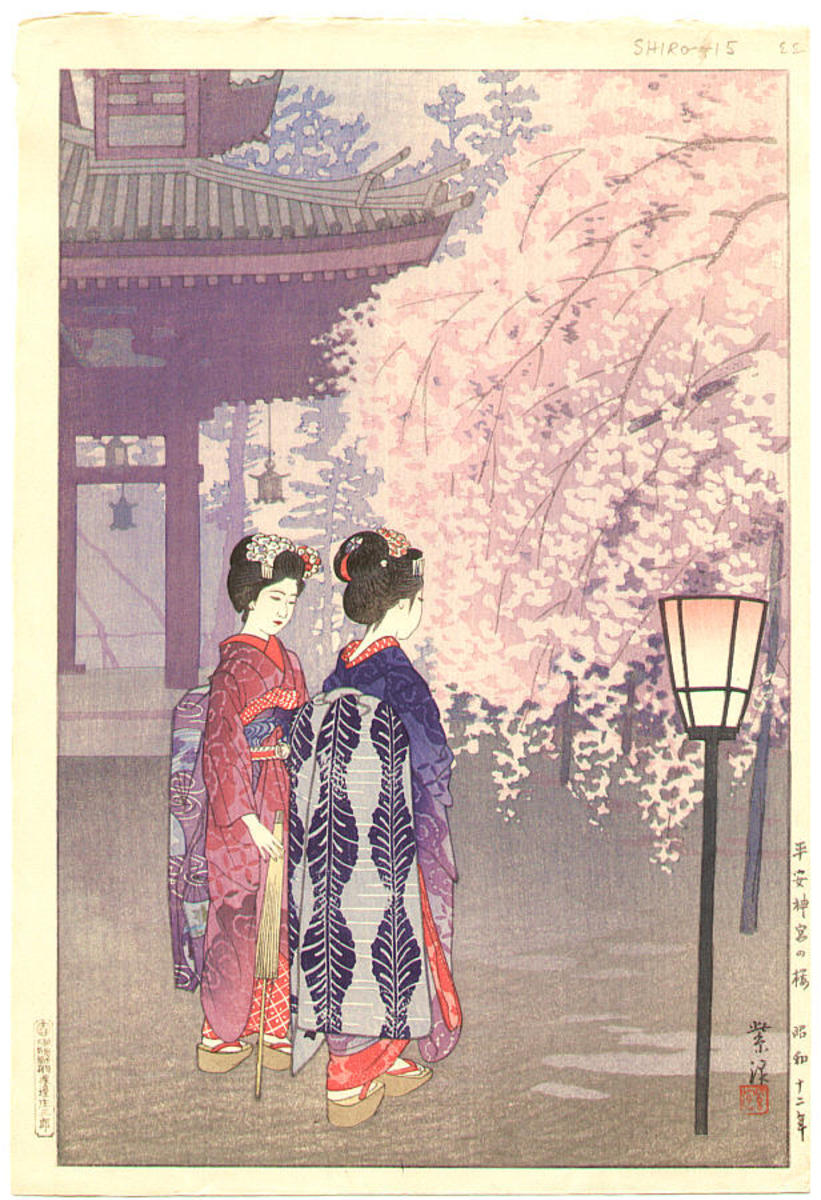
Heian Shrine, in Japanese Heian Jingu, is a Shinto shrine in central Kyoto built in 1895 to commemorate the eleven hundredth anniversary of the founding of Heian-kyo, the ancient name of the city laid out in 794, in present-day Sakyo Ward. The shrine stands in the Okazaki cultural district north of the Sanjo and Niomon avenues and east of the Kamogawa River, with a large open approach and the enormous vermilion otorii gate, standing approximately 24 meters tall and 33 meters wide and constructed of steel-reinforced concrete, dating to 1929 as a celebration of the enthronement of the Showa emperor. The main shrine buildings are a partial scale reconstruction at approximately five-eighths scale of the Daigokuden audience hall of the original Heian-period imperial palace, executed in the Heian palace architectural style of green-tiled roofs, vermilion-and-white painted timbers, and blue-tiled accents, and arrayed in a U-shaped plan with the Daigokuden in the center and the Soryu and Byakko towers flanking. The shrine enshrines Emperor Kammu, who founded the city in 794, and Emperor Komei, the last emperor to reign from Kyoto before the Meiji Restoration and the father of the Meiji emperor; the enshrinement of Komei was added in 1940 on the 2600th anniversary of the founding of the imperial dynasty. The surrounding Shin'en garden, designed by the master gardener Ogawa Jihei VII (also known as Niwashi Ueji, 1860-1933), is one of the major Meiji and Taisho-period garden compositions in Kyoto and is renowned for its weeping cherry trees, water iris (kakitsubata), water lilies, the Garyukyo stepping stones across the central pond, and seasonal phenomena. The garden is among the best surviving examples of the modern stroll garden of the late Meiji period. For Japanese printmaking Heian Shrine is a Meiji and later subject. Although founded after the close of the principal ukiyo-e period, the shrine became a regular subject of the shin-hanga revival within a generation of its construction. Kawase Hasui produced notable rain and snow views of the otorii gate and the approach, treating the dramatic scale of the gate against the surrounding city in compositions that became some of the most reproduced of his Kyoto sheets, and Tsuchiya Koitsu, Asano Takeji, and Tokuriki Tomikichiro contributed further compositions of the shrine, the otorii, and the surrounding Okazaki cultural district. Tokuriki Tomikichiro included the shrine in his Kyoto sosaku-hanga series across multiple decades. The visual character of Heian Shrine in prints is built on the dramatic scale of the otorii against the urban approach, with the vivid vermilion painted steel of the gate set against the surrounding sky and the lights of the avenue beneath, the vermilion architecture of the main precinct against snow or autumn foliage, the weeping cherry trees of the Shin'en garden in spring producing pink masses against the green of the surrounding planting, and the diffused atmospheric conditions of the Kyoto basin. The shrine remains a major Kyoto site, particularly during the cherry blossom season in early to mid April and the Jidai Matsuri festival each October 22, in which a procession of approximately two thousand participants in costumes representing different historical periods of Japan moves from the Kyoto Imperial Palace to Heian Shrine, and the shrine is reached most directly via the Higashiyama subway station of the Tozai Line.
Hiroshima
広島
5 prints
Hiroshima is a city in southwestern Honshu on the delta of the Ota River where it enters the Seto Inland Sea, the principal city of Hiroshima Prefecture in the Chugoku region. The city was founded as a castle town in the late sixteenth century by the daimyo Mori Terumoto, who built Hiroshima Castle on the central delta island in 1589, and it served across the Edo period as the seat of the Asano clan domain after the Mori were transferred to Choshu following the Battle of Sekigahara in 1600. The name means broad island, referring to the delta geography on which the city was laid out, with multiple branches of the Ota River dividing the city into a series of low islands connected by bridges. Hiroshima developed as a regional commercial and administrative center, with the castle and the surrounding samurai and merchant districts forming the urban core, and with the nearby sacred island of Itsukushima, known as Miyajima, serving as the principal religious site of the surrounding region. After the Meiji Restoration the city became an important military headquarters and during the Sino-Japanese War of 1894-1895 the imperial court temporarily relocated to Hiroshima Castle as the wartime command center. The city is internationally known today primarily for its destruction by atomic bombing on 6 August 1945, when the United States dropped the uranium-based atomic bomb known as Little Boy on the city center, killing approximately 140,000 people by the end of 1945 from the immediate blast and subsequent radiation effects, and the subsequent rebuilding and dedication as a city of peace, with the Peace Memorial Park designed by Tange Kenzo, the surviving Atomic Bomb Dome (the former Industrial Promotion Hall designed by the Czech architect Jan Letzel), and the Hiroshima Peace Memorial Museum forming the principal contemporary commemorative landscape. For Japanese printmaking Hiroshima appears most often through depictions of nearby Itsukushima Shrine on Miyajima, which is treated under its own entry in this database, and through individual sheets of the castle and the city by late Edo and Meiji artists. Utagawa Hiroshige treated the city in his Famous Views of the Sixty-Odd Provinces (Rokujuyoshu meisho zue) issued from 1853 to 1856, in which a sheet of Aki Province depicts Itsukushima Shrine with its torii in the sea. Edo-period printed travel guides to the Sanyo road region included views of the castle and the surrounding districts. The shin-hanga revival included Hiroshima and the surrounding Seto Inland Sea subjects in the work of Kawase Hasui, Yoshida Hiroshi, and Tsuchiya Koitsu, who treated the harbor, the castle, and Miyajima in seasonal compositions, with Hasui producing notable Hiroshima Castle and harbor sheets and Yoshida Hiroshi treating the Inland Sea in his celebrated 1926 Sailing Boats series. After the atomic bombing, a number of postwar sosaku-hanga artists treated the surviving Atomic Bomb Dome and the Peace Memorial Park, with prints by Hiratsuka Un'ichi and others contributing to the commemorative iconography. The visual character of Hiroshima in prints across the historical depth is built on water and bridges of the delta, the castle keep against the surrounding plain, and the islands and inland sea views of the broader region, with the postwar commemorative iconography centered on the skeletal dome of the surviving Industrial Promotion Hall against the cleared park beyond. Contemporary visitors approach the city principally for the Peace Memorial sites and for the day trip to Miyajima via the Sanyo Shinkansen and the JR Sanyo Line.

Kamakura
鎌倉
10 prints
Kamakura is a coastal town in eastern Kanagawa Prefecture, situated at the head of a small bay on Sagami Bay, surrounded on three sides by wooded hills and opening south to the Pacific. The town is historically important as the seat of the first shogunal government in Japan, established by Minamoto no Yoritomo in 1185 and lasting until the fall of the Hojo regents in 1333 during the broader Kamakura period of Japanese history. The Kamakura period saw the construction of the great Buddhist institutions for which the town is principally known, including the bronze Great Buddha (Daibutsu) of Kotoku-in cast in 1252 and standing approximately 11.4 meters high, originally housed within a great hall that was destroyed by tsunamis or storms in the late thirteenth and again in the fifteenth century, after which the bronze figure remained in its present open-air setting; the Tsurugaoka Hachiman Shrine, established by Minamoto no Yoritomo in 1180 and rebuilt in expanded form across the medieval and early modern periods as the cultic center of the new bakufu and of the Minamoto warrior cult; the Engaku-ji and Kencho-ji Zen monasteries founded in the late thirteenth century as the first major Rinzai Zen institutions in eastern Japan; the Hase-dera with its enormous wooden eleven-headed Kannon image; the Hokoku-ji with its bamboo grove garden; and a number of smaller temples and shrines distributed across the surrounding valleys. The five great Zen temples of Kamakura (Kamakura Gozan) formed the eastern parallel to the Kyoto Gozan within the medieval Rinzai institutional system. After the fall of the Kamakura bakufu in 1333 and the subsequent Nanboku-cho upheavals, the town declined to a fishing village, but the Buddhist institutions and the Daibutsu remained as objects of pilgrimage and travel literature across the Edo period, with the great bronze Buddha drawing constant visitors. For Japanese printmaking Kamakura appears in late Edo and Meiji meisho-e sets and prominently in the shin-hanga revival. Utagawa Hiroshige treated Kamakura in his Famous Views of the Sixty-Odd Provinces and in individual sheets of the surrounding Sagami coast, and Hokusai included views of the area in some of his minor print sets and printed-book illustrations. The shin-hanga revival of the early twentieth century returned to Kamakura repeatedly. Kawase Hasui produced numerous Kamakura compositions including views of the Daibutsu in snow and rain, Tsurugaoka Hachiman Shrine, the Hase-dera approach, and the surrounding coast, and Yoshida Hiroshi treated the Daibutsu in his individual landscape sheets including the celebrated Kamakura Great Buddha print in which the seated bronze figure is treated under varied lighting conditions in his characteristic variant-impression practice. Tsuchiya Koitsu, Asano Takeji, and the postwar Tokyo and Kanto-area sosaku-hanga circle including Sekino Junichiro contributed further compositions of the Daibutsu and the shrine. The visual character of Kamakura in prints is built on the dark green of the surrounding wooded hills, the great bronze figure of the Daibutsu seated against trees, the curving approach paths through the temple precincts of Tsurugaoka Hachiman, the seasonal phenomena of cherry blossom along the Dankazura approach in spring and autumn maple in the surrounding hills, and the maritime light of the bay and the Pacific coast. Modern Kamakura is a major weekend destination from Tokyo, reached via the JR Yokosuka Line in approximately an hour from central Tokyo, with the principal sites linked by walking routes through the central districts and the Enoden tram running along the coast to Enoshima and Fujisawa providing access to Hase-dera, the Daibutsu, and the surrounding beach.
Kanazawa
金沢
4 prints
Kanazawa is a city on the Sea of Japan coast of central Honshu, the principal city of Ishikawa Prefecture in the Hokuriku region. The city developed across the late sixteenth century as the castle town of the Maeda clan, who governed the wealthy Kaga domain from 1583 through the Meiji Restoration as the largest non-Tokugawa-related daimyo holding in Japan, with stipend at roughly one million koku of rice and accordingly enormous resources for cultural patronage. The Maeda investment in cultural sophistication produced one of the largest concentrations of provincial cultural patronage in early modern Japan, with notable craft traditions in lacquer including Wajima-nuri and Kaga maki-e, ceramics including Kutani-yaki, textile dyeing including Kaga yuzen, and gold leaf production for which Kanazawa supplied approximately ninety-eight percent of Japan's total output by the modern period, and with significant Noh, Kyogen, and tea-ceremony traditions sustained by the daimyo court. The principal monuments include Kanazawa Castle, partly preserved within an urban park with the Ishikawamon gate, the Hishi yagura, and the Gojikken nagaya storehouse rebuilt and accessible; the great strolling garden of Kenrokuen adjacent to the castle, founded in stages from the seventeenth century by successive Maeda lords as the family's outer garden and one of the three most famous gardens in Japan (the Nihon Sankei-en, alongside Kairakuen in Mito and Korakuen in Okayama); the historic samurai district of Nagamachi with its earthen walls and stone-lined drainage canals; the eastern teahouse district of Higashi Chaya with its wooden machiya facades; and the smaller western and Kazue-machi chaya districts. The city largely escaped destruction during the firebombing campaigns of 1944-1945 and preserves a substantial historic urban fabric, including some of the largest surviving samurai and merchant districts of any provincial city in Japan. For Japanese printmaking Kanazawa appears in late Edo meisho prints of the Kaga domain and the Hokuriku region, with Utagawa Hiroshige treating Kaga Province in his Famous Views of the Sixty-Odd Provinces, and Hasegawa Sadanobu producing Kansai-region sheets that include the surrounding Hokuriku coast. The city figures more prominently in the shin-hanga revival. Kawase Hasui produced Kanazawa subjects in his extensive travel-based print practice, including snow views of the Kenrokuen garden and the surrounding districts and twilight views of the chaya districts, and Yoshida Hiroshi, Tsuchiya Koitsu, and the sosaku-hanga artists of the postwar period including Tokuriki Tomikichiro and Saito Kiyoshi included the city and the surrounding region in their bodies of work. Sosaku-hanga artist Kasamatsu Shiro and other postwar artists treated the city's gardens, castles, and chaya districts in seasonal compositions. The visual character of Kanazawa in prints is built on the castle walls and turrets against the surrounding moats and stone embankments, the curving paths and stone lanterns of Kenrokuen with its seasonal blossoms and the distinctive snow protection ropes called yukitsuri that suspend pine branches against winter snowfall, the wooden facades and dark-stained timbers of the chaya districts and the samurai house quarters, and the local seasonal phenomena of heavy winter snowfall and the diffused Sea of Japan light. Contemporary Kanazawa is reached by the Hokuriku Shinkansen from Tokyo in approximately two and a half hours and is among the principal regional destinations for travelers seeking preserved Edo-period and early modern urban landscapes outside the large metropolitan centers, with the 21st Century Museum of Contemporary Art, the Kenrokuen garden, the castle park, and the chaya districts forming the principal contemporary visitor circuit.

Kinkaku-ji
金閣寺
3 prints
Kinkaku-ji, formally Rokuon-ji and known popularly as the Golden Pavilion, is a Zen Buddhist temple of the Rinzai sect's Shokoku-ji branch in northwestern Kyoto, in present-day Kita Ward. The temple originated in the late fourteenth century when the shogun Ashikaga Yoshimitsu (1358-1408) acquired the site in 1397 from the Saionji family and developed his retirement villa, called Kitayama-den, as an opulent estate combining Buddhist architecture with aristocratic and bushi residential traditions, and the property was converted to a Zen temple of the Rinzai school upon Yoshimitsu's death in 1408 according to the terms of his will. The principal building, the Shariden reliquary hall whose three stories integrate three different architectural styles (the first floor in shinden-zukuri aristocratic style, the second in samurai bukke style, and the third in Chinese Zen Buddhist Karayo style with a phoenix finial), is set on a pond such that its reflection is visible in the still water before it and the upper two stories are covered in gold leaf, which served as a symbolic statement of the Ashikaga regime's economic and cultural prominence at its high point. The original Shariden survived multiple fires and the upheavals of the Onin War and the medieval period in its original form but was destroyed by arson committed by a 21-year-old novice monk on 2 July 1950, an event that drew international attention and inspired Mishima Yukio's 1956 novel Kinkakuji (The Temple of the Golden Pavilion). The present building is a faithful reconstruction completed in 1955 based on the historical documentation and the surviving photographs of the original, with the gold leaf renewed in 1987 in a more lavish application than the prewar building. The pond garden, called Kyoko-chi (Mirror Pond) and dating from the Yoshimitsu period, the surrounding wooded slope, the small Sosei waterfall, and the secondary structures including the Sekkatei tea pavilion form one of the most visited Zen temple compounds in Japan. For Japanese printmaking Kinkaku-ji belongs to the canonical Kyoto meisho. The pavilion is included in Edo-period printed guidebooks to Kyoto and in individual sheets of the late Edo period by Hiroshige and others, but it became most prominent through the shin-hanga revival, in which Kawase Hasui, Tsuchiya Koitsu, Asano Takeji, and Tokuriki Tomikichiro all produced compositions of the pavilion and its reflection under seasonal conditions including snow, autumn maple, and the calm of summer evening. Hasui's snow Kinkaku-ji compositions and his evening compositions are among the most reproduced of his Kyoto sheets, and Tsuchiya Koitsu's gold pavilion in snow is similarly canonical. Tokuriki Tomikichiro included the temple in his Kyoto-centered series across multiple decades, and Yoshida Hiroshi treated the pavilion in his individual sheets in his characteristic variant-impression practice with versions under different light conditions. The visual character of Kinkaku-ji in prints is built on the gilded surface of the pavilion catching the pond surface, the inverted reflection in the water below producing a doubled image, the foreground pine, snow, or maple foliage of the surrounding garden, and the dark wooded slope of the mountain rising behind, with the seasonal phenomena providing the principal compositional variable. The seasonally most striking views are the snow-covered pavilion in midwinter and the autumn maple reflected with the pavilion in mid-November. Contemporary visitors approach the temple from the western edge of central Kyoto via the Kyoto City Bus from Kyoto Station or the surrounding districts, with the pavilion remaining one of the most heavily photographed and visited monuments in Japan, viewed along a single one-way walking circuit around the pond and through the upper garden.

Kiyomizu Temple
清水寺
4 prints
Kiyomizu-dera, the Pure Water Temple, is a Buddhist temple of the Hosso sect (since 1965 of the independent Kita-Hosso sect after separation from the parent Hosso school), founded according to tradition in 778 by the priest Enchin on the wooded slope of Mount Otowa in the Higashiyama district of eastern Kyoto in present-day Higashiyama Ward. The temple takes its name from the Otowa waterfall on the temple grounds, whose three streams of clear water are believed by tradition to confer longevity, success in studies, and successful relationships when drunk in the proper sequence with the long-handled ladles provided for visitors. The principal hall (hondo) is celebrated for the great wooden veranda (butai) that projects approximately 13 meters from the main building over the steep hillside on the south face of the temple, supported by an array of tall keyaki (Japanese zelkova) pillars assembled without nails, and offering a panoramic view westward over the Kyoto basin to the distant Atago and Arashiyama hills. The veranda generated the Japanese expression Kiyomizu no butai kara tobiori (jumping off the Kiyomizu veranda), meaning to take a decisive resolution, from the Edo-period practice of jumping from the platform as a religious act believed to grant wishes if survived. The present main hall was rebuilt in 1633 by order of the third Tokugawa shogun, Iemitsu, as the principal seventeenth-century Tokugawa religious foundation in Kyoto, and the surrounding structures, including the Nio gate at the western entrance, the three-story pagoda, the Okuno-in inner sanctuary at the far end of the temple complex, the Koyasu pagoda, and the Jishu shrine of love at the rear of the main hall, were also rebuilt or established in the same Edo-period campaign. Kiyomizu-dera was designated a UNESCO World Heritage Site in 1994 as part of the Historic Monuments of Ancient Kyoto group. For Japanese printmaking Kiyomizu-dera stands as one of the most depicted Kyoto sites. Utagawa Hiroshige treated the temple in his Famous Views of Kyoto issued around 1834, in which the veranda and the surrounding cherry blossom are the principal subject, and in individual sheets, with the dramatic projection of the platform offering an unusually adaptable compositional motif. The temple appears in Edo-period printed guidebooks to the city, in Hasegawa Sadanobu's Kansai-region sheets, and in the Meiji-period kaika-e treatments of Kyoto. The shin-hanga revival brought a sustained engagement, with Kawase Hasui producing snow, twilight, and night views of the veranda, the pagoda, and the approach through the surrounding Sannenzaka and Ninenzaka streets below, including the celebrated Kiyomizu in Snow and similar compositions, and Tsuchiya Koitsu, Asano Takeji, Tokuriki Tomikichiro, and Yoshida Hiroshi contributing further compositions. Yoshida Hiroshi's Kiyomizu sheets include variant impressions under different conditions. The temple is also a recurrent subject of Kyoto sosaku-hanga prints across the twentieth century, with Saito Kiyoshi, Tokuriki Tomikichiro, and the Kyoto creative-print circle treating the architecture in graphic compositions. The visual character of Kiyomizu in prints is built on the projecting veranda against the steep wooded slope, the slender vermilion pagoda rising among the surrounding maple trees, the curving roof lines of the main hall, the lantern-lit approach paths from the Sannenzaka and Ninenzaka streets below with their preserved Edo-period wooden facades, the foreground figures of pilgrims and visitors, and the seasonal phenomena of cherry blossom in early April and brilliant autumn maple in mid-November that frame the temple buildings. Contemporary visitors find Kiyomizu among the most heavily visited temples in Kyoto, reached via the City Bus to Gojo-zaka or Kiyomizu-michi stops or by walking up the Sannenzaka and Ninenzaka approach streets, with the standard Higashiyama walking circuit linking it to the Yasaka Shrine, Chion-in, and Maruyama Park to the north.
Kobe
神戸
8 prints
Kobe is a city on the northwestern shore of Osaka Bay, the principal city of Hyogo Prefecture in the Kansai region, situated on a narrow coastal strip beneath the Rokko mountain range and opening south to the Inland Sea. The harbor of Hyogo, the historical name for the western portion of the modern city, was one of the principal medieval trading ports of Japan, with traffic to Korea and China documented from the eighth century, and it served across the Edo period as a coastal commercial port. Hyogo was the historical capital of the brief Fukuhara-kyo project of Taira no Kiyomori, who relocated the imperial capital to Hyogo in 1180 in an effort to consolidate Taira power before the project was abandoned within six months and the court returned to Kyoto. The defining transformation came after the opening of the port to foreign trade in January 1868 under the treaties of the Bakumatsu and early Meiji period, when Kobe became one of the principal foreign settlements in Japan, with a distinct Western-style district of consulates, churches, banks, and residences developing in the area between the harbor and the foothills, called the Kobe Foreign Settlement (Kobe Kyoryuchi). The city grew rapidly across the late nineteenth and early twentieth centuries as the principal commercial port serving the Kansai region, with the development of major shipyards including the Mitsubishi Kobe Shipyard, the establishment of foreign trading houses, and the development of the Kitano-cho district of foreign residences (ijinkan) on the slopes north of the harbor. The Kobe Beef brand of Tajima cattle, developed in the late nineteenth century for the foreign settlement market, became one of the most internationally recognized Japanese culinary products. Significant portions of the city were destroyed in the air raids of 1945 and again in the Great Hanshin Earthquake of 17 January 1995, which killed more than 6,400 people and destroyed substantial portions of the city center and the harbor infrastructure. For Japanese printmaking Kobe appears most prominently in the Meiji-period kaika-e of the late nineteenth century and in the shin-hanga revival of the early twentieth. The kaika-e of Utagawa Hiroshige III, Inoue Yasuji, Kobayashi Kiyochika, and other Tokyo-trained Meiji artists treated the Kobe foreign settlement and the harbor as exemplary subjects of the modernizing nation, with brick architecture, ships, gas lamps, and foreign costume figuring as motifs of the new period. Kawase Hasui produced harbor and city views of Kobe in his extensive travel-based shin-hanga practice, including evening views of the harbor and treatments of the surrounding Hyogo coast, and Yoshida Hiroshi, Tsuchiya Koitsu, and Asano Takeji contributed further compositions of the port and the surrounding region. The sosaku-hanga artist Hide Kawanishi (1894-1965), working in and around Kobe through the mid-twentieth century, produced extensive series treating the city's harbor, foreign quarters, and surrounding Hyogo subjects, becoming the principal creative-print interpreter of Kobe and one of the most identifiably regional sosaku-hanga artists of his generation. The visual character of Kobe in prints is built on harbor cranes, ships at anchor, lit windows of the Western-style buildings on Kitano hill, the silhouette of the Rokko mountains behind the city, the foreign and Japanese pedestrians in the central district, and the seasonal phenomena of the maritime climate. Contemporary Kobe preserves a substantial portion of the Kitano-cho ijinkan foreign-residence district as a heritage area, with several of the historic Western-style buildings open as museums, and the port and surrounding harbor remain working facilities along with the Meriken Park and Harborland leisure districts.
Kyoto
京都
149 prints
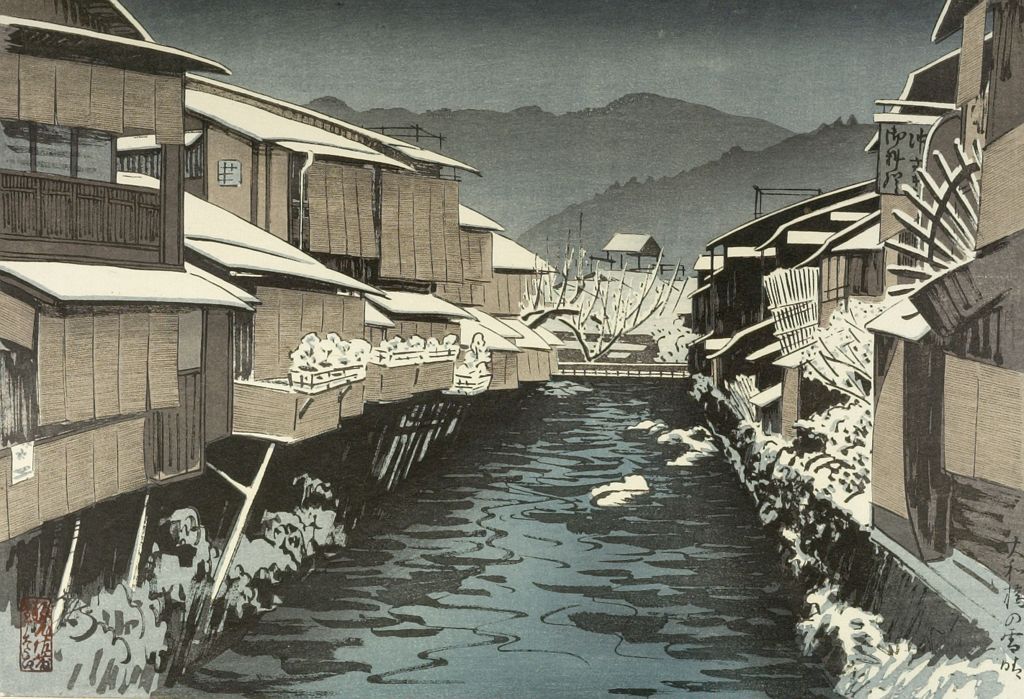
Kyoto, in the southern basin of the Yamashiro plain in west-central Honshu, served as the imperial capital of Japan from its founding as Heian-kyo in 794 until the Meiji Restoration of 1868, when the imperial court relocated to the renamed Tokyo. The city is organized on a classical grid laid down at its founding in deliberate emulation of the Tang Chinese capital at Chang'an, with broad north-south avenues and an east-west cross-axis structured around the Suzaku-oji thoroughfare, and the long centuries of court patronage produced an unusually dense concentration of Buddhist temples, Shinto shrines, aristocratic gardens, and craft workshops, many of which became the meisho, or famous places, on which the meisho-e tradition fed. The city survived without significant destruction through the Onin War, the Meiji transition, and the Pacific War, the last in part because of deliberate U.S. military decisions to spare its historical fabric, and the result is the densest concentration of pre-modern monumental architecture in any major Japanese city. For ukiyo-e and the later shin-hanga and sosaku-hanga schools, Kyoto provided an alternative iconography to Edo, one rooted in seasonal pilgrimage, classical literature, and the visual culture of the Heian court rather than the urban entertainment districts of the eastern capital. The principal Edo-period meisho-e treatment is Utagawa Hiroshige's Famous Views of Kyoto (Kyoto meisho), a horizontal-format series of ten sheets issued by Eisendo around 1834, which covers locations including Arashiyama, Kiyomizu Temple, Gion, Yodo River, Sanjo Bridge, Tadasugawara, the Shimabara pleasure quarter, and the Kamogawa River bridges, and which remains the canonical Edo-period print survey of the city. Hokusai had earlier included scenes of the Tokaido approach to Kyoto in his Travel road compositions and in passages of the One Hundred Views of Mount Fuji, Utagawa Kunisada and Toyokuni III contributed individual Kyoto theatrical and bijin sheets across the late Edo period, and Hasegawa Sadanobu I and II of the Osaka kamigata school produced their own Kyoto and Kansai meisho sets in the mid-nineteenth century. With the shin-hanga revival of the early twentieth century, Kyoto became a major subject for Kawase Hasui, who produced numerous Kyoto views including night and snow scenes of Kiyomizu, Gion, Yasaka pagoda, Heian Shrine, Sanjusangendo, and the Kamogawa, and for Yoshida Hiroshi, Tsuchiya Koitsu, Asano Takeji, and Tokuriki Tomikichiro, the last of whom, working from Kyoto itself, produced extensive Kyoto-centered series including Eight Views of Kyoto, Twelve Months of Kyoto, and the long-running Famous Places of Kyoto print sets across more than three decades. The Kyoto sosaku-hanga response was anchored by artists such as Asada Benji, Tokuriki Tomikichiro, Sekino Junichiro, and the postwar Kyoto-based creative-print circle, who worked within and around the city and brought their own creative-print idioms to its temples, gardens, and street scenes. The visual character of Kyoto in prints is built from a repeating set of motifs, including the cherry blossoms and autumn maples of Arashiyama and Higashiyama, the lantern-lit night quarters of Gion and Pontocho, the bell towers and gates of Higashi and Nishi Honganji, the wooden veranda of Kiyomizudera projecting over its hillside, the golden pavilion of Kinkakuji set on its mirror pond, the great rock garden of Ryoanji, the maiko and geiko of the entertainment districts, and the seasonal festivals such as Gion Matsuri in July, Daimonji Okuribi in August, Jidai Matsuri in October, and the cherry-blossom and autumn-foliage seasons that punctuate the calendar. Locations treated under their own entries in this database include Arashiyama, Chion-in, Daimonji, Fushimi Inari, Gion, Heian Shrine, Kinkaku-ji, Kiyomizu Temple, Maruyama Park, Sagano, and Shirakawa. The city remains the principal pilgrimage destination in Japan for travelers seeking the world depicted in these prints, with the Higashiyama temple district, the Gion entertainment quarter, and the Arashiyama-Sagano western edge preserving the broad outlines of the meisho geography that the printmakers recorded, and the Kyoto National Museum, the Kyoto Municipal Museum of Art, and the Kahitsukan Kyoto Museum of Contemporary Art holding representative print collections.

Lake Chuzenji
中禅寺湖
2 prints
Lake Chuzenji is a mountain lake in the western part of Nikko, in northwestern Tochigi Prefecture, formed approximately twenty thousand years ago when an eruption of Mount Nantai blocked the headwaters of the Daiya River, creating the lake at its present elevation of 1,269 meters above sea level, making it one of the highest natural lakes in Japan. The lake covers approximately twelve square kilometers and reaches depths in excess of 160 meters, and is surrounded by wooded slopes that turn brilliant red and gold in autumn, especially along the southern and eastern shores. The lake outflows over the Kegon Falls (Kegon-no-taki), which drop 97 meters in a single dramatic column at the lake's eastern edge, with twelve smaller subsidiary falls cascading along the surrounding cliff, forming one of the most celebrated waterfalls in Japan and traditionally counted among the three great waterfalls of the country alongside Nachi Falls in Wakayama and Fukuroda Falls in Ibaraki. The surrounding Nikko district was developed as a sacred mountain area from the eighth century onward under the Buddhist priest Shodo Shonin, who is traditionally said to have first ascended Mount Nantai in 782 and to have established the cultic geography that included Lake Chuzenji and the surrounding peaks. Lake Chuzenji and Mount Nantai became major pilgrimage destinations within the Nikko mountain cult, with the small Chuzen-ji temple at the lake's eastern shore (after which the lake takes its name) and the Futarasan Chugu-shi shrine on the lake's southern shore serving as the principal religious sites. From the late Meiji period through the prewar Showa period, Lake Chuzenji served as a summer retreat for the Tokyo diplomatic community and Japanese government officials, with consulate villas, the Italian Embassy summer house (built in 1928 and now operating as a museum), the British Embassy summer house (built in 1896, now also a museum), and a number of Japanese summer villas established on the lake shore, principally on the southern and eastern banks. For Japanese printmaking Lake Chuzenji is most closely associated with the shin-hanga revival of the early twentieth century, when the development of the lake as a summer destination coincided with the renewed interest in landscape print subjects. Kawase Hasui produced multiple views of the lake including snow and autumn compositions, treatments of the Kegon Falls in summer and winter, and views of the surrounding Mount Nantai under varied conditions, with his Chuzenji and Kegon sheets among the most reproduced of his Tochigi subjects. Yoshida Hiroshi included Chuzenji subjects in his Nikko sheets and his individual landscape compositions, treating the lake under different lighting conditions in his characteristic variant-impression practice. Tsuchiya Koitsu, Tokuriki Tomikichiro, and other shin-hanga and sosaku-hanga artists contributed further compositions of the lake and the falls. The visual character of Lake Chuzenji in prints is built on the dark surface of the lake against the surrounding wooded slopes, the broadly symmetrical cone of Mount Nantai rising above the western shore as a recurrent backdrop, the white column of the Kegon Falls dropping into its plunge pool, the brilliant autumn maple of the surrounding hills against the still lake surface, the snow phenomena of the higher elevation in winter, and the small lakeside settlements and torii along the shore. Modern visitors reach the lake via the Iroha-zaka switchback road from Nikko town, a steep ascending and descending pair of roads that pass through dense maple forest, with the lakeside settlements of Chuzenji-onsen and the Kegon Falls observation platform serving as the principal access points and the JR Nikko Line and Tobu Nikko Line linking the area to Tokyo.
Lake Towada
十和田湖
1 print
Lake Towada is a large caldera lake in the mountains on the boundary of Aomori and Akita Prefectures in the northern Tohoku region of Honshu, formed in a series of eruptions of the surrounding stratovolcano across the past two hundred thousand years, with the principal collapse forming the present lake basin approximately fifteen thousand years ago. The lake covers approximately 61 square kilometers at an elevation of 400 meters above sea level, with a maximum depth of 327 meters that makes it the third deepest lake in Japan, and it is surrounded by steep wooded slopes that turn brilliant orange, red, and gold in autumn. The lake is shaped roughly like a triangle, with the small Nakayama and Ogura peninsulas extending into its central area from the southern shore. The outflow runs north through the Oirase Gorge (Oirase Keiryu), a narrow stream-and-waterfall valley running approximately fourteen kilometers from the northern lake shore at Nenokuchi to the village of Yakeyama, which is celebrated for its seasonal foliage and cascade scenery and is one of the most heavily visited autumn destinations in Tohoku. The gorge contains numerous named cascades including Choshi-otaki, Kumoi-no-taki, Shiraito-no-taki, and the Ashura nagare. The lake and surrounding district were developed as a tourism destination from the late Meiji period through the prewar Showa period, with steamer service on the lake, hot spring lodges, and walking paths established along the shore and through the Oirase Gorge, principally as a result of promotion by the local poet and naturalist Omachi Keigetsu, who published widely on the beauty of the region in the late Meiji period and is sometimes credited with elevating Towada to national tourism prominence. The Towada-Hachimantai National Park was established in 1936 to protect the lake, the gorge, and the surrounding mountains. For Japanese printmaking Lake Towada is most prominently associated with Kawase Hasui, who treated the lake and the surrounding Tohoku region in numerous compositions including the celebrated Towada and Oirase Gorge sheets of his travel-based shin-hanga practice, with Hasui's Lake Towada in Autumn and Oirase Stream in Autumn among the most reproduced of his Tohoku subjects. The Towada subjects exemplify Hasui's engagement with northern Honshu, alongside his Aomori, Akita, and Hokkaido compositions, and he visited the region on multiple occasions across the 1930s. Other shin-hanga and sosaku-hanga artists treated the region, with Yoshida Hiroshi, Asano Takeji, and the postwar Tohoku-based creative-print artists including Munakata Shiko (working from his native Aomori) contributing further compositions of the lake and the surrounding forests. The visual character of Lake Towada in prints is built on the dark caldera water against the steep wooded shores, the autumn maple and beech of the Oirase Gorge in stages of color change from green through yellow to red, the white cascades of the gorge falls including Choshi Otaki and Kumoi Falls dropping through the dense forest, the still surface of the lake in early morning with the surrounding peaks reflected, and the diffused atmospheric conditions of the mountainous Tohoku setting. Contemporary visitors approach the lake principally via the Aomori or Akita prefectural roads, with the Oirase Gorge walking path running parallel to the stream from Nenokuchi to Yakeyama, the lakeside settlement at Yasumiya providing accommodation and boat services, and the Nenokuchi shore at the head of the gorge providing the principal photographic viewpoint, all served by bus from JR Hachinohe Station or JR Aomori Station.
Maekawa
前川
1 print
Maekawa, written 前川 and meaning literally fore-river or front-river, is a place name appearing in the title of certain shin-hanga and sosaku-hanga prints whose specific geographic referent is not always reliably documented in collection records. The element maekawa recurs as a place name across multiple regions of Japan, including small rural settlements in Akita, Yamagata, Niigata, Saitama, Aomori, and other prefectures, and identifications in individual catalog records may refer to differing locations depending on the artist's documented travel itinerary, the original Japanese publication record, and any associated series title. The most commonly referenced Maekawa in shin-hanga prints is generally taken to refer to a riverside or coastal hamlet treated in a snow or evening composition by Kawase Hasui or another shin-hanga artist, often within the broader Tohoku or Hokuriku Sea of Japan regional sets, though without specific catalog cross-checking this attribution remains provisional. In Japanese print collecting literature, the same generic place name appears in titles such as Snow at Maekawa (Maekawa no yuki) without clear specification of which Maekawa is depicted, and museum and catalogue records often record the place name without amplification. For Japanese printmaking the term Maekawa is therefore best understood as referring to a rural Japanese hamlet on a river or near the coast, with the specific identification varying by artist and sheet. The visual character of prints titled with reference to Maekawa typically belongs to the rural Tohoku or Hokuriku register of shin-hanga and sosaku-hanga landscape practice, with motifs of river or coastal water, small wooden bridge, snow-covered roofs, harbor fishing boats, and figures of villagers under winter conditions. Kawase Hasui's treatments of small rural Japan in the 1920s and 1930s, alongside the work of other shin-hanga artists, established a generic register for the Japanese rural settlement in print that the Maekawa designations belong within, and the works exemplify the broader shin-hanga interest in recording the receding pre-modern village landscape under the pressures of early-Showa modernization. We recommend that catalog records for individual prints whose title refers to Maekawa be cross-checked against the artist's documented travel itinerary, the original Japanese title and publication record, and any associated series or publisher data before being aggregated into a single geographic page, and that the Hanga database treat Maekawa as a generic placeholder for rural village subjects pending more specific information about which Maekawa is depicted in a given sheet. Where the Maekawa attribution is firm to a specific town, the visual character of the prints typically registers the small-scale rural Japanese landscape of the period, with the print's interest centered on the quiet of the village under seasonal conditions rather than on identifiable monumental architecture.
Maruyama Park
円山公園
1 print
Maruyama Park is a Western-style public park in the Higashiyama district of central Kyoto, established in 1886 on land previously belonging to the Chion-in and Yasaka shrine complex, in present-day Higashiyama Ward, as one of the first Western-influenced public parks in Kyoto. The park occupies the wooded slope between Yasaka Shrine to the west and Chion-in to the east, and incorporates earlier teahouses, ponds, and walking paths from the temple landholdings into a Meiji-period public landscape design. The park is principally celebrated for its great weeping cherry tree (shidare-zakura), called the Gion shidare-zakura, an enormous specimen at the center of the park whose seasonal blossom in early April draws large evening crowds for hanami viewing, with the tree illuminated after dark in a tradition continuing from the late nineteenth century. The present tree is the second-generation tree planted in 1949 to replace the original specimen, which died in the mid-twentieth century, with the surrounding park also containing approximately 680 other cherry trees of various varieties. The park also includes a pond garden, lawns, traditional Japanese restaurants and teahouses, the small Chiyoshogen waterfall, and walking paths connecting to the surrounding Higashiyama temple district, including a steep path north to the Maruyama hill from which much of the eastern Kyoto skyline can be seen. The park's history is tightly tied to the early Meiji program of secularizing temple land and converting religious properties into public parks under the 1873 Public Park Law, with the area between Yasaka Shrine and Chion-in being among the earliest such conversions in Kyoto. For Japanese printmaking Maruyama Park appears almost exclusively in the shin-hanga revival of the early twentieth century, as a Meiji-founded site whose period of greatest pictorial currency falls after the close of the principal ukiyo-e era. Kawase Hasui produced multiple Maruyama compositions including the celebrated night view of the great weeping cherry under lantern light and snow views of the surrounding park, with his evening cherry blossom compositions among the most reproduced of his Kyoto sheets and one of the most recognized shin-hanga images of Kyoto cherry blossom viewing. Tsuchiya Koitsu, Asano Takeji, Yoshida Hiroshi, and Tokuriki Tomikichiro contributed further compositions of the cherry tree, the pond, and the park during cherry blossom season, with Yoshida Hiroshi's variant-impression cherry blossom prints often based on Kyoto and Yoshino subjects of which Maruyama figures as one example. The visual character of Maruyama Park in prints is built on the silhouette of the great weeping cherry against night sky, the pale blossom catching lantern light, the lantern-lit walks of the park, the reflective pond surface, the surrounding pine and maple, and the figures of evening hanami visitors gathered beneath the central tree. The park is most often depicted in spring at peak cherry blossom, though winter snow views and autumn compositions also occur. Contemporary Maruyama Park remains a principal cherry blossom viewing site in Kyoto and is connected via the standard Higashiyama walking circuit to the adjacent Yasaka Shrine, Chion-in, and Kiyomizu temple complex, with the night illumination of the central weeping cherry occurring annually during the brief blossom season in early to mid April.

Matsushima
松島
17 prints
Matsushima is a coastal district in Miyagi Prefecture in the Tohoku region of northeastern Honshu, situated on Matsushima Bay where approximately 260 small pine-covered islands rise from shallow water along the Pacific coast. The bay has been celebrated since at least the medieval period as one of the three most scenic views in Japan, the Nihon Sankei, alongside Amanohashidate on the Sea of Japan coast and Itsukushima (Miyajima) in the Inland Sea, with the designation traditionally attributed to the Edo-period Confucian scholar Hayashi Razan in his Nihon Kokuji Shoki of 1643. The pines for which the bay is named cling to the eroded rock formations of the islands, producing the distinctive silhouettes that have become the defining motif of the region, with successive generations of Pacific storms and tsunamis (including the 2011 Tohoku tsunami which reached the bay but was significantly buffered by the islands) shaping the rocks into their characteristic forms. The Zen monastery of Zuiganji, founded in 828 by Jikaku Daishi Ennin and dramatically rebuilt in 1609 by the Sendai daimyo Date Masamune as the principal funerary temple of his line, stands on the mainland shore facing the bay as one of the great Rinzai institutions of northeastern Japan, with the small island of Godaido (also called Godaido Island) and its small Buddhist temple linked to the shore by a bridge directly offshore from the mainland approach. The Godaido temple is named for the Five Wisdom Kings (Godai Myoo) enshrined within and is one of the most recognizable single buildings in the bay. The poet Matsuo Basho visited Matsushima in 1689 on the journey recorded in his Oku no Hosomichi (The Narrow Road to the Deep North) and famously left no formal poem about the bay because, as legend has it, the scene exceeded his ability to compose, though the haiku attributed to him on the subject (Matsushima ah, ah Matsushima ah, Matsushima ah) is now considered apocryphal. For Japanese printmaking Matsushima belongs to the established roster of Japanese landscape meisho. Utagawa Hiroshige treated Matsushima in his Famous Views of the Sixty-Odd Provinces (Rokujuyoshu meisho zue, 1853-1856), in which a sheet of Mutsu Province depicts the bay with the pine islands and the surrounding shore, and in other landscape sets. Hokusai included the bay in his printed book sets of famous views. The shin-hanga revival of the early twentieth century returned to Matsushima repeatedly. Kawase Hasui produced numerous Matsushima compositions including dawn, sunset, snow, and rain views of the islands and the Godaido temple, with his Matsushima in Morning Mist, Snow at Matsushima, and Evening Glow at Matsushima counted among the most successful of his Tohoku landscape sheets. Yoshida Hiroshi and Tsuchiya Koitsu contributed further compositions, and the postwar Tohoku sosaku-hanga circle treated the bay across various seasons. The visual character of Matsushima in prints is built on the silhouettes of the pine-topped rock islands against bay water, the reflections in the shallow tide, the temple buildings of Godaido and Zuiganji along the shore, the small fishing craft and oyster cultivation rafts in the bay, the seasonal phenomena including snow on the pines and the diffused atmospheric conditions of the Tohoku coast, and the dawn and evening light effects that the shin-hanga artists especially exploited. Contemporary visitors approach Matsushima from Sendai via the JR Senseki Line in approximately forty minutes, with sightseeing boats from the harbor circulating among the principal islands and walking routes connecting the major temple sites along the shore.

Miyajima
宮島
18 prints
Miyajima is the popular name of the island of Itsukushima, situated in the Seto Inland Sea off the coast of Hatsukaichi in Hiroshima Prefecture, approximately twenty kilometers southwest of central Hiroshima. The island, whose name means island shrine and whose formal designation is Itsukushima, is celebrated as the location of Itsukushima Shrine, a Shinto complex documented from the late sixth century and rebuilt in its present form on the model of a Heian-period palace by the Taira clan under Taira no Kiyomori in 1168 during the high point of Taira clan ascendancy. The shrine is constructed on stilts directly over a tidal flat on the northern coast of the island, with the buildings linked by long covered corridors that appear to float above the water at high tide and stand on bare sand at low tide, a remarkable architectural integration of building and tidal environment. The great vermilion otorii gate stands in the sea offshore from the main shrine in the principal axis of approach from the water, the present version dating to 1875 and constructed of camphor wood with a wing-shaped corbel structure that allows the gate to stand by gravity alone, with the most recent major restoration completed in 2022 after several years of scaffolding. The island is also celebrated for the Misen mountain forest, with the 535-meter Mount Misen at its center, the wild sika deer that move freely through the shrine precincts and the surrounding paths, and the surrounding sacred geography of pine, maple, and cherry. The shrine and the island were designated a UNESCO World Heritage Site in 1996 and are part of the Setonaikai National Park established in 1934 as the first national park in Japan. Miyajima, like Matsushima and Amanohashidate, is included in the traditional Nihon Sankei, the three most scenic views of Japan. For Japanese printmaking Miyajima appears in the Edo-period meisho-e tradition. Utagawa Hiroshige treated the shrine in his Famous Views of the Sixty-Odd Provinces, in which a sheet of Aki Province depicts Itsukushima with its torii rising from the water, and Hokusai treated the island in passages of his printed-book travel sets. Hasegawa Sadanobu of the Osaka kamigata school produced Kansai and Setouchi sheets that include Miyajima subjects. The shin-hanga revival brought a sustained engagement, with Kawase Hasui producing celebrated views of the torii and the shrine under snow, rain, and twilight conditions, including evening Miyajima sheets in which the dark silhouette of the gate is set against a softly modulated sky and water, and Yoshida Hiroshi, Tsuchiya Koitsu, Asano Takeji, and Tokuriki Tomikichiro contributing further compositions of the torii and the shrine corridors. Yoshida Hiroshi's Miyajima sheets include variant impressions under dawn, day, and evening conditions in his characteristic atmospheric practice. The visual character of Miyajima in prints is built on the vermilion otorii against the surrounding sea, with the alternating tides revealing or concealing the gate's base in differing compositions, the silhouette of the shrine corridors and the Noh stage above water at high tide, the wooded slopes of Mount Misen behind, the small craft on the water, the dark figures of deer or shrine attendants, and the seasonal phenomena of cherry blossom and autumn maple. Contemporary visitors reach the island via the JR Sanyo Line to Miyajimaguchi Station and the short ten-minute ferry crossing, with the shrine and the surrounding mountain trails including the Misen summit ascent open year-round, and the new Miyajima rope-way providing access to the upper slopes of Mount Misen.

Mount Fuji
富士山
166 prints
Mount Fuji, written Fuji-san in Japanese and rising to 3,776 meters on the boundary of Shizuoka and Yamanashi prefectures southwest of Tokyo, is the highest peak in Japan and the principal sacred mountain of the country's visual tradition. Geologically a young composite volcano whose present cone has formed across the past ten thousand years, Fuji last erupted in 1707-1708 in the Hoei event, which deposited ash across the Kanto plain and formed the asymmetrical Hoei crater on the mountain's southeastern flank, and the mountain has remained quiet through the entire ukiyo-e and shin-hanga periods, allowing successive generations of printmakers to treat the cone as an essentially stable formal motif. The cult of Fuji as a sacred mountain reaches deep into the prehistoric and classical periods, with Shinto associations to the goddess Konohanasakuya-hime enshrined at the Fuji Sengen shrines, Buddhist associations through the Shugendo tradition of mountain pilgrimage, and from the seventeenth century onward the popular Fuji-ko confraternities, lay associations of pilgrims and devotees centered in Edo that organized seasonal climbs through the established northern and southern ascent routes from Yoshida, Subashiri, Suyama, and Murayama. By the late Edo period the mountain stood as a national symbol legible to viewers of every region. For Japanese printmaking the canonical statement is Katsushika Hokusai's Thirty-Six Views of Mount Fuji (Fugaku sanjurokkei), published in vertical and horizontal landscape format in colored woodblock by Eijudo (Nishimuraya Yohachi) from approximately 1830 to 1832, which expanded with ten additional sheets to comprise forty-six designs in total. The series includes The Great Wave off Kanagawa (Kanagawa-oki nami-ura), Fine Wind Clear Morning (Gaifu kaisei, popularly called Red Fuji), Rainstorm Beneath the Summit (Sanka haku-u), and views from points as varied as Mishima Pass, Lake Suwa, the Tama River, Honganji at Asakusa, and the Surugadai district of Edo, and it stands at the foundation of landscape ukiyo-e as a category. Hokusai followed it with the three-volume printed book One Hundred Views of Mount Fuji (Fugaku hyakkei, 1834-1835) in monochrome, which further codified the iconography of the mountain across seasons, weather conditions, and angles of approach. Utagawa Hiroshige treated Fuji recurrently across his career, in the Fifty-Three Stations of the Tokaido in which the mountain appears as a backdrop to many of the stations, in the Thirty-Six Views of Mount Fuji issued late in his life by Tsutaya Kichizo in 1858 in vertical format, in his One Hundred Famous Views of Edo where Fuji punctuates the Edo skyline, and in countless individual sheets. The shin-hanga revival took up the subject with renewed seriousness in the early twentieth century. Yoshida Hiroshi produced his celebrated Ten Views of Mount Fuji (1926), a tightly composed series in which the mountain is seen from differing distances and atmospheric conditions including dawn, daylight, evening, and moonlight, and Kawase Hasui returned to Fuji in many individual landscape prints from his Tokaido, Hakone, and lakeside compositions. Tsuchiya Koitsu treated Fuji in evening and snow compositions, and sosaku-hanga artists including Hiratsuka Un'ichi and Yamaguchi Gen treated the mountain in their own creative-print idioms. The visual character of Fuji in prints is built on the symmetrical conical silhouette, the alternation between snow-covered winter mass and bare summer summit, the contrast between distant horizon-line viewing and close foothill encounters, the seasonal phenomena including the morning red glow recorded in Red Fuji and the after-thunderstorm clarity recorded in many of Hokusai's compositions, and the interplay with foreground subjects ranging from cherry blossoms and pine groves to fishermen, travelers, bridges, rice fields, and the white-capped breakers of the Pacific. The mountain remains the most reliably recognized motif of Japanese art globally, and seasonal climbing routes from the fifth-station trailheads operate during July and August, while the surrounding Fuji Five Lakes region around Lake Kawaguchi, Lake Yamanaka, Lake Saiko, Lake Shojiko, and Lake Motosuko preserves many of the viewpoints from which the historical prints were composed.
Mount Yoshino
吉野山
1 print
Mount Yoshino, in Japanese Yoshinoyama, refers collectively to a wooded mountain range and the surrounding district in central Nara Prefecture, southwest of the city of Nara in the Kii Peninsula region of Honshu. The area is celebrated principally as the most famous cherry blossom viewing site in Japan, with approximately thirty thousand cherry trees of multiple varieties planted across the four main viewing zones of Shimo Senbon, Naka Senbon, Kami Senbon, and Oku Senbon (Lower, Middle, Upper, and Innermost Thousand Trees), ascending the mountain in successive bands that bloom over a period of approximately one month in late March through April, with the lower bands blooming first and the upper bands following in sequence as the season progresses. The tradition of planting cherries on Yoshino reaches back to at least the Heian period, with extensive planting attributed to En no Gyoja, the seventh-century founder of the Shugendo mountain Buddhist tradition, and to the medieval Shugen practitioners who associated the cherry with the bodhisattva Zao Gongen of the Kinpusen-ji temple at the foot of the mountain. The blossoming of Yoshino has been celebrated in Japanese poetry since at least the eighth-century Manyoshu and the tenth-century Kokin Wakashu, and the mountain is associated with the medieval Shugendo tradition of mountain Buddhist practice, with the Kinpusen-ji temple at the foot of the mountain serving as the headquarters of one of the principal Shugendo schools alongside its sister institution Sanbutsuji at Mount Mitake. Yoshino was the temporary court of Emperor Go-Daigo during the Nanboku-cho period of the fourteenth century, when his Southern Court (Nancho) operated from the mountain in opposition to the Ashikaga-supported Northern Court at Kyoto from 1336 to 1392, and the surviving Yoshimizu Shrine on the mountain preserves several buildings associated with this period. The Yoshino-Kumano region was designated a UNESCO World Heritage Site in 2004 as the Sacred Sites and Pilgrimage Routes in the Kii Mountain Range. For Japanese printmaking Mount Yoshino is most often treated as a meisho specifically associated with cherry blossom, and as a recurrent literary and seasonal subject. The mountain appears in Edo-period meisho-e and in printed guidebook illustration, and in late ukiyo-e and Meiji prints of seasonal phenomena, with Hiroshige treating Yoshino in his Famous Views of the Sixty-Odd Provinces and individual sheets and Hokusai including the mountain in his printed-book sets. The shin-hanga revival included Yoshino in the work of Yoshida Hiroshi, Kawase Hasui, and Tsuchiya Koitsu, who treated the cherry blossom slopes under varied conditions, and Yoshida in particular produced multiple Yoshino compositions for his cherry blossom sets including the celebrated Yoshino in cherry blossom in which the layered pink masses of blossom occupy the receding mountain slopes. Tokuriki Tomikichiro and other Kyoto-based sosaku-hanga artists treated the mountain in their Kansai-region series, and the postwar Nara and Kansai sosaku-hanga circle produced further compositions. The visual character of Mount Yoshino in prints is built on the layered pink masses of cherry blossom on the receding slopes of the mountain, the temple roofs and pagodas of Kinpusen-ji and the secondary temples emerging from the foliage, the diffused atmospheric conditions of the early spring weather, the small figures of pilgrims and viewers on the mountain paths, and frequently the distant view of further mountain ranges beyond. The seasonally most striking views occur at the moment when one band of trees has reached peak blossom while the band above remains in bud, producing the characteristic graded pink composition. Contemporary visitors reach Yoshino via the Kintetsu Yoshino Line from Osaka and Nara to Yoshino Station, then by ropeway to the lower viewing zone, with the principal blossom viewing season concentrated in late March through April depending on year and altitude band.
Nagasaki
長崎
13 prints
Nagasaki is a city on the southwestern coast of Kyushu, the principal city of Nagasaki Prefecture, situated on a long deep harbor opening south to the East China Sea between steeply sloping hills that descend directly to the water. The city was founded in 1571 as a Portuguese trading port at the invitation of the local daimyo Omura Sumitada, who had converted to Christianity and offered the harbor to Portuguese Jesuit traders, and across the early seventeenth century it served as the principal channel of European and Chinese trade and missionary activity with Japan. After the Tokugawa shogunate's expulsion of European missionaries and traders in the 1630s and the closure of the country to foreign contact under the sakoku (closed country) policy, Nagasaki retained a singular role as the sole port at which limited foreign trade was permitted, with Dutch traders confined to the artificial fan-shaped island of Dejima in the harbor (constructed in 1634-1636 originally for Portuguese traders and reassigned to the Dutch from 1641) and Chinese traders confined to the separate Tojin Yashiki quarter on the eastern shore (established in 1689). This restricted foreign presence at Nagasaki across the Edo period produced the genre of Nagasaki-e, woodblock prints made in the city itself and in Edo and Kyoto that depicted foreigners, foreign ships, Western technology, exotic animals brought to Nagasaki, and the costumes and customs of the Dutch and Chinese traders, and which functioned as one of the few channels through which Japanese viewers could see images of the outside world during the long period of national seclusion. The Nagasaki-e tradition is sometimes distinguished from the broader category of Nanban-e (southern barbarian pictures), which refers more specifically to the earlier seventeenth-century paintings of Portuguese subjects, while Nagasaki-e refers to the eighteenth and early nineteenth-century woodblock prints. After the opening of the country in the Bakumatsu period under the Treaty of Kanagawa (1854) and subsequent treaties, Nagasaki was one of the original treaty ports opened to general foreign trade in 1859, and it became a major shipbuilding and industrial city across the late nineteenth and early twentieth centuries with the establishment of the Mitsubishi Heavy Industries Nagasaki Shipyard, until its destruction by atomic bombing on 9 August 1945, when the plutonium-based bomb known as Fat Man killed approximately 70,000 people by the end of 1945 from the immediate blast and subsequent radiation effects. For Japanese printmaking, Nagasaki figures both as the source of the Nagasaki-e and Nanban-e foreign-subject prints of the seventeenth through nineteenth centuries, treated by anonymous and regional artists who worked specifically within the Nagasaki context for the visiting samurai and merchant market, and as a subject of late Edo, Meiji, and shin-hanga compositions. Utagawa Hiroshige treated Nagasaki in his Famous Views of the Sixty-Odd Provinces (1853-1856), in which a sheet of Hizen Province depicts the harbor with foreign ships at anchor and the surrounding city distributed along the steep slopes, and Kawase Hasui, Tsuchiya Koitsu, and other shin-hanga artists produced views of the harbor and the historical Dutch and Chinese quarters in the prewar period. The visual character of Nagasaki in prints is built on the long curving harbor, the steep terraced slopes of the surrounding district, the foreign-style architecture of the Dutch and Chinese quarters and the later Glover Garden district on the southern slope (developed in the late nineteenth century by Scottish merchant Thomas Glover), and the ships and bridges of the working port, and the post-bombing iconography centered on the Urakami Cathedral, the Peace Park, and the surviving fragments. Contemporary visitors find the Peace Park, the Atomic Bomb Museum, the Dejima reconstructed historical district (now landlocked due to harbor reclamation), Glover Garden, and the Oura Catholic Church serving as the principal sites, reached via the Sanyo Shinkansen to Hakata and the JR Limited Express Kamome to Nagasaki Station.

Nara
奈良
41 prints
Nara is a city in the northern Yamato basin of central Honshu, the principal city of Nara Prefecture and the historical capital of Japan from 710 to 784, during the period now known as the Nara period. The capital, known then as Heijo-kyo, was laid out on a Chinese grid plan modeled on the Tang capital at Chang'an as the first permanent imperial capital of Japan (preceding capitals having been relocated with each new emperor), and the surviving institutions of the city, including the great Buddhist temples of Todai-ji, Kofuku-ji, Yakushi-ji, Toshodai-ji, Saidai-ji, and the smaller temples of the original urban grid; the Shinto Kasuga Taisha shrine on the wooded slopes of Mount Mikasa; and the broad Nara Park preserving substantial portions of the original imperial grounds, constitute one of the most important concentrations of early Buddhist monumental architecture in East Asia. Todai-ji houses the bronze Great Buddha (Daibutsu) of the Birushana figure, originally cast in 752 at imperial command during the reign of Emperor Shomu and rebuilt several times after fires in the medieval and early modern periods, the present figure dating principally to the seventeenth-century reconstruction completed in 1709, and contained within the great Daibutsuden hall which is one of the largest wooden buildings in the world. The wild sika deer that wander freely through Nara Park, traditionally considered messengers of the Kasuga deity since the establishment of the Kasuga shrine in 768, are one of the recognizable features of the city, with approximately 1,200 deer documented in the park. After the relocation of the capital first to Nagaoka in 784 and then to Heian-kyo (Kyoto) in 794, Nara declined to a provincial center and pilgrimage town, retaining its importance as the seat of major Buddhist institutions but losing its political centrality. The Historic Monuments of Ancient Nara were designated a UNESCO World Heritage Site in 1998. For Japanese printmaking Nara appears in the late Edo meisho-e tradition, in the printed travel guides to the Kansai region, and in the shin-hanga revival of the early twentieth century. Utagawa Hiroshige treated Nara in his Famous Views of the Sixty-Odd Provinces, including views of Kasuga Taisha and the surrounding deer park, and individual sheets of Todai-ji and the Daibutsu appear across the late Edo and Meiji periods. Hokusai included Nara subjects in his printed-book sets, and Hasegawa Sadanobu of the Osaka kamigata school produced Kansai-region sheets that include Nara views. The shin-hanga revival brought a sustained engagement, with Kawase Hasui producing views of the temples and Nara Park including snow and twilight compositions, and Yoshida Hiroshi, Tsuchiya Koitsu, Asano Takeji, and Tokuriki Tomikichiro contributing further compositions of the Daibutsu hall, the Kasuga lanterns (with the celebrated Mantoro lantern festival providing one principal motif), the five-story pagoda of Kofuku-ji, and the seasonal phenomena. Tokuriki Tomikichiro included Nara in his Kyoto and Kansai-centered creative-print series. The visual character of Nara in prints is built on the broad sweep of Nara Park with its wandering deer, the dark roofs of the Daibutsuden of Todai-ji rising above the trees as one of the most distinctive silhouettes of any temple architecture in Japan, the stone lanterns of Kasuga Taisha in their lines through the cedar forest leading to the shrine, the five-story pagoda of Kofuku-ji on the western edge of the park, the cherry blossom and autumn maple of the temple precincts, and frequently the diffused atmospheric conditions of the Yamato basin including morning fog and evening haze. The deer figure as the principal foreground motif in many Nara compositions. Contemporary visitors reach Nara from Kyoto and Osaka by frequent direct trains on the JR and Kintetsu lines in under an hour, with the major temples and Nara Park preserving the principal sites of the historical and pictorial geography, and the Nara National Museum holding significant collections of early Buddhist art and the surrounding shrine and temple treasures.

Nihonbashi
日本橋
15 prints
Nihonbashi is a district in central Tokyo, in present-day Chuo Ward, organized around the historic Nihonbashi bridge over the Nihonbashi River (formerly part of the Edo river system, now a tributary of the Sumida system). The bridge was first constructed in 1603 in conjunction with the founding of Edo as the Tokugawa shogunal capital, and from that date it served as the official kilometer-zero point of the five great highways of Edo Japan (the Gokaido), the Tokaido, Nakasendo, Nikko Kaido, Oshu Kaido, and Koshu Kaido, with all road distances measured from a marker at the foot of this bridge that is preserved today as the Nihon Doro Genpyo (Japan Road Zero Marker), still set into the modern bridge with the official distances of the historical highways from the central point. The surrounding district became the principal mercantile zone of Edo, housing the city's central Uogashi fish market through 1923 (when it was relocated to Tsukiji after the Great Kanto Earthquake), the Mitsui (founders of the Mitsui Echigoya kimono store of 1673, the predecessor of the Mitsukoshi department store) and other major merchant houses including the Shirokiya and the Daimaru, and the offices of the great publishers of the late Edo period, including Tsutaya Juzaburo's Koshodo at the southeast corner of Tori-Aburacho and Nishimuraya Yohachi's Eijudo, who issued the principal ukiyo-e print designs of Utamaro, Sharaku, Hokusai, and others. The bridge was rebuilt repeatedly in wood across the Edo period after recurring fires and finally in stone in 1911, with the present granite double-arched span dating to that Meiji-era reconstruction and incorporating bronze ornaments including the lion statues and the kirin sculptures by Watanabe Osao. In the postwar period the bridge was overshadowed by the Shuto Expressway elevated viaduct, completed in 1964 in preparation for the Tokyo Olympics, which passes directly above it. For Japanese printmaking Nihonbashi figures across the entire span of the meisho-e tradition. Hokusai placed Nihonbashi in his Thirty-Six Views of Mount Fuji in the celebrated sheet Nihonbashi Bridge in Edo (Edo Nihonbashi), in which the bridge appears as the principal foreground motif with the distant Mount Fuji visible upriver above the receding rows of merchant storehouses, embedding the mercantile heart of the city into the Fuji iconography. Utagawa Hiroshige treated Nihonbashi as the first station of his Fifty-Three Stations of the Tokaido issued by Hoeido around 1833-1834, in which the bridge appears at dawn as the starting point of the great road with a procession of samurai and the morning fish-market traffic crossing, and again in One Hundred Famous Views of Edo (Meisho Edo hyakkei) of 1856-1858, in which Nihonbashi Bridge in Snow (Nihonbashi yuki-bare) records the bridge under heavy snowfall with the procession of an early-morning fish market and the curving canal of the surrounding district. Hiroshige III, Inoue Yasuji, and Kobayashi Kiyochika produced Meiji-period kaika-e treating the bridge under its new stone form and the surrounding modernized district. Shin-hanga and sosaku-hanga artists returned to Nihonbashi in their Tokyo sets, with Kawase Hasui producing rain and snow views and Onchi Koshiro and others treating the district within the One Hundred Views of New Tokyo project. The visual character of Nihonbashi in prints is built on the arched span of the bridge (whether wooden or stone), the canal and boats below, the surrounding merchant houses and Edo-period white-walled kura storehouses, the procession of travelers, samurai, and packhorses at the foot of the road, and after the Meiji period the streetcars, electric lamps, and stone parapet of the rebuilt bridge. Contemporary Nihonbashi preserves the 1911 stone bridge and the surrounding mercantile district including the original Mitsukoshi flagship building of 1914 and the Nihonbashi Mitsui Tower, though the elevated expressway above the bridge significantly alters the historical view, with current planning efforts since the late 2010s seeking to relocate the highway underground and restore the open sky above the bridge in time for the centennial.

Nikko
日光
33 prints
Nikko is a town in northwestern Tochigi Prefecture in the Kanto region of Honshu, situated in the foothills of the volcanic mountains of the Nikko massif, approximately 140 kilometers north of Tokyo. The area has been a sacred mountain district since the eighth century, when the Buddhist priest Shodo Shonin established the principal mountain temples and made the first recorded ascent of Mount Nantai in 782, but its present importance derives principally from its selection as the burial site of the first Tokugawa shogun, Tokugawa Ieyasu, after his death in 1616. The Toshogu shrine complex, established in 1617 and dramatically expanded by the third shogun, Tokugawa Iemitsu, in 1636 in the great Kan'ei reconstruction, is one of the most architecturally elaborate religious monuments in Japan, with its main buildings covered in polychrome lacquer carvings, gold leaf, and ornamental metalwork in a deliberately maximalist mode distinguished from the more austere Edo Shinto and Buddhist architectural conventions. The complex includes the Yomei-mon gate, the principal main hall (honden) and worship hall (haiden), the Karamon Chinese-style gate, the bronze and stone lanterns donated by subsidiary daimyo, the Sleeping Cat carving attributed to Hidari Jingoro, and the Three Wise Monkeys panel of the sacred horse stable depicting the famous see-no-evil, hear-no-evil, speak-no-evil monkeys. Adjacent shrine and temple complexes include Futarasan-jinja (founded 782 by Shodo Shonin), Rinno-ji (the head temple of the Tendai school in the region), and the burial complex of the third shogun at Taiyu-in completed in 1653. The town is also celebrated for its waterfalls, including the Kegon Falls and the surrounding mountain landscape extending toward Lake Chuzenji, which is treated under its own entry. The Shrines and Temples of Nikko were designated a UNESCO World Heritage Site in 1999. For Japanese printmaking Nikko appears as one of the canonical Japanese meisho. Utagawa Hiroshige treated Nikko in his Famous Views of the Sixty-Odd Provinces and in individual sheets of the shrine and the surrounding landscape, and Hokusai included Nikko in passages of his minor printed sets. The shin-hanga revival brought a sustained engagement with the shrine complex and the surrounding mountain district. Kawase Hasui produced numerous Nikko compositions including snow and twilight views of the Yomei-mon gate, the Shinkyo sacred bridge (the curved red lacquered bridge across the Daiya River at the entrance to the shrine district, founded in legend by Jakko in the eighth century), and the surrounding shrine precincts, with his Nikko sheets across multiple decades among the most reproduced of his Kanto regional subjects. Yoshida Hiroshi treated Nikko in his individual landscape sheets including memorable snow scenes of the shrine architecture and variant impressions of the temples under different conditions. Tsuchiya Koitsu, Asano Takeji, Tokuriki Tomikichiro, and the postwar sosaku-hanga circle contributed further compositions. The visual character of Nikko in prints is built on the dense polychrome ornamentation of the Toshogu architecture set against the surrounding dark green cryptomeria (sugi) forest, the curved red Shinkyo bridge across the Daiya River at the entrance to the shrine district, the seasonal phenomena of snow on the eaves and gates in winter, autumn maple in October and November, and spring fresh foliage, and frequently the foreground stone lanterns or pilgrims approaching the gates. The contrast between the elaborate polychrome of the architecture and the dark surrounding cedars produces the principal compositional tension in most Nikko prints. Contemporary visitors reach Nikko via the JR Nikko Line and the Tobu Nikko Line from Tokyo (approximately two hours via the Tobu Limited Express SPACIA), with the shrine and temple complex preserved as a UNESCO World Heritage Site and the surrounding mountain district extending north to Lake Chuzenji and beyond, accessible via the dramatic Iroha-zaka switchback road.

Osaka
大阪
17 prints
Osaka is a city on the eastern shore of Osaka Bay at the mouth of the Yodo River, the principal city of Osaka Prefecture and the historical commercial center of the Kansai region. The city developed across the Asuka, Nara, and Heian periods as a port serving the Yamato and Heian capitals (the area was known historically as Naniwa and was briefly the imperial capital of Japan in the fifth century at Naniwa-kyo), and it acquired its present importance from the late sixteenth century onward, when Toyotomi Hideyoshi constructed the great Osaka Castle on the elevated bluff above the Yodo River from 1583, intending the castle to serve as the political center of his unification project. Although the Tokugawa shogunate destroyed the castle in the Siege of Osaka of 1614-1615 after Toyotomi's death and subsequently rebuilt it under their own administration, Osaka was not made a shogunal political center, and it instead developed across the Edo period as the principal commercial and rice-trading center of western Japan. The rice markets at Dojima, established in 1697 and formally chartered in 1730, became the world's first organized commodity futures exchanges, with sophisticated forward and futures contracts traded on the standardized koku of rice from daimyo holdings, and the city functioned as the wholesale and warehousing hub for goods moving among western provinces, earning the appellation tenka no daidokoro (the kitchen of the realm). The merchant culture of Edo-period Osaka, distinct from the samurai and consumer culture of Edo, produced its own theater traditions, with the kabuki and bunraku puppet theaters of Dotonbori serving as the principal performing arts venues of the western provinces, and its own variant of the ukiyo-e print, the Osaka kamigata-e school, whose actor prints by Shunkosai Hokushu, Shunbaisai Hokuei, Shunko, Hokuju, Hokucho, Konishi Hirosada, Utagawa Yoshitaki, the Sadanobu (Hasegawa) lineage of Hasegawa Sadanobu I, II, and III, and others are distinguished from their Edo counterparts by darker palette, denser composition, more elaborate metallic and embossed effects, and a closer engagement with the specific actors and productions of the local theater. The kamigata-e tradition is also distinguished by the higher proportion of fan prints (uchiwa-e) and theatrical surimono than the Edo equivalent. For Japanese printmaking Osaka is significant both as the subject of meisho-e and as the production center of the kamigata-e school. The meisho-e treatment of the city includes Utagawa Hiroshige's Famous Views of Naniwa (an older name for Osaka), individual sheets of the city across the late Edo and Meiji periods, and the Osaka contributions to Famous Views of the Sixty-Odd Provinces. The shin-hanga revival included Osaka in the work of Kawase Hasui, with views of the castle and the surrounding canal district, and the One Hundred Views of New Osaka (Shin Osaka hyakkei) collaborative project of the late 1920s and 1930s, organized in parallel with the Tokyo project, produced sosaku-hanga views of the modernizing city by the local creative-print circle. Akamatsu Rinsaku produced his Thirty-Six Views of Osaka in the mid-twentieth century, treating the canals, parks, and bridges of the city in the sosaku-hanga idiom in deliberate echo of Hokusai's earlier Fuji series. The visual character of Osaka in prints is built on the castle keep against the surrounding moats and stone walls, the canals and bridges of the Dotonbori, Aiaibashi, Tenmabashi, and Ebisubashi district, the wooden facades and signage of the theater quarter, the warehouses of the Dojima rice market, and the merchant houses of the central commercial district. The bridges over the city's many canals provide a recurrent compositional motif, leading to the Edo-period saying eight hundred and eight bridges (yaoyabashi) describing the dense canal infrastructure. Contemporary Osaka preserves the rebuilt Osaka Castle (reconstructed in 1931 in concrete and substantially restored in 1997), the Dotonbori entertainment district with its illuminated signage and the surviving Aiaibashi and Ebisubashi spans, and the surrounding canal network as the principal landmarks of the historical city, with the Osaka Municipal Museum of Art and the National Museum of Art holding representative print collections.

Sagano
嵯峨野
1 print
Sagano is a rural district in the western foothills of Kyoto, in present-day Ukyo Ward, lying north and west of Arashiyama and the Katsura River. The area was developed across the Heian period as the location of aristocratic villas and Buddhist temples, with the principal monuments including the Daikaku-ji temple, originally a Heian-era imperial detached palace built by Emperor Saga in 814 and converted to a Shingon Buddhist temple in 876 with the artificial Osawa-no-Ike pond as one of the oldest surviving Heian-period landscape gardens in Japan; the Tenryu-ji Zen monastery on the southern edge of the district founded in 1339; the Nison-in with its elegant garden; the Jojakko-ji on the slopes above the bamboo grove; the small Gio-ji thatched-roof temple; and the Adashino Nenbutsu-ji at the western edge of the district, the latter containing approximately eight thousand small Buddhist statues collected from neglected graves across Kyoto and arranged in commemoration of the dead. The Saga-Toriimoto Preservation District protects a portion of the old approach to Adashino Nenbutsu-ji with surviving wooden machiya facades. The district is celebrated for its bamboo grove, the principal path through which (the Sagano Chikurin no Komichi) has become one of the most photographed sites of Kyoto, for the seasonal foliage of the surrounding hills, and for the rural temple landscape that has preserved more of the pre-modern character of the area than the more developed districts within the city center. The Hozugawa river, called the Katsura on its lower reaches, flows out of the Sagano district through Arashiyama and toward the city. For Japanese printmaking Sagano appears in the meisho-e tradition as part of the Kyoto western-foothill geography. Utagawa Hiroshige treated the district in his Famous Views of Kyoto issued around 1834, with views of the bamboo and the temple precincts, and Edo-period printed guidebooks to Kyoto including the Miyako Meisho Zue of 1780 included Sagano in their itineraries with detailed illustrations. Hasegawa Sadanobu and Kansai-region artists produced additional Sagano subjects. The shin-hanga revival brought a sustained engagement, with Kawase Hasui producing views of the temple precincts and the rural landscape including the Saga torii gate, and Yoshida Hiroshi, Tsuchiya Koitsu, and Asano Takeji contributing further compositions. Tokuriki Tomikichiro, working from Kyoto, included Sagano subjects in his Kyoto-centered creative-print series across multiple decades, and the Kyoto sosaku-hanga circle of the postwar period including Asada Benji treated the bamboo grove and the surrounding rural landscape as a recurrent motif. The visual character of Sagano in prints is built on the dense vertical green of the bamboo, the small temple roofs emerging from the surrounding foliage, the path of the railway and the road through the western hills, the small thatched-roof farmhouses of the surrounding rural settlements, the small wooden bridges over the irrigation canals, and the seasonal phenomena of cherry blossom in early spring, autumn maple in mid-November, and rural snow in winter. The bamboo grove in particular generates a distinctive compositional register of vertical green stripes with diffused light filtering through, a visual quality the printmakers exploited especially in the shin-hanga period. Contemporary visitors find Sagano connected to Arashiyama by a continuous walking circuit through the bamboo grove and the surrounding temples, with the Sagano Romantic Train (Sagano Torokko) providing a scenic railway route through the Hozugawa valley between Arashiyama and Kameoka and the boat descent down the Hozugawa offering a reverse route.

Sanchi
サーンチー
1 print
Sanchi is a small village in Raisen district in central Madhya Pradesh in India, principally known as the location of the Great Stupa of Sanchi, one of the oldest and best-preserved Buddhist monuments in the world. The stupa was originally established by the emperor Ashoka in the third century BCE as a relic shrine of the historical Buddha, and it was enlarged from a brick mound to its present stone-faced form and provided with elaborately carved stone gateways (toranas) across the subsequent centuries through the first century BCE under the Shunga and early Satavahana dynasties. The Great Stupa is a hemispherical mound (anda) approximately 36 meters in diameter and 16 meters in height, faced with stone and surmounted by a square railing (harmika) and a triple ceremonial umbrella (chhatra), surrounded by a stone railing (vedika) and pierced by four monumental gateways (toranas) at the cardinal directions, each carved in extraordinary detail with scenes from the life of the Buddha (depicted in the early Buddhist convention through symbols rather than as a figural representation, with the Buddha indicated by an empty throne, footprints, a wheel, or the bodhi tree), from the jataka tales of his previous incarnations, and from the prevailing royal and religious iconography of the period. The carvings of the gateways are among the principal sources for the visual culture of pre-Gupta-period India. The surrounding hilltop complex includes subsidiary stupas including Stupa 2 and Stupa 3 (the latter containing relics of the Buddhist disciples Sariputra and Mahamoggallana), the foundations of monastic buildings, several pillar fragments, and a small Gupta-period temple of approximately the fifth century. The site was rediscovered by the British general Henry Taylor in 1818 after centuries of abandonment, and was conserved and partially restored by John Marshall in the 1910s under the British Archaeological Survey of India. The Buddhist Monuments at Sanchi were designated a UNESCO World Heritage Site in 1989. For Japanese printmaking Sanchi appears as one of the Indian Buddhist sites treated in the South Asian travel sheets of Yoshida Hiroshi from his 1930-1931 trip to India and surrounding countries. Yoshida's India series, of which the principal sheets treat Benares, Sanchi, Ajanta, the Taj Mahal at Agra, Darjeeling, and other northern Indian sites, represents one of the most extensive shin-hanga engagements with non-Japanese subjects, alongside his Egypt, Switzerland, and United States sheets. The Yoshida Sanchi sheet (commonly titled Sanchi Toba or similar) treats the Great Stupa under varied conditions and is among the most reproduced of his Indian compositions. The visual character of Sanchi in Yoshida's prints is built on the hemispherical mass of the great stupa against the surrounding plain and trees, the carved stone gateways with their dense relief catching slanted light, the small foreground figures of monks or pilgrims providing scale and human reference, and the diffused light of the central Indian setting. Yoshida's characteristic variant-impression practice produced versions of the Sanchi composition under different times of day and atmospheric conditions. The site is today managed as a UNESCO World Heritage Site, and the village of Sanchi serves as the access point for the stupa complex, reached principally from Bhopal by train or road approximately fifty kilometers to the northeast.

Seto Inland Sea
瀬戸内海
19 prints
The Seto Inland Sea, in Japanese Seto Naikai, is the body of water enclosed by the three principal southern islands of Japan, Honshu to the north, Shikoku to the south, and Kyushu to the west, with narrow straits connecting it to the open ocean at the Kanmon Strait at its western end between Honshu and Kyushu, the Naruto Strait between Awaji Island and Shikoku, and the Akashi Strait between Awaji and Honshu. The sea covers approximately 23,000 square kilometers and contains more than three thousand islands, ranging from small rocky outcrops to the substantial islands of Awaji, Shodoshima, Itsukushima (Miyajima), Naoshima, Inujima, Teshima, and the islands of the Geiyo and Yoshima archipelagos. The sea has been one of the principal maritime trade routes of Japan since the prehistoric period, with major ports including Hyogo (modern Kobe), Murotsu, Onomichi, Tomonoura, Mihara, and Shimonoseki distributed along its shores, and with the Setouchi shipping tradition producing the distinctive Senkokubune and Higaki shipping types that operated through the Edo period as the principal cargo vessels of Japanese maritime trade. The sea is celebrated in Japanese poetry and literature from the Manyoshu onward, and the eleventh-century Tale of Genji refers to several of its locations including Suma, where Genji is exiled, and the surrounding Akashi area. The pine-covered islands and the calm protected waters have made the Inland Sea a recurrent subject of landscape painting and printmaking across the early modern and modern periods. The Setonaikai National Park was established in 1934 as the first national park in Japan, recognizing the cultural and scenic importance of the region. For Japanese printmaking the Seto Inland Sea appears across the meisho-e tradition. Utagawa Hiroshige treated the Inland Sea in his Famous Views of the Sixty-Odd Provinces (Rokujuyoshu meisho zue, 1853-1856), with sheets depicting the principal provinces along its shores including Aki (the location of Miyajima), Bingo (the location of Tomonoura), Sanuki (on Shikoku), Awaji, and Suo. Hokusai treated Inland Sea subjects in passages of his printed-book sets. Hasegawa Sadanobu of the Osaka kamigata school produced Kansai-region sheets that include Inland Sea views. The shin-hanga revival brought sustained engagement with the Inland Sea landscape. Kawase Hasui produced numerous Inland Sea compositions including views of Tomonoura, Onomichi, the Shimanami strait, Naoshima, and the surrounding islands, and Yoshida Hiroshi produced his celebrated Inland Sea series of 1926 (also called Sailing Boats), in which the same composition of sailing boats against an Inland Sea horizon is treated under six varied lighting conditions of dawn, morning, day, afternoon, evening, and night, all printed from the same key blocks with different color block applications, one of the most thoroughly worked atmospheric series in his career and a tour de force of variant-impression printmaking practice. Tsuchiya Koitsu, Asano Takeji, and other shin-hanga artists contributed further Inland Sea compositions, and the sosaku-hanga artist Hide Kawanishi treated the Kobe and surrounding Inland Sea in extensive series. The visual character of the Inland Sea in prints is built on the silhouettes of small pine-topped islands receding to the horizon, the white sails of the traditional cargo and fishing craft, the diffused light over calm protected water, the seasonal atmospheric phenomena of mist and rain, and frequently the small ports and fishing villages distributed along the shores. The Inland Sea horizon line with sailing craft figures as one of the principal compositional motifs of mid-twentieth century Japanese landscape printmaking. Contemporary visitors approach the Inland Sea via the Shimanami Kaido cycling and driving route across the islands between Onomichi and Imabari (opened 1999), by the boat services from the principal port cities, by the ferry routes to Miyajima and the other major shrine and temple islands, and by the contemporary art island circuit including Naoshima and Teshima developed by the Benesse Foundation.
Shiba
芝
3 prints
Shiba is a district in central Tokyo, in present-day Minato Ward, organized around the Zojo-ji temple complex and the surrounding park. The area takes its name from the broader Shiba district of Edo, which extended south from the central castle ward toward the bay along the historic Tokaido approach to the city center, with the Shiba ward serving across the Edo period as a transitional area between the central daimyo residential districts and the southern outer suburbs. The principal historical institution of the district is Zojo-ji, the chief temple of the Jodo Pure Land Buddhist sect in eastern Japan, which was relocated to its present site in 1598 at the order of the first Tokugawa shogun, Tokugawa Ieyasu, and which served across the Edo period as one of the two principal funerary temples of the Tokugawa shogunal family (alongside Kan'ei-ji at Ueno), with six shogunal mausolea constructed in its precincts for shoguns Hidetada, Ienobu, Ietsugu, Ieshige, Iehida, and Iemochi. The temple and the surrounding district were severely damaged in the air raids of 1945, and the present Sanmon gate, dating from 1622 and one of the few major Edo-period wooden gates to survive in central Tokyo, is among the few major Edo-period structures preserved in the area; the main hall and most subsidiary structures were destroyed in 1945 and rebuilt in the postwar period. The Shiba district is also the location of Tokyo Tower, the 333-meter steel-lattice broadcasting tower designed by Naito Tachu and completed in 1958, which has become one of the most recognizable features of the central Tokyo skyline. For Japanese printmaking Shiba and Zojo-ji appear across the meisho-e tradition. Utagawa Hiroshige treated the district in his One Hundred Famous Views of Edo (Meisho Edo hyakkei, 1856-1858), including the celebrated sheet Zojo-ji Pagoda and Akabane in which the temple pagoda is seen across the surrounding river and the snow-covered Akabane bridge, and Hiroshige treated the temple again in other Edo views and in his Famous Places in the Eastern Capital series. Hokusai included Shiba in his Thirty-Six Views of Mount Fuji with the distant mountain seen from the district in compositions including the well-known Sazaido of the Five Hundred Rakan Temple at Honjo. The Meiji-period kaika-e treated the surrounding district under the modernizing conditions of the late nineteenth century. The shin-hanga revival returned to the temple repeatedly, with Kawase Hasui producing celebrated snow, twilight, and rain views of the Zojo-ji Sanmon gate and the surrounding park, which became some of his most reproduced compositions, including Snow at Zojo-ji (1925) in which a single figure with an umbrella walks before the great gate under heavy falling snow, Spring Evening at Zojo-ji (1925) and similar twilight views, and later compositions through the 1930s and into the postwar period in which the Tokyo Tower appears in the background. Yoshida Hiroshi, Tsuchiya Koitsu, and other shin-hanga artists contributed further Shiba compositions. The visual character of Shiba in prints is built on the great red Sanmon gate of Zojo-ji against trees and sky, the pagodas of the surrounding compound, and after 1958 the silhouette of Tokyo Tower above the temple roofs, the seasonal phenomena of cherry blossom along the Sotobori, autumn maple, and snow, and frequently the foreground figures of a single pedestrian under an umbrella that Hasui made into a signature compositional element. Contemporary visitors approach the district via the Toei Mita Line to Onarimon Station, the Toei Oedo Line to Daimon Station, or the Tokyo Metro Hibiya Line, with the Zojo-ji Sanmon, the surrounding Shiba Park (Tokyo's oldest public park, founded 1873), and Tokyo Tower forming the principal contemporary landmarks.
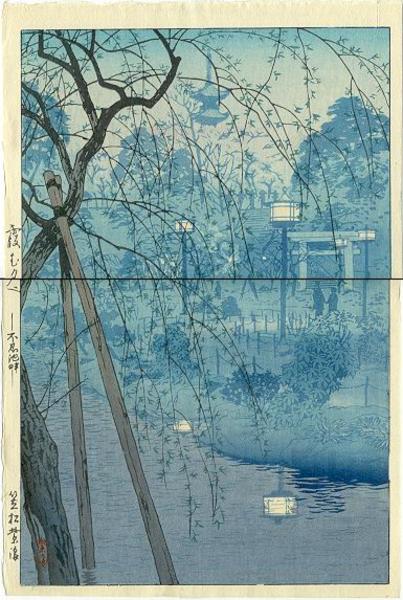
Shinobazu Pond
不忍池
5 prints
Shinobazu Pond is a natural pond on the southern edge of Ueno Park in central Tokyo, in present-day Taito Ward, formed in a low-lying area of the eastern Tokyo plain that was originally part of an inlet of Tokyo Bay before the long Holocene retreat of the bay shoreline. The pond is divided into three sections by the embankments of the Bentenjima island and the Ueno Zoo, with the central Bentenjima island connecting the lotus-covered northern section (Hasuike) to the open boat-pond southern section (Botto) and the smaller cormorant section (U no Ike) used as part of the Ueno Zoo. The small island of Bentenjima at the center of the pond is the location of the Bentendo, a small Buddhist temple dedicated to the goddess Benzaiten (one of the seven gods of fortune and associated with music, eloquence, and water), modeled on the Hogonji temple of Chikubushima island in Lake Biwa and dating in its present form from the seventeenth century within the Kan'ei-ji compound. The Bentendo was destroyed in 1945 and rebuilt in 1958. The northern section of the pond is celebrated for its summer lotus, which fills the water with broad green leaves and pink-and-white blossoms from late June through August, with the principal flowering peak in mid-July. The pond and the surrounding Ueno hill were developed across the Edo period as a popular leisure ground, with the great Kan'ei-ji temple complex established on the hill above by the priest Tenkai in 1625 and the surrounding teahouses, archery galleries, and entertainment establishments distributed along the pond. For Japanese printmaking Shinobazu Pond figures prominently in the late Edo meisho-e tradition. Utagawa Hiroshige treated the pond in his One Hundred Famous Views of Edo, including views of the Bentendo island, the cherry blossoms of the surrounding Ueno slope, and the surrounding district under varied seasonal conditions, and in his Famous Places in the Eastern Capital series, which included Shinobazu under autumn moon and other seasonal motifs. Hokusai included Shinobazu in his minor Edo prints and printed-book illustrations. The Meiji-period kaika-e treated the pond and the surrounding Ueno Park under its new identity as a Western-style public park established in 1873, with Inoue Yasuji and Kobayashi Kiyochika producing notable Shinobazu compositions, and the shin-hanga revival returned to the pond repeatedly. Kawase Hasui produced views of the Bentendo and the surrounding lotus in snow, rain, twilight, and summer conditions, with his evening lotus and snow Shinobazu sheets among the more reproduced of his Tokyo subjects, and Yoshida Hiroshi treated the pond in his individual Tokyo sheets. Onchi Koshiro and other members of the sosaku-hanga circle, including the participants in the One Hundred Views of New Tokyo project, treated the pond in their Tokyo compositions, and the postwar Tokyo sosaku-hanga circle including Sekino Junichiro and Saito Kiyoshi treated the pond in cityscape compositions. The visual character of Shinobazu in prints is built on the lotus mass of the northern section, with the broad pads and pink blossoms filling the surface, the Bentendo island with its small temple and surrounding trees set against the pond, the surrounding city and the slope of Ueno hill with the temple buildings of Kan'ei-ji and (after 1873) the Ueno museums above, and the seasonal phenomena of summer blossom, autumn migration of waterbirds, and winter snow on the bare pond surface. The lotus has functioned as one of the principal compositional motifs of Tokyo summer prints across the meisho-e and shin-hanga periods. Contemporary visitors find Shinobazu Pond at the southern edge of Ueno Park, reached most directly via the JR Yamanote Line or Tokyo Metro Hibiya Line to Ueno Station, with the Bentendo and the surrounding lotus pond preserving the principal motifs of the historical pictorial geography.

Shirakawa
白川
2 prints
Shirakawa, written 白川 and meaning white river, is a small stream that flows from the eastern foothills of Kyoto through the Higashiyama and Gion districts before joining the Kamogawa River near the Sanjo Bridge. The element shirakawa, however, also names several other significant geographic features in Japan, including the Shirakawa river in southern Fukushima Prefecture associated with the historic Shirakawa Barrier (Shirakawa no seki) on the northern edge of the Kanto plain, one of the three great barriers of ancient Japan, and the Shirakawa-go village complex in northern Gifu Prefecture, a UNESCO World Heritage Site celebrated for its steep-roofed gassho-zukuri farmhouses, but the present description focuses on the Kyoto Shirakawa stream, which is the referent most likely associated with the shin-hanga and sosaku-hanga prints in the typical Japanese print collection unless catalog records specifically indicate otherwise. The Kyoto Shirakawa runs along the northern edge of the historic Gion district through Gion Shirakawa, providing one of the most evocative streetscapes of central Kyoto, with willow trees overhanging the stone-paved stream banks, narrow stone bridges crossing at intervals including the small Tatsumi Bridge, and traditional wooden machiya facades lining the lanes. The stream is especially associated with the Gion Shirakawa subdistrict, which has been designated as a Preservation District for Groups of Traditional Buildings, preserving one of the most intact small-scale historic streetscapes of central Kyoto. The small Tatsumi Daimyojin shrine at the bend of the stream, dedicated to the kami of the geisha quarter, is a recurring motif in shin-hanga compositions of the area. For Japanese printmaking the Kyoto Shirakawa appears in the meisho-e tradition and prominently in the shin-hanga and sosaku-hanga treatments of Kyoto. Utagawa Hiroshige's Famous Views of Kyoto included the broader Gion district, and the stream and bridge passages of the Shirakawa appear in printed guidebook illustration of the late Edo period. Kawase Hasui produced celebrated views of the Shirakawa under snow, rain, and twilight conditions, with the willows and the wooden facades of the surrounding teahouses figuring as the principal motifs, and the Tatsumi Bridge appearing in several of his Gion compositions. Tsuchiya Koitsu, Asano Takeji, and Tokuriki Tomikichiro contributed further compositions of the stream and the surrounding district, with Tokuriki including the Shirakawa in his Kyoto-centered creative-print series across multiple decades. Where catalog records refer to the Shirakawa-go farmhouse village in Gifu Prefecture rather than the Kyoto Shirakawa, the visual character includes the steep thatched roofs of the gassho-zukuri houses against the surrounding mountains and seasonal snowfall, particularly in the work of postwar sosaku-hanga artists who treated the rural Hokuriku subjects. The visual character of the Kyoto Shirakawa in prints is built on the willow branches overhanging the stream with their long pendant leaves catching reflections, the dark water and stone embankments of the narrow channel, the lantern-lit machiya facades reflected in the water at night, the small humpbacked stone bridges and the Tatsumi Bridge, and the seasonal phenomena of cherry blossom along the banks in early April, autumn foliage of the surrounding maple, and the rain or snow that the shin-hanga artists especially exploited for atmospheric depth.

Sumida River
隅田川
20 prints
The Sumida River is a tidal river that flows from the Arakawa River system through the eastern part of Tokyo, defining the historic eastern edge of central Edo and emptying into Tokyo Bay near the present Tsukiji and Tsukuda districts. The river is approximately 23.5 kilometers long in its modern channel from its diversion off the Arakawa at Iwabuchi, but the lower tidal stretch through what was historically central Edo is the section most closely associated with Japanese printmaking. The principal bridges across the river within central Edo, including from north to south the Senju Ohashi, Azuma-bashi at Asakusa, Komagata-bashi, Umaya-bashi, Ryogoku-bashi, Shin-Ohashi at Atake, Eitai-bashi, and the more recent Kachidoki-bashi, anchored the geography of the eastern districts and provided the principal subjects of the river-centered meisho-e, with each bridge generating its own distinct iconography and seasonal motifs. The Sumida was the site of major Edo-period seasonal observances including the great summer firework displays at Ryogoku (the Ryogoku Hanabi, which began as a memorial in 1733 for victims of the Kyoho famine and developed into the principal summer entertainment of the city), the cherry blossom viewing along the Mukojima embankment north of Asakusa (planted with cherries by the shogun Tokugawa Yoshimune in the 1720s), and the autumn moon viewing at multiple river locations. The riverboats that plied the Sumida between Asakusa and the Yoshiwara along the Nihon-zutsumi embankment provided the principal transport to the licensed quarter and figured as a recurrent motif in bijin-e and meisho prints. For Japanese printmaking the Sumida figures throughout the meisho-e tradition and across the shin-hanga and sosaku-hanga periods. The most celebrated single sheet may be Utagawa Hiroshige's Sudden Shower over Shin-Ohashi Bridge and Atake (Ohashi atake no yudachi), from One Hundred Famous Views of Edo (1856-1858), in which figures crossing the wooden bridge are caught in a vertical curtain of rain, with the river and the opposite shore visible through the rainfall and the dark gray of the storm overhead. The print became one of the most reproduced of Hiroshige's late designs and was famously copied by Vincent van Gogh in 1887 in his Bridge in the Rain (After Hiroshige) oil painting, now in the Van Gogh Museum in Amsterdam. Other Sumida sheets in Hiroshige's series include views of the Mukojima cherry-blossom embankment, the great fireworks at Ryogoku, the Komagata-bashi bridge, the Suijin Shrine on the Mukojima, and the seasonal phenomena at multiple bridges. Hokusai treated the Sumida in passages of his Thirty-Six Views of Mount Fuji and his One Hundred Views of Mount Fuji, including the celebrated Sazaido of the Five Hundred Rakan Temple, in which figures on a temple gallery look out across the river toward Mount Fuji. The Meiji-period kaika-e of Kobayashi Kiyochika, who lived along the river in the Honjo district, recorded the modernized embankments and the new iron bridges in some of his most celebrated night and twilight compositions, with the lights of factories and steamships reflecting in the river. The shin-hanga revival returned to the Sumida repeatedly, with Kawase Hasui producing rain and snow views of the bridges and the surrounding river district, and the One Hundred Views of New Tokyo (Shin Tokyo hyakkei) project of 1928-1932 treating the post-earthquake river in multiple compositions. The visual character of the Sumida in prints is built on the curving bridges of varying types from wood-railed Edo construction to Meiji iron and reinforced concrete, the boats and ferries on the water from cargo lighters to pleasure boats, the dense settlement of the riverbank districts, the cherry blossoms of Mukojima in spring and the fireworks at Ryogoku in summer, the autumn moon and migrating waterfowl, and the seasonal phenomena of rain, mist, and snow that the printmakers especially exploited. The river's broad sweep through the eastern city provided one of the principal organizing motifs of Edo and Tokyo cityscape. Contemporary visitors find the Sumida River along its principal Tokyo course from Asakusa south through Ryogoku and the bridges of the eastern district, with the Sumidagawa cruise boats (suijo bus) running between Asakusa, Hama-rikyu Gardens, and Odaiba and the riverside walking paths preserving access to the historical pictorial geography.

Taj Mahal
タージ・マハル
4 prints
The Taj Mahal is a marble mausoleum in Agra, on the south bank of the Yamuna River in Uttar Pradesh in north-central India, constructed between 1632 and 1653 by the Mughal emperor Shah Jahan as the tomb for his wife Mumtaz Mahal, who died in childbirth in 1631. The complex includes the central marble mausoleum on a raised platform, four flanking minarets each approximately 40 meters tall and inclined slightly outward so that they would fall away from the central building in an earthquake, a great gateway (darwaza-i-rauza), a mosque in red sandstone west of the mausoleum and a symmetrical answering jamaat hall (or mihman khana) to the east, and the formal char-bagh garden of paths and water channels extending south from the platform in the classical Persian-Islamic quadripartite garden tradition. The mausoleum itself is constructed of white Makrana marble inlaid with semiprecious stones in floral and calligraphic designs (the inlay technique known as pietra dura or parchin kari), with twenty-eight different varieties of precious and semiprecious stones used in the inlays, and is considered one of the architectural masterpieces of the Islamic world and one of the finest expressions of Mughal architecture in its mature seventeenth-century form. The principal architect of the project is generally identified as Ustad Ahmad Lahauri. The complex was largely complete by 1653, with subsequent additions, restorations, and modifications across the Mughal and British colonial periods including the modifications to the gardens under Lord Curzon in the early twentieth century. The Taj Mahal was designated a UNESCO World Heritage Site in 1983. For Japanese printmaking the Taj Mahal appears as one of the South Asian subjects of Yoshida Hiroshi's 1931-1932 India series. Yoshida visited Agra during his 1930-1931 South Asian travel, which also took him to Benares, Sanchi, Ajanta, Darjeeling, and other Indian sites, and from those observations he produced several compositions of the mausoleum, including views of the building from across the Yamuna River, views through the great gateway, views of the mausoleum from within the char-bagh garden, and dawn, daylight, and evening atmospheric treatments. The Taj prints are issued through Yoshida's own studio in Tokyo in the years following the trip and constitute, with the Benares, Sanchi, and Ajanta sheets, the principal Indian works in his international landscape series. The Taj Mahal series exemplifies Yoshida's distinctive shin-hanga practice of variant impressions, in which the same design is printed under varied light and color combinations to produce dawn, morning, midday, evening, and moonlight versions of a single composition, generally from the same key blocks with different color block applications, allowing the viewer to apprehend the building's relationship to changing light without changing the underlying composition. The visual character of the Taj Mahal in Yoshida's prints is built on the symmetrical white marble silhouette of the mausoleum and the four minarets against the sky, with the central dome flanked by the four smaller chhatri kiosks at the corners of the main platform, the reflection in the still water of the char-bagh canals or the Yamuna River, the diffused atmospheric light, and frequently the small figures of visitors or attendants providing scale and human reference. The site is today managed as a UNESCO World Heritage Site under the Archaeological Survey of India, and Agra serves as the principal access point for visitors, reached by train from Delhi in approximately three hours along the Agra Cantonment line.

Teradomari
寺泊
1 print
Teradomari is a coastal town on the Sea of Japan in Niigata Prefecture in central Honshu, situated approximately fifty kilometers southwest of the city of Niigata on the historic Hokuriku coastal road. The town is now administratively part of the city of Nagaoka after a 2006 municipal merger, but it has retained its identity as a distinct coastal community. Teradomari developed across the medieval and Edo periods as a port on the Sea of Japan, with traffic to the small offshore island of Sado (which lies approximately 33 kilometers offshore) and to other Hokuriku ports across the relatively narrow strait separating the two. Teradomari is associated with the medieval Buddhist priest Nichiren, founder of the Nichiren sect, who departed from Teradomari in October 1271 on his exile to Sado Island following his persecution by the Kamakura shogunate, and several local temples preserve the tradition of his stay at the port before the crossing, with Myoho-ji temple commemorating the event. The town is celebrated for its surviving fishing port, its hot springs (Teradomari Onsen), the seasonal Sea of Japan storms that produce dramatic surf along the rocky northern coast and Sea of Japan winds (uminari), and the seasonal cherry blossom along the surrounding river valleys. The Iwafune Shrine north of the town is associated with maritime safety traditions. For Japanese printmaking Teradomari is most prominently associated with Kawase Hasui, who treated the town in several distinctive shin-hanga compositions including the celebrated Snow at Teradomari (Teradomari yuki), in which the snow-covered coastal road, the wooden houses of the harbor, and the dark Sea of Japan converge in one of his most atmospheric night-and-winter sheets, generally counted among the finest of his Sea of Japan-coast Niigata subjects. Teradomari appears in Hasui's travel-based Hokuriku and Sea of Japan compositions, alongside his other Niigata, Toyama, Ishikawa, and Akita subjects, and the town exemplifies the kind of regional fishing-port subject that Hasui returned to repeatedly across his career. Hasui's visits to the Sea of Japan coast in the 1930s and after the war produced the principal modern shin-hanga record of these small communities. Other shin-hanga and sosaku-hanga artists treated the broader Niigata coast in the same period, with Hashiguchi Goyo, Yoshida Hiroshi, and Tsuchiya Koitsu producing occasional Niigata subjects and the postwar Niigata regional sosaku-hanga circle producing further work. The visual character of Teradomari in Hasui's prints is built on the snow-covered or rain-soaked coastal road running along the shore, the dark wooden facades of the harbor houses with their low eaves and snow-protection boards, the silhouettes of fishing boats and harbor works pulled up on the beach in the winter off-season, the rolling silver-and-gray water of the Sea of Japan at the edge of the composition, and frequently the lantern light spilling from windows into the snow or rain. The diffused gray light and heavy snowfall characteristic of the Sea of Japan winter (yukiguni or snow country) provide the principal atmospheric register. Contemporary visitors reach Teradomari via the JR Echigo Line from Niigata, with the small surviving harbor district, the surrounding coastal road, the Teradomari Aquamarine (Marine Pia Nihonkai) facility, and the daily fishing port (Ame Ichi market) preserving access to the pictorial geography of Hasui's prints.

Tokyo
東京
248 prints
Tokyo, the present-day capital of Japan, occupies the alluvial plain at the mouth of the Sumida River on the western shore of Tokyo Bay, in the Kanto region of central Honshu. From its founding as the Tokugawa shogunal seat in 1603 the city was known as Edo, and the present name Tokyo, written with characters meaning eastern capital, was adopted only after the Meiji Restoration of 1868, when the emperor relocated from Kyoto and the city was redesignated as the political center of a newly modernizing state. For Japanese printmaking the city is foundational. The ukiyo-e tradition itself emerged in the pleasure quarters and theaters of seventeenth- and eighteenth-century Edo, with publishers concentrated in the Nihonbashi district producing the bijinga, yakusha-e, and meisho-e that defined the school. Hishikawa Moronobu, Suzuki Harunobu, Torii Kiyonaga, Kitagawa Utamaro, Toshusai Sharaku, Katsushika Hokusai, and Utagawa Hiroshige all worked within the network of Edo publishers, carvers, and printers, including Tsutaya Juzaburo, Nishimuraya Yohachi, Iseya Sanjiro, and Uoya Eikichi, that gave the city its primary association with the woodblock medium. The meisho-e tradition for Edo is anchored by Hiroshige's One Hundred Famous Views of Edo (Meisho Edo hyakkei, 1856-1858), a 119-sheet vertical-format series issued by Uoya Eikichi in which districts as varied as Yoshiwara, Atake, Suruga-cho, Asakusa, Mannen Bridge, Surugadai, and the seasonal phenomena of cherry blossom and snowfall received individual sheets, and by his earlier Famous Places in the Eastern Capital (Toto meisho) series of the late 1830s, his Eight Views of Edo, and his Edo Suburb Names. Hokusai's Thirty-Six Views of Mount Fuji (c. 1830-1832) included Edo locations such as Nihonbashi, Surugadai, Senju, and the Mannen Bridge from which the distant mountain could be observed, embedding the city into the iconography of the great volcano. Tomioka Eisen, Kitao Shigemasa, and other later eighteenth-century artists produced bijin-e set in specific Edo neighborhoods, and the Utagawa school under Toyokuni I, Kunisada, and Kuniyoshi produced extensive theatrical, historical, and meisho prints anchored in the city. After the renaming to Tokyo, the Meiji-period kaika-e (enlightenment pictures) of artists including Utagawa Hiroshige III, Hashimoto Chikanobu, Inoue Yasuji, and Kobayashi Kiyochika recorded the city's transformation under gas lamps, brick buildings, horse-drawn streetcars, and rail lines, and the shin-hanga revival of the 1910s through 1930s returned to the metropolis in series such as Kawase Hasui's Twenty Views of Tokyo (Tokyo nijukkei, begun 1925) and Souvenirs of Travel (Tabi miyage), Yoshida Hiroshi's discrete Tokyo subjects, and Tsuchiya Koitsu's evening and night views. The sosaku-hanga response was equally consequential. The 1928-1932 collaborative project One Hundred Views of New Tokyo (Shin Tokyo hyakkei), coordinated by Onchi Koshiro and Nakajima Jutaro and drawing on eight creative-print artists including Onchi, Hiratsuka Un'ichi, Maekawa Senpan, Fukazawa Sakuichi, Suwa Kanenori, Henmi Takashi, Kawakami Sumio, and Fujimori Shizuo, made the rebuilt post-earthquake city its primary subject and remains one of the central statements of late-Taisho and early-Showa printmaking. The visual character of Tokyo across these centuries is bound up with specific recurring motifs, including the curving span of Nihonbashi at the city's mercantile heart, the Sumida and its bridges, the gates and lanterns of Asakusa, the pond of Shinobazu beneath Ueno hill, the Akasaka and Marunouchi government quarters, the Yoshiwara quarter north of Asakusa, and after 1923 the new boulevards, ferroconcrete office blocks, and elevated railways of the reconstructed metropolis. Specific districts treated in this database under their own entries include Asakusa, Ginza, Nihonbashi, Shiba, Shinobazu Pond, Ueno, Yanaka, and the Sumida River, each contributing to the larger Edo and Tokyo iconography. Modern visitors find the historical neighborhoods of Asakusa, Yanaka, Nihonbashi, and Ueno still legible in fragments preserved between layers of postwar redevelopment, and the major print collections of the Edo-Tokyo Museum, the Ota Memorial Museum of Art in Harajuku, the Tokyo National Museum in Ueno, and the Sumida Hokusai Museum hold the canonical impressions of the prints that shaped how the world has seen this city.
Tsuta Onsen
蔦温泉
1 print
Tsuta Onsen is a hot spring resort in the Towada-Hachimantai National Park in southwestern Aomori Prefecture in the Tohoku region of northern Honshu, situated in the wooded mountains north of Lake Towada at an elevation of approximately 450 meters above sea level. The principal lodging at the site, the Tsuta Onsen Ryokan, traces its founding to the late ninth century according to local tradition, with the founder said to have been the wandering monk Jikaku Daishi Ennin, and the present main building dates principally to 1909 with subsequent additions, making it one of the oldest continuously operating onsen lodgings in the Tohoku region. The ryokan is celebrated for the Kyu-honkan (Old Main Building), a multi-story wooden structure with the traditional internal hot spring bath fed directly by the spring rising beneath the bathing floor (the so-called ashimoto wakidashi or under-foot bubbling tradition characteristic of the highest-grade Japanese onsen lodgings). The surrounding district is celebrated for the Tsuta Numa, a small lake among a chain of seven lakes (the Tsuta Shichinuma) set in beech and oak forest at the foot of the surrounding mountains, and for the brilliant autumn foliage that draws visitors in October and November. The site is geologically associated with the wider Hakkoda mountain volcanic system, and the hot springs derive from the geothermal activity of the underlying volcanic terrain. The Tsuta Shichinuma walking trail circulates among the seven small lakes through the surrounding beech forest and is one of the principal autumn destinations of the Towada-Hachimantai region. For Japanese printmaking Tsuta Onsen is most prominently associated with Kawase Hasui, who visited the site in 1933 (his second visit to the broader Towada region) and produced one of the most celebrated single shin-hanga sheets of the Tohoku region, Tsuta Lake (Tsuta no numa) issued by Watanabe Shozaburo, depicting the still water of the small lake against the surrounding autumn forest and rising mist, with the diffused light of the autumn dawn producing one of the most thoroughly atmospheric of Hasui's mountain-lake subjects. The sheet is among the most heavily reproduced of Hasui's Tohoku subjects and is held in major collections worldwide including the Honolulu Museum of Art, the Art Institute of Chicago, the British Museum, and the Museum of Fine Arts Boston. Other shin-hanga and sosaku-hanga artists treated the surrounding Towada-Hachimantai region, but Tsuta Numa is preeminently a Hasui subject, with his composition becoming the canonical visual reference for the lake. The visual character of Tsuta Onsen and Tsuta Numa in prints is built on the still surface of the small lake against the surrounding wooded slope, the autumn maple and beech foliage reflected in the water in stages from green through yellow to deep red, the diffused mist of the autumn dawn or evening, and frequently the silhouette of the surrounding mountains rising into the distance. The autumn reflection imagery is central to the iconography of the site. Contemporary visitors reach Tsuta Onsen via the rural prefectural roads north of Lake Towada from JR Aomori or Hachinohe Station, with the historic ryokan continuing to operate as a working onsen inn (it remains one of the most distinguished traditional onsen lodgings in the country) and the surrounding lakes accessible via a walking circuit of approximately one to two hours through the surrounding beech forest.
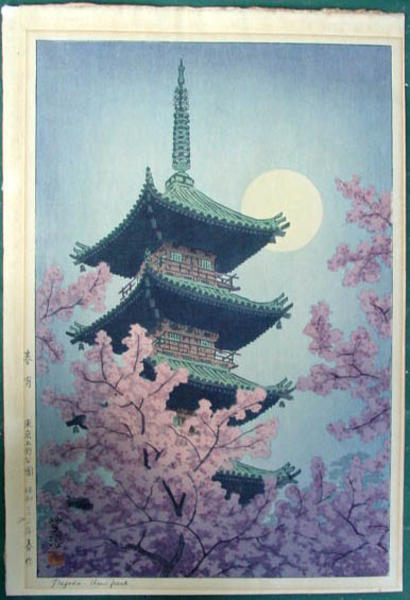
Ueno
上野
39 prints
Ueno is a district in northeastern Tokyo, in present-day Taito Ward, organized around the elevated wooded hill of Ueno-no-Yama on which the great Kan'ei-ji temple complex was established in 1625. The temple was founded by the priest Tenkai at the direction of the Tokugawa shogunate to provide a guardian temple for the northeastern, traditionally inauspicious, kimon (demon gate) direction of Edo, mirroring the role of the Enryaku-ji on Mount Hiei as the guardian temple of the northeastern direction of the older capital at Kyoto. Tenkai modeled the layout of Ueno on the Mount Hiei monastic geography, with the principal halls distributed across the hill and the small Bentendo island on Shinobazu Pond at the southern edge of the temple grounds modeled on the Chikubushima island in Lake Biwa. Across the Edo period the temple complex grew to be one of the largest in eastern Japan, with the Kiyomizu-do (modeled on the Kiyomizu-dera of Kyoto), the Bentendo, the five-story pagoda, the Toshogu shrine of the Tokugawa, and the great main hall distributed across the wooded hill, and with the surrounding Shinobazu Pond, treated under its own entry, forming the southern edge of the temple grounds. Kan'ei-ji also served as the funerary temple for six of the Tokugawa shoguns, alongside Zojo-ji at Shiba. The temple complex was largely destroyed in the Battle of Ueno during the Boshin War on 4 July 1868, when the Shogitai loyalist forces, the last organized Tokugawa resistance in central Edo, were defeated by the new Meiji government forces under Omura Masujiro, and most of the surviving land was redeveloped in 1873 as Ueno Park, the first Western-style public park in Japan, designed by the Dutch military doctor and urban planner Bauduin and inaugurated as part of the early Meiji program of secularizing temple land and creating modern public spaces. Ueno Park houses the Tokyo National Museum (founded 1872 as Japan's first museum), the Tokyo Metropolitan Art Museum (founded 1926), the Tokyo University of the Arts, the National Museum of Western Art (designed by Le Corbusier and inaugurated 1959, now a UNESCO World Heritage Site), the National Science Museum, and the Ueno Zoo (founded 1882 as Japan's first public zoo). The remaining historical buildings include the Toshogu shrine of the Tokugawa (rebuilt 1651), the surviving Kiyomizu-do (rebuilt 1631) and Bentendo, and the five-story pagoda (rebuilt 1639). The cherry blossoms of Ueno Park, planted from the Edo period when Tenkai brought cherries from Yoshino, have been celebrated since that period and remain one of the principal hanami sites in Tokyo. For Japanese printmaking Ueno figures across the entire meisho-e tradition. Utagawa Hiroshige treated Ueno in his Famous Places in the Eastern Capital and in One Hundred Famous Views of Edo, including views of the Kiyomizu-do, the Toshogu shrine, the cherry blossoms of the Ueno slope, the great main hall of Kan'ei-ji, the Shinobazu Pond, and the surrounding district under varied conditions. Hokusai included Ueno in passages of his Thirty-Six Views of Mount Fuji and his minor Edo print sets. Meiji-period kaika-e treated the new park and its Western-style buildings under the changing nineteenth-century conditions, and the shin-hanga revival of the early twentieth century returned to Ueno repeatedly. Kawase Hasui produced views of the Kiyomizu-do, the pagoda, the Toshogu, and the surrounding park under varied seasonal and atmospheric conditions including snow, rain, and twilight, with his Ueno cherry blossom and snow sheets among the more reproduced of his Tokyo subjects. Yoshida Hiroshi treated the park in his individual sheets, and the sosaku-hanga circle including Onchi Koshiro and Hiratsuka Un'ichi contributed further compositions of the temple buildings, the park, and the surrounding district within the One Hundred Views of New Tokyo and other Tokyo cycles. The visual character of Ueno in prints is built on the cherry blossoms of the park slope along the principal Sanbashi avenue, the temple roofs and pagoda rising among the trees, the Kiyomizu-do veranda on its elevated platform overlooking the Shinobazu, the Toshogu approach and stone lanterns, and the seasonal phenomena of snow, rain, twilight, and the autumn foliage of the park's gingko avenues. Contemporary Ueno remains one of the principal cultural districts of Tokyo, with the museums, the park, the surrounding Ameya-Yokocho (Ameyoko) shotengai, and the connecting Yamanote, Ginza, Hibiya, and other rail lines making it a heavily visited central district, reached most directly via JR Ueno Station or the Tokyo Metro Ueno Station.
Yanaka
谷中
0 prints
Yanaka is a district in northeastern Tokyo, occupying the slope between Ueno Park and Nippori Station within present-day Taito Ward. The neighborhood originated as a temple town established along the western edge of Edo in the seventeenth century, when the Tokugawa shogunate concentrated a large number of Buddhist temples in the area as part of the broader policy of organizing religious institutions on the outer rings of the city and creating buffer zones of low fire-risk wooden temple architecture between dense urban districts. The result is one of the densest concentrations of historic temple architecture in central Tokyo, with more than seventy temples within a small radius, including Tennoji at the center of the district, the extensive Yanaka cemetery on the elevated ground above the Yamanote railway, the Jomyoin, the Kannon-ji, and a scattering of smaller institutions distributed along the narrow lanes. The Yanaka cemetery, originally part of the Tennoji grounds before being secularized in 1874, is the burial ground of the last Tokugawa shogun Yoshinobu, the painter Yokoyama Taikan, the novelist Natsume Soseki's family, and many other Meiji-period cultural figures. Because Yanaka largely escaped both the fires of the late Edo period and the destruction of the 1923 Great Kanto Earthquake and the firebombing of 1944-1945, it preserves more of the low-rise wooden urban fabric of pre-war Tokyo than almost any other district in the city, with traditional shotengai (covered shopping streets), wooden houses, sento bathhouses, and small temple gardens distributed across the area. For Japanese printmaking, Yanaka appears in late Edo-period meisho-e of the temple precincts and the cherry trees of Tennoji, with Utagawa Hiroshige treating the area in his Famous Places in the Eastern Capital and one of his Edo views, and Hokusai depicting Tennoji in passages of his minor Edo prints. The district appears more prominently in the work of shin-hanga and sosaku-hanga artists during the twentieth century. Kawase Hasui produced winter and twilight views of the district within his Tokyo sets, and Onchi Koshiro and other members of the Tokyo creative-print circle treated the neighborhood as part of their engagement with the surviving older quarters of the modernizing capital. Hiratsuka Un'ichi, a long-time resident of the surrounding Negishi area, treated temple architecture from Yanaka and the surrounding Negishi and Sendagi neighborhoods across his career, and the postwar Tokyo sosaku-hanga circle including Sekino Junichiro and Saito Kiyoshi treated Yanaka subjects in their cityscape practice. The visual character of Yanaka in prints is built on temple roofs and pagoda silhouettes against the sky, gravestones, narrow lanes, wooden houses, the bell tower of Tennoji, blooming cherry and plum trees in the cemetery, persimmon trees in small gardens, and the slope down toward the Yanaka Ginza shotengai. The neighborhood is associated in modern Japanese cultural memory with the surviving register of shitamachi (low-city) artisan and middle-class neighborhood life that has otherwise been largely effaced from central Tokyo. Contemporary visitors find Yanaka still legible as an Edo and early-Tokyo neighborhood, with the temple-and-cemetery district remaining one of the principal historical walking areas in central Tokyo, reached most directly from JR Nippori Station or the Sendagi station of the Tokyo Metro Chiyoda Line, and with the SCAI The Bathhouse contemporary art gallery occupying a converted Edo-period sento that signals the district's distinctive integration of historical fabric with present-day cultural use.
Yokohama
横浜
8 prints
Yokohama is a city on the western shore of Tokyo Bay, the principal city of Kanagawa Prefecture and the second largest city in Japan by population. The city was a small fishing village called Yokohama-mura across the Edo period, with approximately one hundred families, but it was selected in 1858-1859 as the principal foreign treaty port for the Kanto region under the Ansei Treaties (the Japan-United States Treaty of Amity and Commerce of 1858 being the principal document), opening formally on 1 July 1859, and across the subsequent decades it grew rapidly as the principal point of foreign mercantile activity in eastern Japan. The selection of Yokohama, on a fishing-village site adjacent to the larger town of Kanagawa-juku on the Tokaido, was made by the Tokugawa shogunate as a strategy to physically separate the foreign settlement from the existing Japanese town and from the principal east-west traffic on the Tokaido. The original foreign settlement was concentrated in the Kannai district along the harbor, with the Yamate (Bluff) hill to the south occupied by Western-style residences and consulates, and the surrounding districts developing rapidly as a working port and industrial city. Yokohama was one of the principal sources of Yokohama-e, a category of late Edo and early Meiji prints depicting foreigners, foreign ships, foreign architecture, and foreign customs as observed in the new treaty port. The Yokohama-e genre flourished from approximately 1860 to 1880, with Utagawa Yoshikazu, Utagawa Hiroshige III (also known as Andokichi or Shigemasa), Utagawa Yoshitora, Hashimoto Sadahide, Utagawa Yoshitoshi, and Tsukioka Yoshitoshi all producing notable Yokohama subjects. The prints functioned both as documentary records of the new foreign presence and as objects of curiosity for Japanese viewers nationwide, who could see images of Western ships, locomotives, soldiers in uniform, the dress and customs of the foreigners, and exotic foreign animals such as elephants and giraffes only through these woodblock sheets. Hashimoto Sadahide's eight-sheet Yokohama Trade Picture (Yokohama Kaiko Kenmon Shi) of 1862 stands as one of the most ambitious treatments of the new port. Yokohama was substantially destroyed in the 1923 Great Kanto Earthquake, which leveled most of the original Yokohama-e era foreign settlement, and again in the air raids of 1945, with the original Yokohama-e era settlement preserved only in fragments in the present Motomachi and Kannai districts. For Japanese printmaking Yokohama is significant both as the subject of the Yokohama-e genre and as a subject of the later shin-hanga and sosaku-hanga periods. Kawase Hasui produced harbor and city views of Yokohama in his Tokyo-area compositions, and the One Hundred Views of New Tokyo project of 1928-1932 treated Yokohama subjects within its broader survey of the modernizing metropolitan region. The Meiji-period kaika-e of Kobayashi Kiyochika treated Yokohama subjects in his early career. The visual character of Yokohama in prints is built on the harbor with its ships and warehouses, the brick and stone Western-style buildings of the central district, the foreign costume and dress of the original Yokohama-e prints, the wide variety of foreign nationals depicted (including American, British, French, Dutch, Russian, and Chinese figures), the exotic animals brought into the harbor for foreign menageries, and the seasonal and atmospheric phenomena of the maritime climate. The Yokohama-e prints typically arrange foreign subjects in heavily ornamented bordered designs distinct from the conventional Edo print format, often with extensive printed text describing the customs being depicted. Contemporary Yokohama preserves significant portions of the Motomachi shopping street, the Yamate foreign residences (a number of which operate as historical house museums), the Yokohama Customs House, the Aka Renga (Red Brick Warehouse) district, and the surrounding Minato Mirai harbor district as the principal pictorial heritage of the city, with the Kanagawa Prefectural Museum of Cultural History holding significant Yokohama-e collections.
Zojoji Temple
増上寺
4 prints
Zojo-ji is a Buddhist temple in the Shiba district of central Tokyo, in present-day Minato Ward, the head temple of the Jodo Pure Land Buddhist sect for eastern Japan. The temple was founded in 1393 in a different location near the present Kojimachi by the priest Yuyo Shoso as a teaching seminary, and was relocated to its present site in 1598 at the order of the first Tokugawa shogun, Tokugawa Ieyasu, as part of the broader Tokugawa program of organizing temples within the Edo urban plan and assigning Buddhist institutions to specific functions within the new shogunal capital. Across the Edo period, Zojo-ji served as one of the two principal funerary temples of the Tokugawa shogunal family (alongside Kan'ei-ji at Ueno), with six shogunal mausolea constructed in its precincts for the second shogun Hidetada, the sixth Ienobu, the seventh Ietsugu, the ninth Ieshige, the twelfth Ieyoshi, and the fourteenth Iemochi, and with extensive supporting halls, gates, and subsidiary structures sustained by ongoing Tokugawa patronage. The principal surviving structure from the Edo period is the great Sanmon main gate (Sangedatsu-mon), dating from 1622 and standing approximately 21 meters high and 19 meters wide, one of the largest wooden gates of the Edo period to survive in central Tokyo, the temple's main hall and most subsidiary structures having been destroyed in the air raids of 10 March 1945 and rebuilt in the postwar period from the 1950s onward. The shogunal mausolea were largely destroyed in 1945, with only fragments preserved. The temple is also distinguished by the presence of Tokyo Tower, the 333-meter steel-lattice broadcasting tower designed by Naito Tachu and completed in 1958, which rises directly behind the temple compound and which has become a recurrent secondary motif in modern depictions of Zojo-ji. The Daimon (Great Gate) at the southwestern entrance to the temple precincts (now rebuilt in concrete) and the surrounding Shiba Park (founded 1873 as one of the first public parks of Tokyo) form the larger ceremonial approach to the temple. For Japanese printmaking Zojo-ji and the surrounding Shiba district figure prominently across the meisho-e tradition. The temple is treated in Utagawa Hiroshige's One Hundred Famous Views of Edo, his Famous Places in the Eastern Capital, and individual sheets, including the celebrated Zojo-ji Pagoda and Akabane in which the temple pagoda is seen across the snow-covered Akabane bridge, and Hokusai included Shiba in his Thirty-Six Views of Mount Fuji. The Meiji-period kaika-e treated the surrounding district under the modernizing conditions of the late nineteenth century. The shin-hanga revival of the early twentieth century returned to Zojo-ji repeatedly, with Kawase Hasui producing some of the most celebrated of all shin-hanga prints in his snow, rain, and twilight views of the Sanmon gate. The principal Hasui Zojo-ji sheets include Snow at Zojo-ji (Yuki no Shiba Zojoji, 1925, issued by Watanabe Shozaburo) in which a single solitary figure in a black coat carries a red umbrella against the great gate under heavy falling snow, Spring Evening at Zojo-ji (Haru no yu Zojoji, 1925) in which the temple appears under a soft spring twilight with cherry blossoms in the foreground, and later compositions through the 1930s and into the postwar period in which the Tokyo Tower appears in the background as a marker of the changed urban context. These designs became some of the most heavily reproduced of all twentieth-century Japanese prints, with Snow at Zojo-ji in particular entering the international visual canon of Tokyo and serving as one of the most recognizable single images of the modern Japanese print tradition. Tsuchiya Koitsu produced his own night and snow views of the Sanmon gate, Asano Takeji contributed Zojo-ji compositions, and the postwar sosaku-hanga circle treated the temple in various register. The visual character of Zojo-ji in prints is built on the great red Sanmon gate against the surrounding park and sky, the falling snow or rain over the gate and approach providing the principal atmospheric motif, the small foreground figures of pilgrims or the signature single umbrella-bearing walker of the Hasui compositions, the surrounding cherry blossoms in spring, the autumn maple in November, and after 1958 the silhouette of Tokyo Tower behind the temple roofs, with the contrast between the historic temple architecture and the modern broadcasting tower providing one of the most legible compositional motifs of postwar Tokyo. Contemporary visitors approach Zojo-ji via the Toei Mita Line to Onarimon Station, the Toei Oedo Line to Daimon Station, or the JR Yamanote Line to Hamamatsucho Station, with the Sanmon, the rebuilt main hall, the surrounding Shiba Park, and Tokyo Tower forming the contemporary pictorial landscape of the historical temple.