Biography
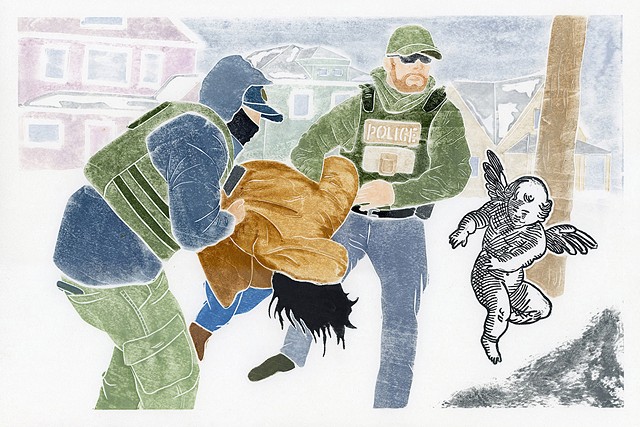
Annie Bissett is an American mokuhanga printmaker based in Northampton, Massachusetts, whose politically charged and narratively driven woodblock prints have made her one of the most distinctive voices in the contemporary mokuhanga movement. A mostly self-taught artist, Bissett began her art career as a freelance digital illustrator, working with major clients including National Geographic Society, The Wall Street Journal, Time-Life Publications, and numerous magazines before turning to printmaking.
Bissett's introduction to mokuhanga came in 2005 when she studied briefly with New Hampshire woodblock artist Matt Brown. The experience proved transformative, and she quickly devoted herself to the centuries-old Japanese technique of water-based woodblock printing, which uses waterborne pigments, brushes instead of rollers, and a hand-held baren instead of a mechanical press. What distinguishes Bissett's work within the mokuhanga community is her unflinching engagement with political and social themes -- she explores the visual symbols and verbal cliches associated with various belief systems, from the religious to the political to the economic.
Her most acclaimed series demonstrate this commitment to political commentary through the traditional Japanese medium. The 'Secret Codewords of the NSA' series examines government surveillance through the lens of declassified code names, while 'Playing with Fire' addresses themes of political power and its consequences. 'Relieved of Duty' and '48 Days' tackle questions of accountability in public institutions. Her 'Intercessors' series explores figures who intervene between ordinary people and the forces that shape their lives, and her more recent 'Guardians' series continues this investigation of protective and watchful figures. Her prints have been included in the Biennale Internationale d'Estampe Contemporaine de Trois-Rivieres in Quebec, most recently in its 2025 edition.
Bissett's technical mastery has earned her a position as a leading educator in the field. She teaches mokuhanga at Zea Mays Printmaking in Florence, Massachusetts. Her work is held in the permanent collections of the New York Public Library, Boston Public Library, Portland Museum of Art, and Hood Museum of Art at Dartmouth College. Solo exhibitions include 'Playing with Fire' (2018) at Oxbow Gallery in Northampton, 'Past/Present/Now' (2016) at Charles Krause Reporting in Washington DC, and 'I Was a 20th Century Lesbian' (2015) at Hosmer Gallery in Northampton. She also took part in the exhibition of the International Mokuhanga Conference in Kyoto in 2011.
Key Facts
- Active Period
- 1954
- Nationality
- 🇺🇸United States
- Movement
- Contemporary Mokuhanga
Frequently Asked Questions
Annie Bissett is an American mokuhanga printmaker based in Northampton, Massachusetts, whose politically charged and narratively driven woodblock prints have made her one of the most distinctive voices in the contemporary mokuhanga movement. A mostly self-taught artist, Bissett began her art career as a freelance digital illustrator, working with major clients including National Geographic Society, The Wall Street Journal, Time-Life Publications, and numerous magazines before turning to printmaking.
Annie Bissett was active born in 1954. They were associated with the Contemporary Mokuhanga movement.
Annie Bissett's work was shaped by the Contemporary Mokuhanga tradition in Japanese woodblock printmaking. Contemporary Mokuhanga: Contemporary mokuhanga (literally "wood-block print") encompasses artists working from approximately 1970 to the present who continue or reinvent traditional Japanese woodblock printing techniques.