Biography
Colin Harvey is a British mokuhanga artist based in England who works with the traditional Japanese technique of water-based woodblock printing. His practice contributes to the growing community of mokuhanga practitioners in the United Kingdom, a country with deep printmaking traditions of its own that have provided fertile ground for the adoption of Japanese water-based methods.
Britain has a particularly rich history of engagement with Japanese art and culture, dating back to the Victorian-era enthusiasm for japonisme that influenced artists from Whistler to the Arts and Crafts movement. The contemporary British mokuhanga community builds on this historical connection while approaching the technique on its own terms, as a living practice rather than a historical curiosity. Harvey's work is part of this tradition of thoughtful cultural exchange.
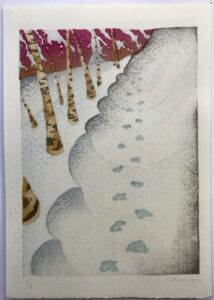
Harvey participated in the 2024 International Mokuhanga Conference held in Echizen, Japan, where his print 'birch and wind scoop', made with the mokuhanga technique on Awagami washi, was shown in the conference's juried international exhibition among the works grouped from Europe. The IMC in Echizen brought together mokuhanga practitioners from around the world in a region celebrated for its centuries-old papermaking traditions. Echizen, in Fukui Prefecture, has produced washi for over 1,500 years, and the conference's location connected contemporary printmakers with the living craft traditions that supply the essential materials of their practice.
The juried exhibition at the 2024 IMC presented work by mokuhanga artists from around the world, organized into regional groupings, and it demonstrated how widely the water-based woodblock technique has been adopted by printmakers well beyond Japan. Harvey's inclusion reflects the continuing strength of mokuhanga practice in the United Kingdom.
Harvey's work with mokuhanga engages with the specific qualities that distinguish water-based printing from oil-based methods: the translucency of color, the integration of image and paper surface, the responsiveness of the process to humidity and hand pressure, and the quiet luminosity that results from pigments absorbed into rather than deposited onto the paper fibers. These characteristics give mokuhanga prints a contemplative quality that many artists find essential to their expressive aims.
England's printmaking scene provides a supportive environment for mokuhanga practice, with organizations, galleries, and educational institutions that recognize water-based woodblock printing as a valuable addition to the national printmaking tradition. The country's long history of artistic exchange with Japan, from the Arts and Crafts movement's admiration for Japanese design to contemporary artist residency programs, creates a cultural context in which Harvey's cross-cultural practice finds both understanding and appreciation. His participation in the 2024 IMC further strengthens these international connections.
Key Facts
- Nationality
- 🇬🇧United Kingdom
- Movement
- Contemporary Mokuhanga
- Works Indexed
- 1
Frequently Asked Questions
Colin Harvey is a British mokuhanga artist based in England who works with the traditional Japanese technique of water-based woodblock printing. His practice contributes to the growing community of mokuhanga practitioners in the United Kingdom, a country with deep printmaking traditions of its own that have provided fertile ground for the adoption of Japanese water-based methods.
Colin Harvey's work was shaped by the Contemporary Mokuhanga tradition in Japanese woodblock printmaking. Contemporary Mokuhanga: Contemporary mokuhanga (literally "wood-block print") encompasses artists working from approximately 1970 to the present who continue or reinvent traditional Japanese woodblock printing techniques.