Biography
Deidre Vaill is an Australian mokuhanga artist whose work in water-based woodblock printing contributes to the growing community of practitioners in the Oceania region. Based in Australia, she has participated in international exhibitions that showcase the global reach of contemporary mokuhanga practice.
Vaill exhibited in the Oceania regional exhibition at the 2024 International Mokuhanga Conference in Echizen, Japan. The IMC is the primary international gathering for water-based woodblock printmakers, organized approximately every three years by the International Mokuhanga Association. The 2024 conference in Echizen was the fifth in the series, and its regional exhibition structure -- with separate exhibitions for the Americas, Europe, Asia, and Oceania -- reflected the truly global scope that mokuhanga practice has achieved since the first conference in 2011.
The Oceania exhibition represented artists from Australia and New Zealand, demonstrating that mokuhanga has developed a substantial presence in the Southern Hemisphere. Australian printmakers have been among the most active non-Japanese participants in the international mokuhanga community, drawn to the technique for reasons that range from its environmental friendliness to its unique aesthetic possibilities to its capacity for capturing the subtle atmospheric qualities of Southern Hemisphere light and landscape.
Australia's engagement with Japanese art and culture has deep roots, supported by geographic proximity across the Pacific and by decades of cultural exchange programs, educational partnerships, and artist residencies. The country's printmaking community is well-established, with strong programs at universities and art schools across the continent, and the adoption of mokuhanga has enriched this existing tradition with new technical possibilities and cultural connections.
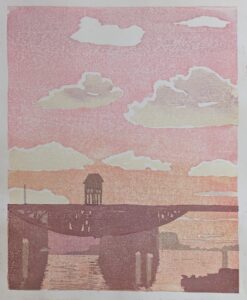
Vaill's practice with water-based woodblock printing reflects the particular qualities that attract artists to the medium: the translucent luminosity of water-based pigments on handmade washi paper, the integration of image and paper surface that results from the absorption of color into the fibers, and the individual character that hand printing with a baren gives to each impression. These qualities distinguish mokuhanga from all other printmaking techniques and provide artists with expressive possibilities unavailable through other means.
The Australian artistic landscape, with its emphasis on engagement with the natural environment and its tradition of innovative printmaking, provides a fertile context for mokuhanga practice. Australian artists have found that the technique's responsiveness to ambient conditions -- humidity, temperature, and atmospheric pressure all affect the printing process -- creates a dialogue between the work and its environment that resonates with broader Australian artistic concerns about place, climate, and the relationship between human activity and the natural world.
Key Facts
- Nationality
- 🇦🇺Australia
- Movement
- Contemporary Mokuhanga
Frequently Asked Questions
Deidre Vaill is an Australian mokuhanga artist whose work in water-based woodblock printing contributes to the growing community of practitioners in the Oceania region. Based in Australia, she has participated in international exhibitions that showcase the global reach of contemporary mokuhanga practice.
Deidre Vaill's work was shaped by the Contemporary Mokuhanga tradition in Japanese woodblock printmaking. Contemporary Mokuhanga: Contemporary mokuhanga (literally "wood-block print") encompasses artists working from approximately 1970 to the present who continue or reinvent traditional Japanese woodblock printing techniques.