Biography
Ema Shin is a Melbourne-based, Niigata-born artist whose practice ranges across Japanese woodblock printing, embroidery, papier-mâché, tapestry weaving, bookmaking, urauchi (chine-collé), and collage. Her work is unified by a sustained interest in tactile materiality, historical women's craft traditions, and the body — particularly anatomical motifs (hearts, lungs, wombs, pelvic bones) presented as vessels of feminine experience and inheritance.
Shin trained as a printmaker in Japan, completing undergraduate studies at Tama Art University in Tokyo, where she studied traditional and contemporary Japanese woodblock processes, and then a Master of Fine Art at Aichi Prefectural University of the Arts in Nagoya. Self-taught as an embroiderer, she developed her tapestry practice after relocating to Melbourne, undertaking an Artist-in-Residence position at the Australian Tapestry Workshop (ATW) in 2012. Her ongoing collaboration with the ATW culminated in Hearts of Absent Women (Tree of Family) (2026), a handwoven tapestry and papier-mâché soft sculpture co-woven with ATW weaver Saffron Gordon and commissioned for the 25th Biennale of Sydney.
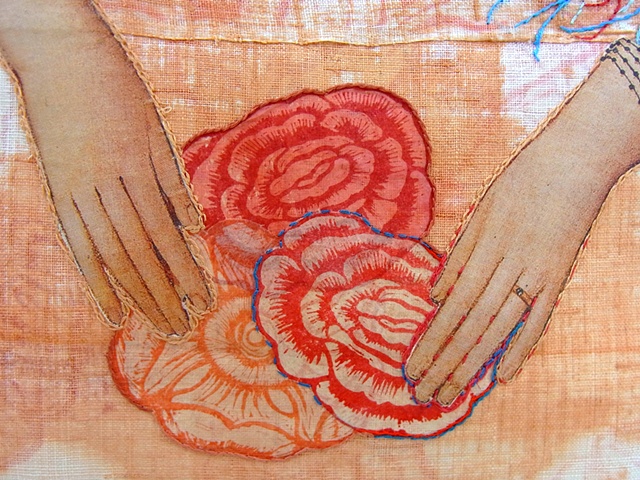
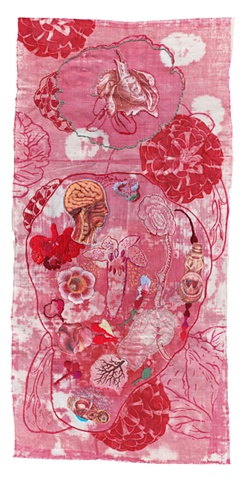
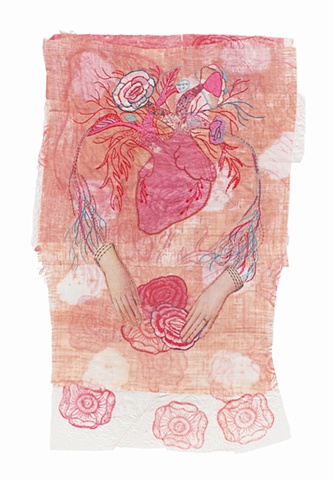
Her printmaking is most concentrated in the My Garden series, a body of multimedia works built on a Japanese woodblock-printed substrate. Each sheet combines mokuhanga in water-based pigment with additional printing, stamping, and surface embroidery, fusing anatomical illustration with botanical and floral overlays. The series typifies her approach of using the woodblock as one technical layer within a larger embroidered, collaged, mixed-media surface rather than as a standalone print.
A second print-derived body of work is the Maternal Garden series, in which papier-mâché sculptural forms are surfaced with woodblock-printed and stamp-printed patterning together with hand embroidery. The Devoted Body installation, shown as part of the Tamworth Textile Triennial, was made in collaboration with a group of embroidery artists and demonstrates her use of community-based making as a structural part of her practice.
Shin's more recent and most widely circulated works include the soft-sculpture Hearts of Absent Women series, the Soft Alchemy tapestry series, and the Resettled Body installation. She is represented by Gallerysmith in Melbourne, and her work has been included in tapestry-and-textile-focused group exhibitions, including Open House at the Tamworth Textile Triennial.
Within the contemporary mokuhanga and Australian printmaking communities Shin is best understood as a hybrid practitioner — formally trained in Japanese woodblock and committed to its visual and material vocabulary, but extending it through embroidery, sculpture, and tapestry into work that is fundamentally interdisciplinary. Her selection for the 25th Biennale of Sydney reflects her standing among diasporic Japanese-Australian artists working across textile, print, and sculpture.
Key Facts
- Nationality
- 🇦🇺Australia
- Movement
- Contemporary Mokuhanga
- Subjects
- Gardens
- Works Indexed
- 2
Frequently Asked Questions
Ema Shin is a Melbourne-based, Niigata-born artist whose practice ranges across Japanese woodblock printing, embroidery, papier-mâché, tapestry weaving, bookmaking, urauchi (chine-collé), and collage. Her work is unified by a sustained interest in tactile materiality, historical women's craft traditions, and the body — particularly anatomical motifs (hearts, lungs, wombs, pelvic bones) presented as vessels of feminine experience and inheritance.
Ema Shin's work was shaped by the Contemporary Mokuhanga tradition in Japanese woodblock printmaking. Contemporary Mokuhanga: Contemporary mokuhanga (literally "wood-block print") encompasses artists working from approximately 1970 to the present who continue or reinvent traditional Japanese woodblock printing techniques.
Ema Shin's prints frequently feature gardens.