Biography
Haruka Furusaka (b. 1976, Osaka) is a Japanese mokuhanga printmaker and educator whose practice grounds the Japanese water-based woodblock tradition in materials gathered from her surrounding natural environment — soil pigments, cultivated indigo, and paper from regional sources. She earned her B.A. in Painting from Musashino Art University in 1999, then worked as an assistant in a woodblock print workshop before beginning her own practice in 2002. In 2010 she founded Kucyusansou Woodblock Printmaking (空中山荘, 'mountain cottage in the sky'), a studio and workshop in Osaka where she teaches mokuhanga.
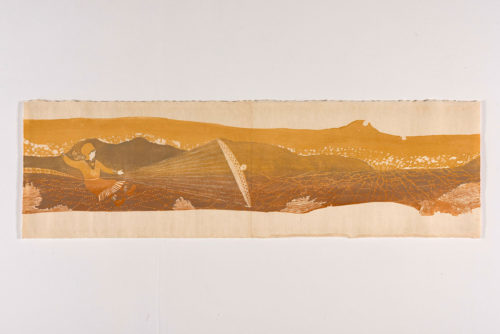
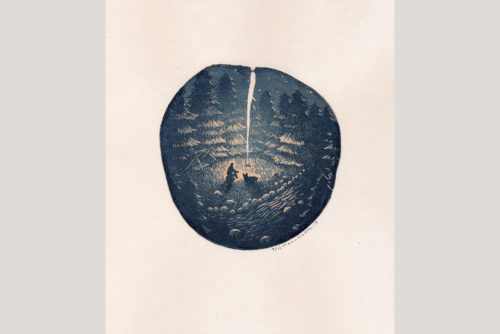
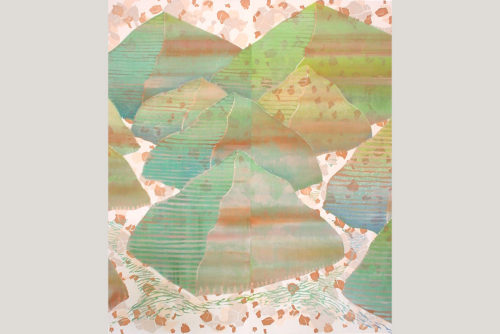
Furusaka treats the mokuhanga medium as a vehicle for engagement with nature rather than as a craft tradition to be preserved at arm's length. Her technique has developed in response to Japan's humid climate and the materials available from nearby forests. She works with high-quality washi, traditional carving chisels, and bamboo-sheath barens, but selects her pigments from natural materials in her immediate surroundings, including soil and locally cultivated indigo. The resulting prints are characterized by an earthy palette, soft tonal modulation, and a landscape orientation toward the human relationship with the natural world.
Much of her work has grown out of extended stays in northern Europe. She held residencies at Ateljé Stundars in Solf, Finland (2002) and at the art centre in Máze, Norway (2003, 2005, and 2011), a Sámi community where she lived and worked among the Indigenous, reindeer-herding Sámi people; this experience informed her later 'Duodji from Mt. Reindeer' work (2014), which addresses the words and handwork of people who coexist with nature — a theme that has continued to shape her recent projects. She was also artist-in-residence at the Aomori Contemporary Art Center in Japan (2017). Her ongoing 'Soma's Boat' series has been presented in the solo exhibition project 'A Vessel in Layers / Soma's Boat,' shown at Gallery Parc in Kyoto (2023) and at further venues in 2024–2025, and she has exhibited internationally in group shows across Europe, Asia, and North America.
Furusaka was one of the fourteen artists in the Nagasawa 14 'NOIR / KURO' international mokuhanga exchange portfolio, coordinated by Nel Pak and Michael Reed, which placed her within an active international circle of mokuhanga practitioners alongside Yoonmi Nam, April Vollmer, Hiroki Satake, Eva Pietzcker, Miriam Zegrer, Aleksander Wozniak, and others. The Nagasawa 14 are artists connected through the Nagasawa artist-in-residence program, established to teach Japanese water-based woodblock printing to contemporary artists.
Within the contemporary international mokuhanga community, Furusaka is one of the more visible Japanese voices working in a sustainability-and-locality register — her use of local pigment, regional washi, and the theme of human coexistence with nature aligns her practice as much with Scandinavian craft sensibilities and the Sámi duodji tradition as with the urban mokuhanga scene. Through her sustained Norwegian–Japanese exchange and her teaching at Kucyusansou, she has become a recognizable figure in a rural-oriented, environmentally engaged strand of contemporary Japanese printmaking.
Key Facts
- Active Period
- 1976
- Nationality
- 🇯🇵Japan
- Movement
- Contemporary Mokuhanga
- Subjects
- Boats & Ships
- Works Indexed
- 3
Frequently Asked Questions
Haruka Furusaka (b. 1976, Osaka) is a Japanese mokuhanga printmaker and educator whose practice grounds the Japanese water-based woodblock tradition in materials gathered from her surrounding natural environment — soil pigments, cultivated indigo, and paper from regional sources. She earned her B.A. in Painting from Musashino Art University in 1999, then worked as an assistant in a woodblock print workshop before beginning her own practice in 2002. In 2010 she founded Kucyusansou Woodblock Printmaking (空中山荘, 'mountain cottage in the sky'), a studio and workshop in Osaka where she teaches mokuhanga.
Haruka Furusaka was active born in 1976. They were associated with the Contemporary Mokuhanga movement.
Haruka Furusaka's work was shaped by the Contemporary Mokuhanga tradition in Japanese woodblock printmaking. Contemporary Mokuhanga: Contemporary mokuhanga (literally "wood-block print") encompasses artists working from approximately 1970 to the present who continue or reinvent traditional Japanese woodblock printing techniques.
Haruka Furusaka's prints frequently feature boats & ships.