Biography
Michiko Hoshino (born 1934, Tokyo) is a Japanese painter and printmaker whose lithographic practice, sustained across several decades, forms one of the more cosmopolitan bodies of contemporary Japanese print work — a long sequence of richly textured, atmospheric lithographs that take the literary world of the Argentine writer Jorge Luis Borges as their primary intellectual and visual scaffolding. She first studied liberal arts at Tokyo Woman's Christian University, completing a B.A. in 1954, then turned to art and entered the oil-painting course at Tokyo National University of Fine Arts (Tokyo Geidai, now Tokyo University of the Arts), graduating with a B.A. in oil painting in 1963.
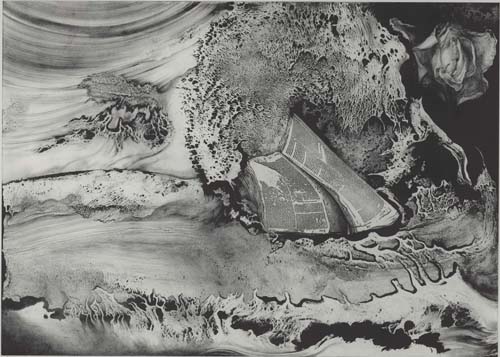
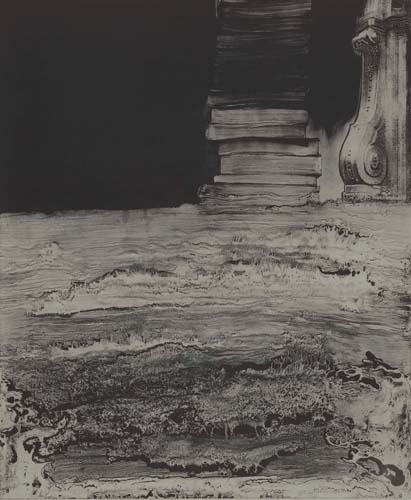
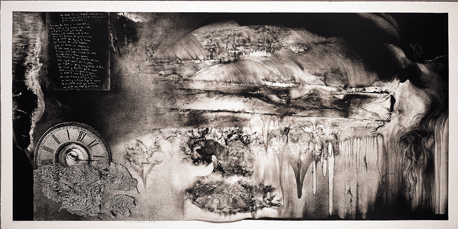
In the late 1960s Hoshino began to focus almost exclusively on lithography, a shift that reshaped her work toward the multi-layered, grey-and-bone-white surfaces that became her hallmark. Her mature prints draw on Borges's literary architecture — the labyrinth, the library, the universal book, mirrored and dissolving time — using melting textures, disembodied clock faces and books to explore memory, time and spatial form.
Over the following decades she exhibited extensively through the international print biennials of Europe, the Middle East and Latin America, including Ljubljana and Kraków, as well as in Japan. In the 1990s she traveled to Buenos Aires and New York City on an overseas-study scholarship from the Japanese government, deepening the Borges themes that run through her work; a catalogue of her Borges lithographs (hommage à Borges) documents this body of work.
Hoshino's prints are held in the permanent collections of the British Museum, the United States Library of Congress, the Museum of Modern History in Ljubljana, the National Museum in Kraków and — most closely tied to her subject — the Argentine collections of the Museo Nacional del Grabado and the Fundación Internacional Jorge Luis Borges in Buenos Aires, among other institutions in Japan, Europe and the Americas. The Argentine holdings are particularly unusual: she is one of the few Japanese printmakers whose work is collected systematically by Latin American print museums.
She is a member of the Kokugakai Art Association, the Japan Artist Association and the Japan Print Association, and maintains a working studio in Tokyo. Her prints have appeared in the College Women's Association of Japan (CWAJ) Print Show in Tokyo and are documented in the United States through the Annex Galleries / Daniel Lienau collection records.
Within postwar Japanese lithography Hoshino occupies a distinctive position. Where much of her generation engaged with international Pop, geometric abstraction or photo-based printmaking, her sustained commitment to a single literary source — the slow accretion of a Borges-themed corpus across decades — has produced one of the more internally coherent print projects of her era.
Key Facts
- Active Period
- 1934
- Nationality
- 🇯🇵Japan
- Movement
- Contemporary Mokuhanga
- Works Indexed
- 3
Frequently Asked Questions
Michiko Hoshino (born 1934, Tokyo) is a Japanese painter and printmaker whose lithographic practice, sustained across several decades, forms one of the more cosmopolitan bodies of contemporary Japanese print work — a long sequence of richly textured, atmospheric lithographs that take the literary world of the Argentine writer Jorge Luis Borges as their primary intellectual and visual scaffolding. She first studied liberal arts at Tokyo Woman's Christian University, completing a B.A. in 1954, then turned to art and entered the oil-painting course at Tokyo National University of Fine Arts (Tokyo Geidai, now Tokyo University of the Arts), graduating with a B.A. in oil painting in 1963.
Michiko Hoshino was active born in 1934. They were associated with the Contemporary Mokuhanga movement.
Michiko Hoshino's work was shaped by the Contemporary Mokuhanga tradition in Japanese woodblock printmaking. Contemporary Mokuhanga: Contemporary mokuhanga (literally "wood-block print") encompasses artists working from approximately 1970 to the present who continue or reinvent traditional Japanese woodblock printing techniques.