Biography
Teruo Isomi (born December 6, 1941, Kamakura, Kanagawa Prefecture) is one of the senior figures of the postwar Japanese woodblock print scene, known for monumental black-ink prints that reframe figure, flower, and tree subjects through deliberately rough cedar-board grain. He studied oil painting at the Tokyo University of the Arts under Kaoru Yamaguchi, then began woodblock printing during graduate studies under Tadashige Ono and Matsutatsu Koyama, completing his graduate work in 1973.
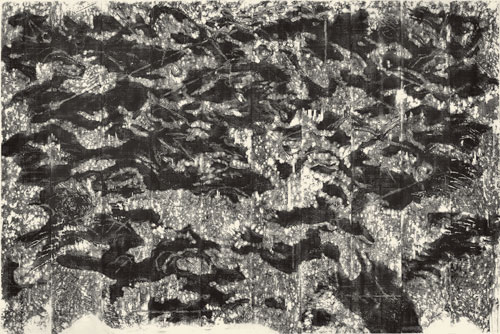
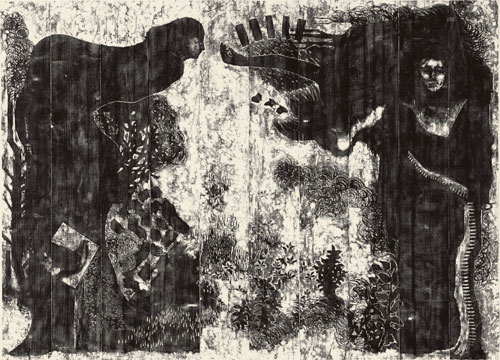
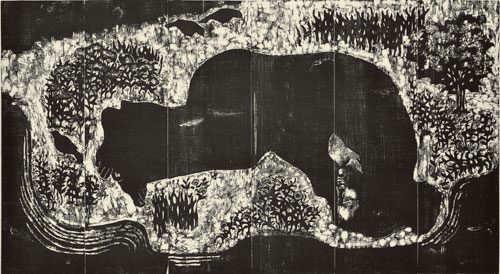
Isomi's signature approach is to print from cedar boards joined edge-to-edge into very large surfaces, treating the visible joins between boards and the natural variation of the cedar grain as part of the printed image rather than as imperfections to be hidden. He prints these large impressions on specially prepared washi paper in a deliberately bold, primitive black-ink register that has been described by Japanese critics as recovering an older, pre-modern sense of the woodblock medium. The technique developed across decades and produced an unusually consistent body of large-format prints in which the human figure or natural form emerges from a heavily worked black surface.
His subjects are deliberately limited: people, flowers, and trees, usually rendered as singular figural presences against an active, gestural ground. The work is often described in catalog texts as exploring "human presence" through abstraction and monochrome composition. Where his contemporaries pursued international modernist abstraction or photo-printmaking, Isomi committed to a sculptural, almost archaic relationship to the wood block as raw material.
Isomi received the Japan Print Association Prize in 1979, was selected for the Ljubljana International Print Biennial in 1989, and won the Yamaguchi Gen Grand Prize in 2003 and the Nagoya Municipal Art Prize Special Award in 2008. His exhibition history includes the group show Contemporary Japanese Prints 1990 at the Shoto Museum of Art in Shibuya (1990), a two-person exhibition at the Tokyo Opera City Art Gallery (2008), and a 2016 two-person show at the Yokosuka Museum of Art paired with the painter Shōzō Shimada. His prints are held in public collections in Japan — including the Aichi Prefectural Museum of Art, the Nagoya City Art Museum, and the Toyama and Kanagawa prefectural museums of modern art — as well as the Los Angeles County Museum of Art.
In 2007 Isomi was appointed President (Rector) of the Aichi Prefectural University of Fine Arts and Music, where he served through 2013. His administrative work alongside continued exhibiting marks him as one of the key institutional figures who carried the Japanese woodblock tradition from the postwar generation into contemporary practice.
The catalog Teruo Isomi: Complete Prints, 1971–1983 (published by Sōbunsha in 1983) remains the standard catalog reference for his early period. His later work has been documented through individual museum exhibition catalogs rather than a unified raisonné. Within the Japanese print field he is recognized among the postwar generation who treated woodblock not as a modernized continuation of ukiyo-e but as a sculptural medium in its own right.
Key Facts
- Active Period
- 1941
- Nationality
- 🇯🇵Japan
- Movement
- Contemporary Mokuhanga
- Works Indexed
- 2
Frequently Asked Questions
Teruo Isomi (born December 6, 1941, Kamakura, Kanagawa Prefecture) is one of the senior figures of the postwar Japanese woodblock print scene, known for monumental black-ink prints that reframe figure, flower, and tree subjects through deliberately rough cedar-board grain. He studied oil painting at the Tokyo University of the Arts under Kaoru Yamaguchi, then began woodblock printing during graduate studies under Tadashige Ono and Matsutatsu Koyama, completing his graduate work in 1973.
Teruo Isomi was active born in 1941. They were associated with the Contemporary Mokuhanga movement.
Teruo Isomi's work was shaped by the Contemporary Mokuhanga tradition in Japanese woodblock printmaking. Contemporary Mokuhanga: Contemporary mokuhanga (literally "wood-block print") encompasses artists working from approximately 1970 to the present who continue or reinvent traditional Japanese woodblock printing techniques.
Teruo Isomi's prints frequently feature trees, birds & flowers, portraits, figures.