Biography
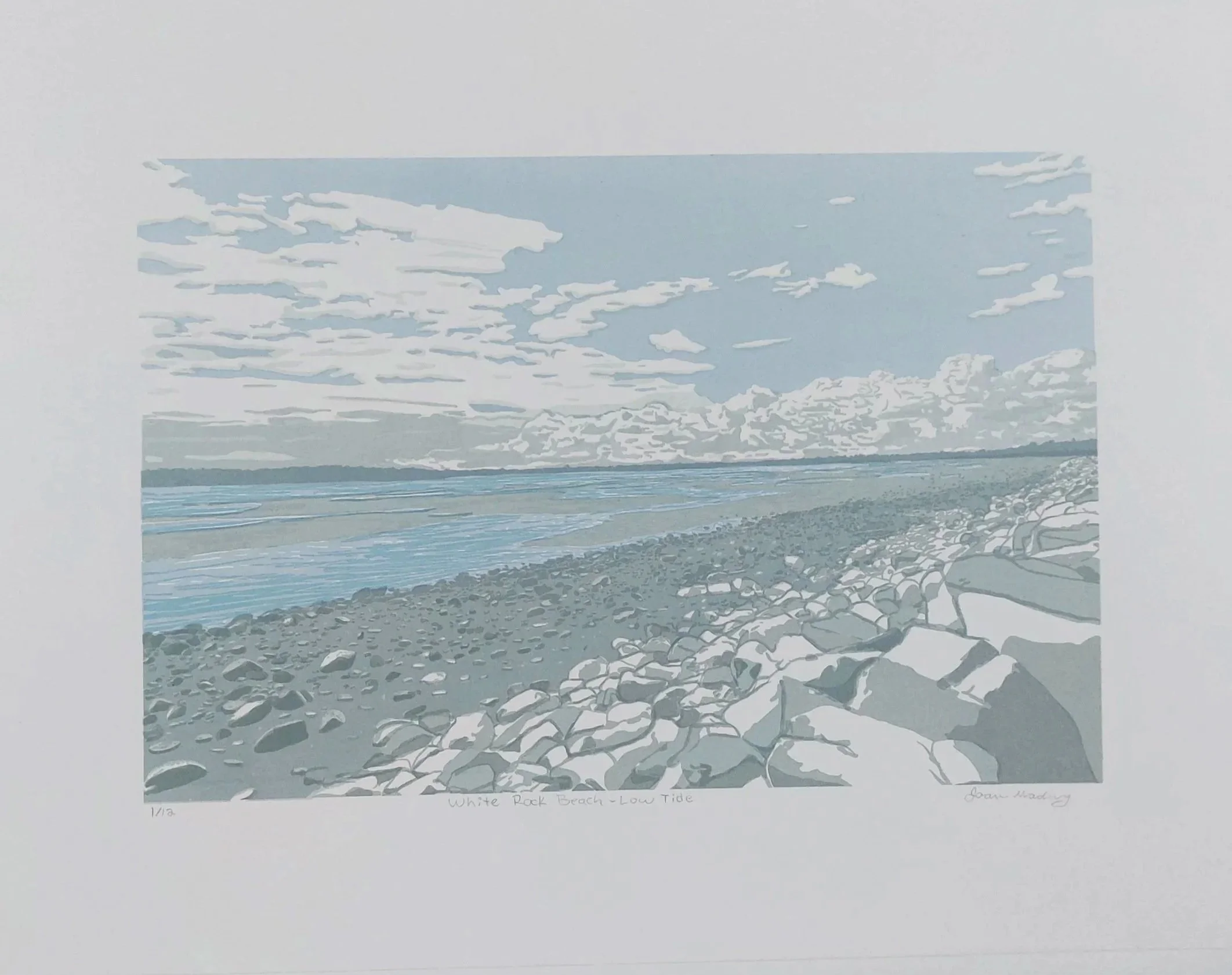
Joanne Madeley is a Canadian printmaker and illustrator based in Edmonton, Alberta, whose mokuhanga work — multi-block water-based Japanese woodblock prints, hand-printed onto Japanese paper — sits within a broader print practice that also includes screenprinting and miniature works. She was born in Vancouver, British Columbia, and took a Bachelor of Fine Arts with a major in printmaking from Concordia University in Montreal; Concordia's Studio Arts department has been one of the major Canadian training environments for studio-based printmaking since the 1980s and supplies a substantial portion of working Canadian printmakers of her generation. Her studio operates under the imprint Studio Arbutus, after the West Coast tree of her Vancouver origin. Madeley has worked in screenprinting through residencies in Lendava, Slovenia, and Berkeley, California, and entered the Japanese woodblock tradition through a mokuhanga course in Japan, which has since become a sustained line of her practice; recent prints such as Goldfish II (an 8 × 10-inch woodcut printed by hand in six color layers on paper) and the bird and landscape compositions Owl, Magpie, Butterfly, Badlands, and Near Lake Louise are made in the multi-block, multi-impression mode characteristic of contemporary mokuhanga and circulated as small editions through her online shop, the SNAP (Society of Northern Alberta Print Artists) catalogue in Edmonton, and the Printmakers Council. Her exhibition record runs across Canada and the United States, although it has not been the subject of a published monograph or institutional retrospective, and individual venue documentation remains scattered across the Edmonton print scene, the SNAP exhibition programme, and the Printmakers Council artist registry. Her own writing on her practice — collected on her studio site and Instagram (studio_arbutus) — describes the work as an attempt to recover a child's openness of attention through close observation of place, ephemera collected on walks, and conversation, and her stated source material is consistently landscape, animal, and plant. The mokuhanga prints make particular use of layered transparent color, partial overlays, and the gradation possible with hand-brushed water-based pigment on washi, all features that distinguish her output from the harder-edged screenprint practice associated with the Slovenian and Californian residencies. Standard biographical particulars — birth year, the years of Concordia training, the specific Japanese mokuhanga programme she attended — are not part of her widely indexed public record, and a comprehensive exhibition résumé has not been compiled. The current view, drawn from her own studio site, the SNAP catalogue, and the Artists in Canada Edmonton printmaker registry, is of a working mid-career Canadian printmaker whose practice has moved progressively toward mokuhanga as a central rather than incidental technique, and whose international exposure is currently being expanded through the Japanese-print exhibition and residency network.
Key Facts
- Nationality
- 🇬🇧United Kingdom
- Movement
- Contemporary Mokuhanga
- Works Indexed
- 1
Frequently Asked Questions
Joanne Madeley is a Canadian printmaker and illustrator based in Edmonton, Alberta, whose mokuhanga work — multi-block water-based Japanese woodblock prints, hand-printed onto Japanese paper — sits within a broader print practice that also includes screenprinting and miniature works. She was born in Vancouver, British Columbia, and took a Bachelor of Fine Arts with a major in printmaking from Concordia University in Montreal; Concordia's Studio Arts department has been one of the major Canadian training environments for studio-based printmaking since the 1980s and supplies a substantial portion of working Canadian printmakers of her generation. Her studio operates under the imprint Studio Arbutus, after the West Coast tree of her Vancouver origin. Madeley has worked in screenprinting through residencies in Lendava, Slovenia, and Berkeley, California, and entered the Japanese woodblock tradition through a mokuhanga course in Japan, which has since become a sustained line of her practice; recent prints such as Goldfish II (an 8 × 10-inch woodcut printed by hand in six color layers on paper) and the bird and landscape compositions Owl, Magpie, Butterfly, Badlands, and Near Lake Louise are made in the multi-block, multi-impression mode characteristic of contemporary mokuhanga and circulated as small editions through her online shop, the SNAP (Society of Northern Alberta Print Artists) catalogue in Edmonton, and the Printmakers Council. Her exhibition record runs across Canada and the United States, although it has not been the subject of a published monograph or institutional retrospective, and individual venue documentation remains scattered across the Edmonton print scene, the SNAP exhibition programme, and the Printmakers Council artist registry. Her own writing on her practice — collected on her studio site and Instagram (studio_arbutus) — describes the work as an attempt to recover a child's openness of attention through close observation of place, ephemera collected on walks, and conversation, and her stated source material is consistently landscape, animal, and plant. The mokuhanga prints make particular use of layered transparent color, partial overlays, and the gradation possible with hand-brushed water-based pigment on washi, all features that distinguish her output from the harder-edged screenprint practice associated with the Slovenian and Californian residencies. Standard biographical particulars — birth year, the years of Concordia training, the specific Japanese mokuhanga programme she attended — are not part of her widely indexed public record, and a comprehensive exhibition résumé has not been compiled. The current view, drawn from her own studio site, the SNAP catalogue, and the Artists in Canada Edmonton printmaker registry, is of a working mid-career Canadian printmaker whose practice has moved progressively toward mokuhanga as a central rather than incidental technique, and whose international exposure is currently being expanded through the Japanese-print exhibition and residency network.
Joanne Madeley's work was shaped by the Contemporary Mokuhanga tradition in Japanese woodblock printmaking. Contemporary Mokuhanga: Contemporary mokuhanga (literally "wood-block print") encompasses artists working from approximately 1970 to the present who continue or reinvent traditional Japanese woodblock printing techniques.
Joanne Madeley is a contemporary printmaker working in the mokuhanga (Japanese woodblock) tradition. Their work contributes to the living tradition of Japanese woodblock printing. Prices for contemporary mokuhanga prints range from $100 for smaller works to $1,500 for major compositions. Most prints sell in the $180–$600 range. The global mokuhanga community has been growing, with increasing exhibition opportunities and collector interest. Contemporary mokuhanga represents an affordable entry point for collectors.