Biography
Joel Karhu is an American-born woodblock printmaker based in Kyoto, Japan, who carries forward the artistic legacy of his father, the legendary Finnish-American artist Clifton Karhu (1927-2007). Born in 1961, he grew up between two cultures, spending his childhood in Japan before returning to the United States for high school.
Karhu's apprenticeship began informally. As a teenager, he worked alongside his father in the Karhu Studio in Kyoto, absorbing the techniques of traditional Japanese woodblock printing through years of hands-on practice. Beginning in 1980, he returned to Kyoto to work full-time for his father, cutting blocks and doing much of the printing for the studio's editions. For sixteen years, from 1980 until 1996, Karhu was an integral part of the operation that produced Clifton Karhu's celebrated prints of Kyoto's temples, townhouses, and streetscapes.
Despite wanting to be an artist from a young age, Karhu recognized that his own creative instincts were heavily influenced by his father's powerful style. Rather than produce derivative work, he made the difficult decision to step away from art entirely, leaving the studio in 1996 to pursue a career importing building materials. It was a long detour, but one that ultimately gave him the distance he needed to develop his own artistic voice.
Following his father's death in 2007, Joel returned to the family studio in Kyoto in 2008 to manage the remaining business and care for his mother. Gradually, surrounded by the tools and blocks of his father's workshop, the urge to create reasserted itself. In 2017, Karhu began making his own original woodblock prints, focusing on the landscapes and architecture of the city he loves.
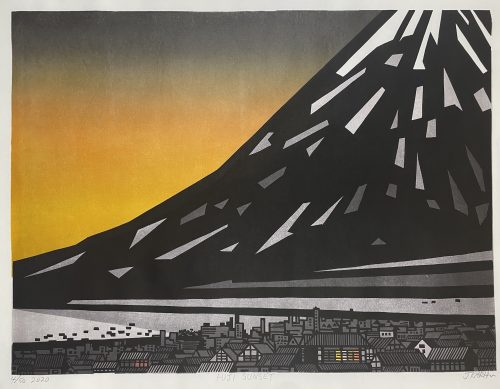
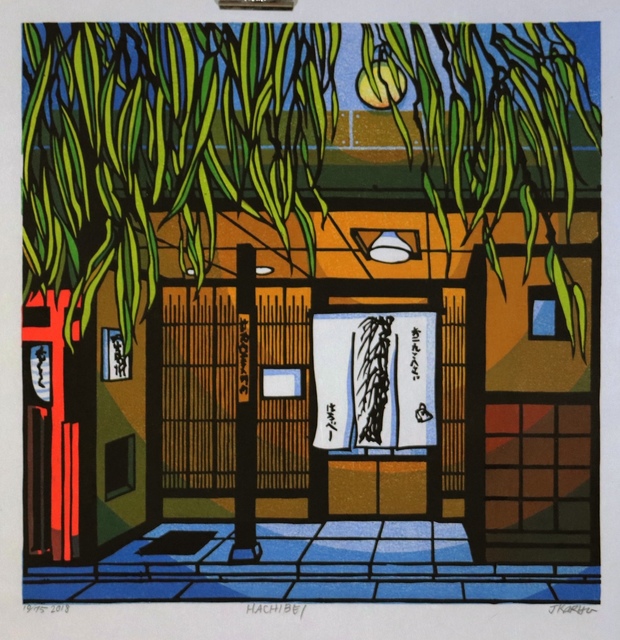
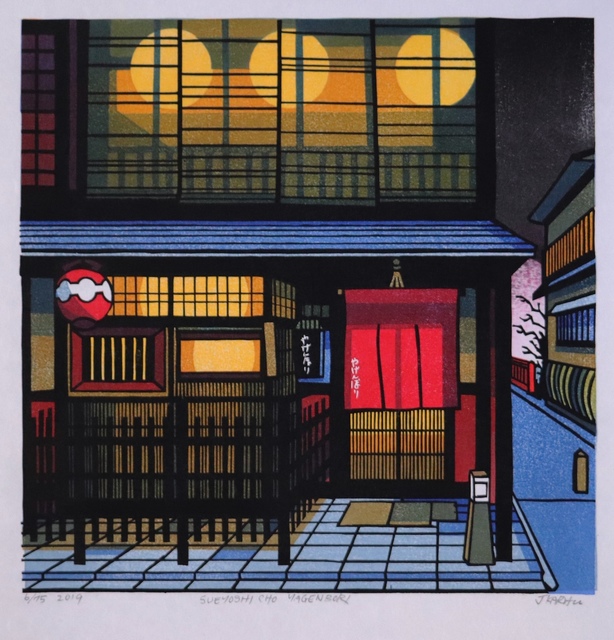
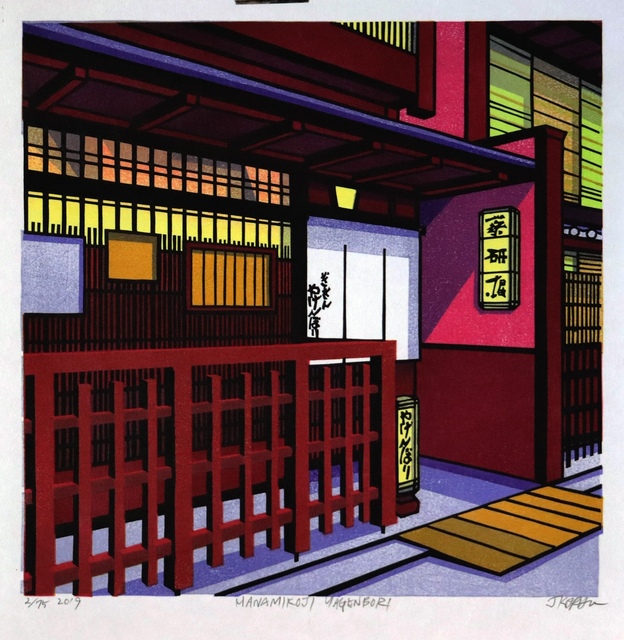
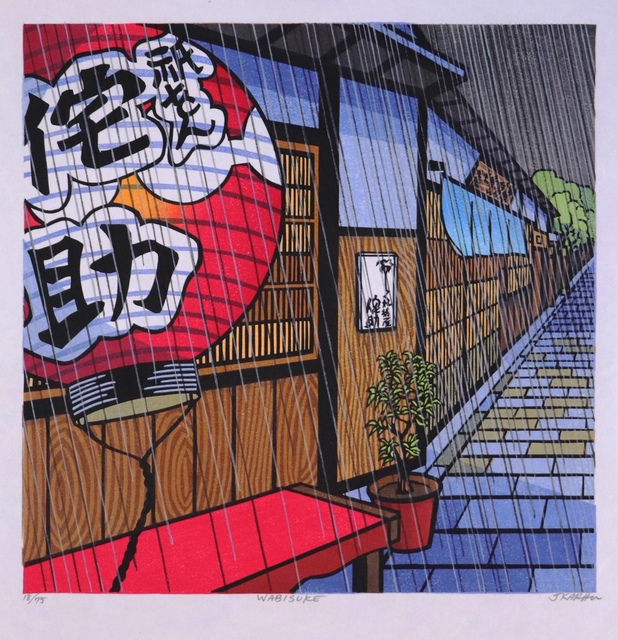
The results bear the unmistakable influence of the Karhu Studio tradition but are distinctly Joel's own. Where Clifton Karhu favored bold, graphic compositions with strong black outlines and a limited palette, Joel's prints tend toward vivid colors and jewel tones that give his images of Kyoto's streets, rooftops, and gardens a luminous, almost stained-glass quality. His technical mastery of carving and printing, honed through those sixteen years of studio work, is evident in the precision and richness of every impression.
Karhu held his first exhibition in Tokyo in 2019, and his work was quickly embraced by collectors who appreciated both its connection to Clifton Karhu's legacy and its fresh perspective. The Ren Brown Collection Gallery in Bodega Bay, California, became the first American gallery to represent him. His prints are also handled by The Tolman Collection of New York.
Joel Karhu continues to live and work in Kyoto, creating woodblock prints that honor the craft he learned from his father while exploring the city's beauty through his own eyes.
Key Facts
- Active Period
- 1961
- Nationality
- 🇺🇸United States
- Movement
- Contemporary Mokuhanga
- Subjects
- Mount FujiLandscapesInteriors
- Works Indexed
- 7
Frequently Asked Questions
Joel Karhu is an American-born woodblock printmaker based in Kyoto, Japan, who carries forward the artistic legacy of his father, the legendary Finnish-American artist Clifton Karhu (1927-2007). Born in 1961, he grew up between two cultures, spending his childhood in Japan before returning to the United States for high school.
Joel Karhu was active born in 1961. They were associated with the Contemporary Mokuhanga movement.
Joel Karhu's work was shaped by the Contemporary Mokuhanga tradition in Japanese woodblock printmaking. Contemporary Mokuhanga: Contemporary mokuhanga (literally "wood-block print") encompasses artists working from approximately 1970 to the present who continue or reinvent traditional Japanese woodblock printing techniques.
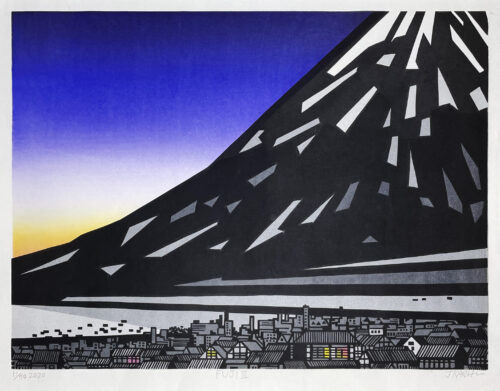
Joel Karhu's prints frequently feature mount fuji, landscapes, interiors.
-500x494.jpeg)