Biography
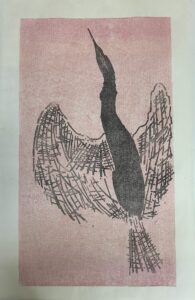
Julianne Smart is a Sydney-based Australian printmaker whose practice has developed around linocut, collagraph, and woodblock — including mokuhanga, the Japanese water-based woodblock technique — and whose subject matter consistently engages an Australian landscape sensibility with an explicit conservation purpose. Her first degree was in Applied Science with honours in Physical Geography from the University of New South Wales, an academic background that has continued to inform her later landscape and habitat subjects. Her formal printmaking training began in 2012 through the workshop programme at the Hazelhurst Arts Centre in Gymea, in the Sutherland Shire south of Sydney, a regional gallery and education centre that is a key access point for adult printmaking training in New South Wales. Subsequent study took her to Japan for residency periods focused on mokuhanga, and her work has appeared in the International Mokuhanga Conference juried exhibition circuit — she was among the artists included at the 2024 IMC in Echizen, Fukui Prefecture, part of the broader Australian contingent active in the international mokuhanga community. Within Australia she is associated with the Southern Printmakers Association, the artist-run collective based in southern Sydney that runs member exhibitions and workshops, and her individual prints have circulated through SPA shows, exhibitions in the Blue Mountains, and the self-initiated Overwintering Project on shorebird habitats. Her image-making sits comfortably in the multi-block, multi-impression mode characteristic of the contemporary mokuhanga revival — water-based pigments brushed onto cherry or shina-plywood blocks and hand-printed with a baren onto Japanese washi — but she has also worked in mixed-technique compositions that pair woodblock with drypoint (Lily in Lockdown) or silk aquatint with collagraph (Unshieldedness), reflecting the cross-medium working practice typical of artists trained inside Australian community-print-workshop programs rather than within dedicated mokuhanga ateliers. Her stated thematic concern is the documentation of habitat under pressure, and her writing on her own work emphasizes the role of printmaking as a slow and observational medium suited to environmental subjects rather than as a vehicle for stylistic display. She has not been the subject of a published monograph, and standard biographical apparatus such as a birth date and a full exhibition résumé are not part of her widely indexed public record; what can be securely reported comes from her own Southern Printmakers Association profile and from the International Mokuhanga Conference exhibition listings, both of which place her within the active mid-career generation of Australian mokuhanga practitioners. She is best understood as a Sydney-based working printmaker whose practice has moved progressively toward Japanese woodblock as its central technique while remaining anchored in Australian landscape and conservation subject matter.
Key Facts
- Nationality
- 🇦🇺Australia
- Movement
- Contemporary Mokuhanga
Frequently Asked Questions
Julianne Smart is a Sydney-based Australian printmaker whose practice has developed around linocut, collagraph, and woodblock — including mokuhanga, the Japanese water-based woodblock technique — and whose subject matter consistently engages an Australian landscape sensibility with an explicit conservation purpose. Her first degree was in Applied Science with honours in Physical Geography from the University of New South Wales, an academic background that has continued to inform her later landscape and habitat subjects. Her formal printmaking training began in 2012 through the workshop programme at the Hazelhurst Arts Centre in Gymea, in the Sutherland Shire south of Sydney, a regional gallery and education centre that is a key access point for adult printmaking training in New South Wales. Subsequent study took her to Japan for residency periods focused on mokuhanga, and her work has appeared in the International Mokuhanga Conference juried exhibition circuit — she was among the artists included at the 2024 IMC in Echizen, Fukui Prefecture, part of the broader Australian contingent active in the international mokuhanga community. Within Australia she is associated with the Southern Printmakers Association, the artist-run collective based in southern Sydney that runs member exhibitions and workshops, and her individual prints have circulated through SPA shows, exhibitions in the Blue Mountains, and the self-initiated Overwintering Project on shorebird habitats. Her image-making sits comfortably in the multi-block, multi-impression mode characteristic of the contemporary mokuhanga revival — water-based pigments brushed onto cherry or shina-plywood blocks and hand-printed with a baren onto Japanese washi — but she has also worked in mixed-technique compositions that pair woodblock with drypoint (Lily in Lockdown) or silk aquatint with collagraph (Unshieldedness), reflecting the cross-medium working practice typical of artists trained inside Australian community-print-workshop programs rather than within dedicated mokuhanga ateliers. Her stated thematic concern is the documentation of habitat under pressure, and her writing on her own work emphasizes the role of printmaking as a slow and observational medium suited to environmental subjects rather than as a vehicle for stylistic display. She has not been the subject of a published monograph, and standard biographical apparatus such as a birth date and a full exhibition résumé are not part of her widely indexed public record; what can be securely reported comes from her own Southern Printmakers Association profile and from the International Mokuhanga Conference exhibition listings, both of which place her within the active mid-career generation of Australian mokuhanga practitioners. She is best understood as a Sydney-based working printmaker whose practice has moved progressively toward Japanese woodblock as its central technique while remaining anchored in Australian landscape and conservation subject matter.
Julianne Smart's work was shaped by the Contemporary Mokuhanga tradition in Japanese woodblock printmaking. Contemporary Mokuhanga: Contemporary mokuhanga (literally "wood-block print") encompasses artists working from approximately 1970 to the present who continue or reinvent traditional Japanese woodblock printing techniques.