
Kikuchi Keigetsu
菊池契月
1879–1955
Japan
Biography
Kikuchi Keigetsu (菊池契月, 1879–1955) was a leading figure of Kyoto nihonga in the late Meiji, Taishō, and early Shōwa periods, the adopted son-in-law and artistic successor of Kikuchi Hōbun (1862–1918), and one of the painters who, at the Kyoto City Specialist School of Painting (Kyōto Shiritsu Kaiga Senmon Gakkō), helped define the Kyoto answer to the Tokyo nihonga of Yokoyama Taikan, Shimomura Kanzan, and the Nihon Bijutsuin. He was born in Nagano Prefecture on November 14, 1879, showed early aptitude for drawing, and first studied painting under Kodama Katei. He later entered the studio of Kikuchi Hōbun, the leading younger painter of the Kyoto historical-figure school, around 1897; in 1906 he married Hōbun's daughter and was adopted into the Kikuchi family, taking the art name Keigetsu under which he would publish for the rest of his career.
The Kyoto nihonga in which Keigetsu trained was distinct from its Tokyo counterpart. Where Tokyo painters around Okakura Kakuzō and the Nihon Bijutsuin pursued an explicit synthesis of East and West, building on the Kanō foundation of Hashimoto Gahō and Kanō Hōgai, the Kyoto school — descended from Maruyama Ōkyo and Matsumura Goshun through Mori Kansai and Kōno Bairei — privileged observed nature, restrained color, and historical-narrative subjects drawn from the Heian and Kamakura courts. Hōbun and his contemporaries Takeuchi Seihō, Yamamoto Shunkyo, and Tsuji Kakō, fellow heirs of the Kōno Bairei line, were among the leading Kyoto painters of the 1890s and 1900s, and through Hōbun, Keigetsu inherited the full Kyoto vocabulary: meticulous observation, atmospheric landscape, and figural narrative rendered with the soft outlines and graded washes characteristic of the Shijō line.
Keigetsu rose to national prominence as one of the first star painters to emerge from the government-sponsored Bunten exhibition, established in 1907. In 1908 he painted Lamenting over the Tomb of a Sage, now in the National Museum of Modern Art, Tokyo, and in 1910 he won a second prize at the Bunten with Dedicating Lanterns, followed by another second prize in 1914 for Summer Evening and, in 1920, Young Girls. Across the 1910s and 1920s he produced a sequence of historical and literary subjects — Buddhist figures, Heian noblewomen, Kamakura warriors, Chinese sages — that became canonical examples of Kyoto nihonga's reflective, classical voice. From 1918 onward he served repeatedly as a juror for the Bunten and its successor the Teiten, joining the small group of Kyoto painters who shaped state taste in the interwar period.
In 1922 Keigetsu travelled to Europe, visiting France, Italy, and England over about a year, studying Renaissance painting and antique sculpture as well as contemporary movements such as Fauvism and Cubism. He returned with a renewed conviction that Japanese painting should pursue clarity of line, classical restraint, and figural seriousness, and his later work — increasingly concerned with Heian and Chinese women, Buddhist figures, and historical literary subjects — pursued these qualities with a quiet intensity. He had become a teaching assistant to Hōbun at the Kyoto City Specialist School of Painting in 1910 and went on to teach there as a professor; in 1925 he founded his own private painting academy, training a generation of Kyoto painters, among them Uda Tekison and Kajiwara Hisako. He was a member of the Japan Art Academy, and in 1934 he was named an Imperial Household Artist (Teishitsu Gigeiin).
Keigetsu continued painting through the war years and into the postwar period; his 1943 Welcoming the Imperial Carriage is a representative late work, returning to the historical subjects of his early career, treated now with the spare line and quiet dignity of his fully mature manner. He died in Kyoto on September 9, 1955, at the age of seventy-five. His work is preserved in major Japanese public collections, including the National Museum of Modern Art, Tokyo, together forming the visual record of a painter who, through five decades of careful and historically informed practice, helped define the classical voice of Kyoto nihonga.
Key Facts
- Active Period
- 1879–1955
- Nationality
- 🇯🇵Japan
- Subjects
- Children
- Works Indexed
- 5
Frequently Asked Questions
Kikuchi Keigetsu (菊池契月, 1879–1955) was a leading figure of Kyoto nihonga in the late Meiji, Taishō, and early Shōwa periods, the adopted son-in-law and artistic successor of Kikuchi Hōbun (1862–1918), and one of the painters who, at the Kyoto City Specialist School of Painting (Kyōto Shiritsu Kaiga Senmon Gakkō), helped define the Kyoto answer to the Tokyo nihonga of Yokoyama Taikan, Shimomura Kanzan, and the Nihon Bijutsuin. He was born in Nagano Prefecture on November 14, 1879, showed early aptitude for drawing, and first studied painting under Kodama Katei. He later entered the studio of Kikuchi Hōbun, the leading younger painter of the Kyoto historical-figure school, around 1897; in 1906 he married Hōbun's daughter and was adopted into the Kikuchi family, taking the art name Keigetsu under which he would publish for the rest of his career.
Kikuchi Keigetsu was active from 1879 to 1955.
Kikuchi Keigetsu's prints frequently feature children.
Original prints by Kikuchi Keigetsu can be found in collections including National Museum of Modern Art, Tokyo (via Wikimedia Commons), Nagano Prefectural Shinano Art Museum (via Wikimedia Commons), Wikimedia Commons (from Katalog of contemporary Japanese painting).
Woodblock Prints by Kikuchi Keigetsu (5)
Lamenting over the Tomb of a Sage (right screen)
嘆きの墓
1908
Folding screen; ink and color on paper

Dedication of Lanterns
灯籠供養
1910
Six-panel folding screen; ink and color on paper
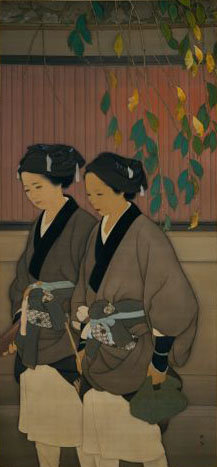
Evening Homeward Journey
夕べの帰り
1918
Ink and color on paper or silk

Young Girl
少女
1920
Ink and color on paper or silk

Standing Women
立女
1924
Hanging scroll or panel; ink and color on silk