Biography
Yasunori Kinukawa (born 1978, Kyoto) is a Japanese artist whose practice combines lithography and video work, with the distinguishing feature that his lithographic plates are not standard limestone slabs but small pieces of natural Japanese limestone that he himself collects, cuts, and grains. He earned his MFA from Kyoto Seika University in 2004 and has taught there as a part-time lecturer.
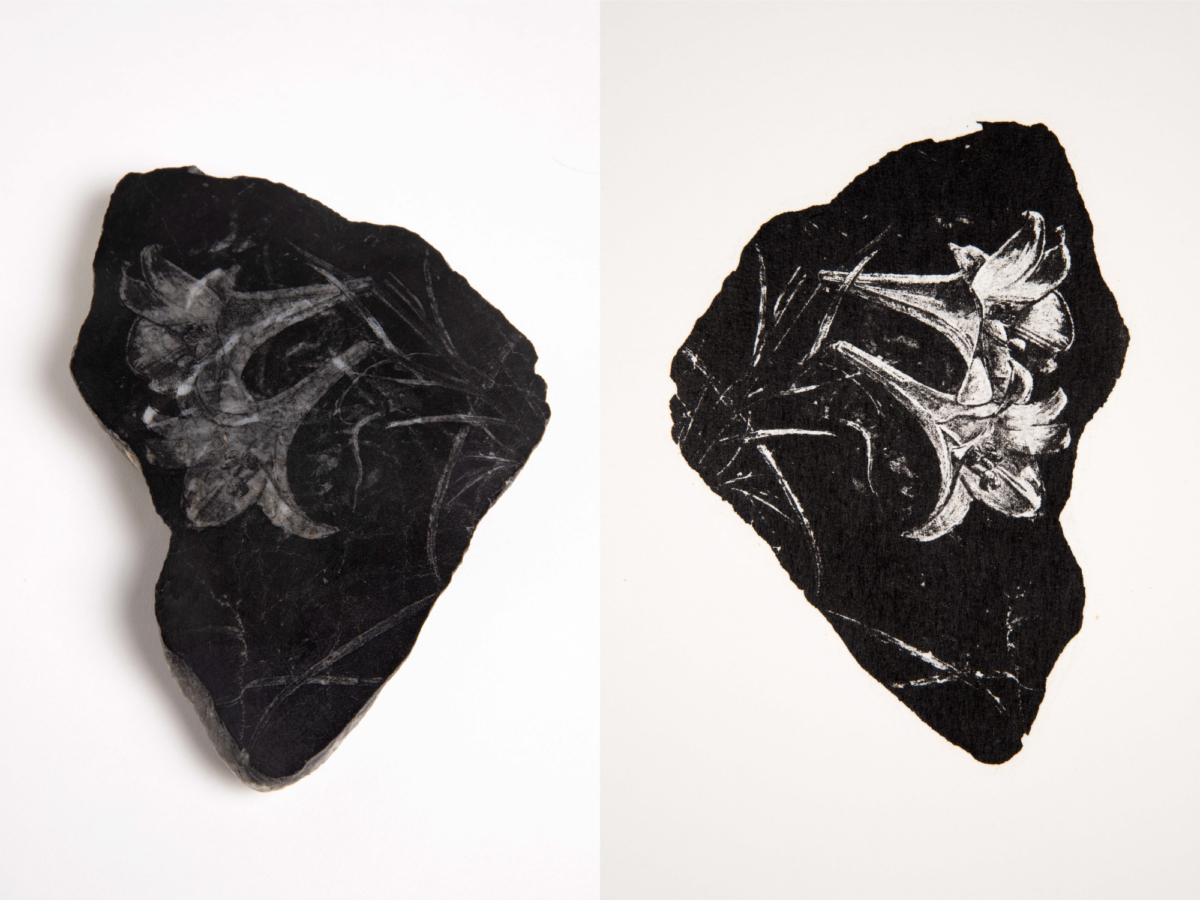
The series central to his practice — titled "Pebble Lithograph" (小石のリトグラフ) — inverts the conventional relationship between the lithographic plate and the printed image. Rather than drawing landscapes on a generic stone surface, Kinukawa identifies a specific limestone source site, collects a small fragment of that stone, hand-grains the surface into a usable lithographic plate, and then prints onto paper a depiction of the very landscape from which the stone was extracted, along with the flora and fauna he encountered there. The stone, in his framing, carries an implied perspective of the place it came from; his observations as collector layer a second perspective onto the same surface. The series was presented in a dedicated solo exhibition at MATSUO MEGUMI + VOICE GALLERY pfs/w in Kyoto in 2022.
The practice is distinguished from the dominant strands of contemporary Japanese mokuhanga by its focus on a planographic technique (lithography) rather than relief woodblock, and by its insistence that the printing matrix be a found stone rather than a manufactured plate. In Kinukawa's framing, the lithographic plate ceases to be a neutral substrate and becomes a documentary specimen, partially carrying its place of origin into the printed image.
Kinukawa works alongside the art project team "Lighter but Heavier," through which he researches and exhibits lithography. His exhibition history includes selection for the 2nd International Biennial of Lithography in Belgrade, Serbia (2020); the group exhibition "Flickering Creatures" (ゆらめくいきものたち) at Kyoto Seika University Gallery Terra-S (2022); and "KOMPAS" at Zebra Culture in Ghent, Belgium (2023). In 2020 he participated in "Hand Specimen: Small Stones, Big Landscapes, and the Horizon Line" at Gallery Heptagon in Kyoto, in collaboration with the mineral collector Nishida Katsuichi.
In 2025, Kinukawa was included in the Echigo-Tsumari Art Field with the work "Mineralized Landscape" (石化する風景), an outdoor installation on view on weekends and holidays from mid-July through August 2025. The Echigo-Tsumari Art Field is one of Japan's principal site-specific contemporary art projects, anchored in Niigata's Tokamachi region.
Kinukawa's work has been documented through the Japan Foundation's ART360° contemporary art platform. His ongoing collaboration with mineral collectors and his hybrid lithography-and-video practice place him within the expanded-printmaking tendency in early-twenty-first-century Japanese art, which extends print logic — repetition, the plate-and-paper relationship, indexicality — into adjacent media including documentary video, found-object sculpture, and site-specific installation.
Key Facts
- Active Period
- 1978
- Nationality
- 🇯🇵Japan
- Movement
- Contemporary Mokuhanga
- Subjects
- Landscapes
- Works Indexed
- 2
Frequently Asked Questions
Yasunori Kinukawa (born 1978, Kyoto) is a Japanese artist whose practice combines lithography and video work, with the distinguishing feature that his lithographic plates are not standard limestone slabs but small pieces of natural Japanese limestone that he himself collects, cuts, and grains. He earned his MFA from Kyoto Seika University in 2004 and has taught there as a part-time lecturer.
Yasunori Kinukawa was active born in 1978. They were associated with the Contemporary Mokuhanga movement.
Yasunori Kinukawa's work was shaped by the Contemporary Mokuhanga tradition in Japanese woodblock printmaking. Contemporary Mokuhanga: Contemporary mokuhanga (literally "wood-block print") encompasses artists working from approximately 1970 to the present who continue or reinvent traditional Japanese woodblock printing techniques.
Yasunori Kinukawa's prints frequently feature landscapes.
