
Biography
Kohei Kyomori (born 1985, Ehime Prefecture) is a Japanese contemporary artist whose practice spans painting, decorative-art reinterpretation, and traditional Japanese woodblock printing. His central preoccupation is the asymmetrical relationship between the depopulating regions of rural Japan, where industry and population are collapsing, and the over-saturated visual culture of contemporary urban centres — a tension he explores through densely ornamented compositions that draw on decorative motifs from across cultures and historical periods.
Kyomori grew up in a dairy-farming family in a depopulated district of Ehime Prefecture on the island of Shikoku, an experience he has cited as the foundation of his interest in the relationship between identity and visuality, and between disappearing local economies and the visual abundance of metropolitan Japan. His mature work treats the act of decoration as the central artistic gesture: he describes himself as a decorative artist reinterpreting decorative arts from different eras and from cultures around the world, and he views ornament as a vehicle for symbolic meaning, transcribed onto two-dimensional surfaces in vibrant painted form.
His paintings combine mineral pigments and UV resin on canvas — a technical hybrid that allows him to layer dense ornamental fields beneath a hard, almost glass-like protective top coat. The compositions use a flat picture-plane construction strongly inflected by ukiyo-e — a deliberate citation of Edo-period printmaking surfaces — and they reach for ornament from textile, ceramic, and architectural sources alongside the Japanese tradition.
In 2022 Kyomori entered into a major collaboration with Unsōdō, the historic Kyoto woodblock-print publishing house founded in 1891 and today one of the only publishers in Japan still producing traditional woodblock-printed books. Working with engraver Shoichi Kitamura and printer Kyoko Hirai, his digital painting was translated into a traditional woodblock print — a project that placed his contemporary ornament-driven composition inside the same tradition of hand-carved, baren-printed woodblock production behind the classic prints of shin-hanga masters such as Kawase Hasui and Hiroshi Yoshida. The collaboration was unveiled at his Whitestone Gallery solo exhibition Impression O in Taipei (2022), which showed the woodblock work alongside his canvas paintings.
His awards have been substantial. He took the Grand Prix of the Hermès carré design competition (Le Grand Prix du Carré Hermès) in 2020, the Grand Prize of the 7th FEI Print Award in 2018, and the Grand Prix of the Art Start Up 100 Rewards Award in 2019, and he was runner-up at both the Spiral Independent Creators Festival 20 and the IAG Awards in 2019. The Hermès prize is a well-known design competition in which the winning design is realised as an Hermès silk carré.
Kyomori is represented by Whitestone Gallery, which operates branches in Tokyo, Hong Kong, Beijing, Taipei, Seoul and elsewhere. His solo exhibitions on the Whitestone circuit include Decorative Man (Tokyo, 2025), Decor Is Painless Domination (Seoul, 2024), Expression M (Beijing, 2023), Impression O (Taipei, 2022), and We Can Always Talk Here (Hong Kong/Tokyo, 2021). He has also been profiled by the Ocula contemporary art platform. In the broader contemporary Japanese art landscape his work occupies an unusual position: a painter whose visual sources reach back to Edo-period printmaking, who collaborates actively with one of Japan's last traditional woodblock publishers, and whose career has been built primarily inside the global commercial gallery circuit rather than the museum and biennial system.
Key Facts
- Active Period
- 1985
- Nationality
- 🇯🇵Japan
- Movement
- Contemporary Mokuhanga
- Works Indexed
- 7
Frequently Asked Questions
Kohei Kyomori (born 1985, Ehime Prefecture) is a Japanese contemporary artist whose practice spans painting, decorative-art reinterpretation, and traditional Japanese woodblock printing. His central preoccupation is the asymmetrical relationship between the depopulating regions of rural Japan, where industry and population are collapsing, and the over-saturated visual culture of contemporary urban centres — a tension he explores through densely ornamented compositions that draw on decorative motifs from across cultures and historical periods.
Kohei Kyomori was active born in 1985. They were associated with the Contemporary Mokuhanga movement.
Kohei Kyomori's work was shaped by the Contemporary Mokuhanga tradition in Japanese woodblock printmaking. Contemporary Mokuhanga: Contemporary mokuhanga (literally "wood-block print") encompasses artists working from approximately 1970 to the present who continue or reinvent traditional Japanese woodblock printing techniques.
Woodblock Prints by Kohei Kyomori (7)

Kohei Kyomori (Studio View 3)
Mineral pigments and UV resin on canvas
Kohei Kyomori (Studio View 1)
Mineral pigments and UV resin on canvas

Kohei Kyomori (Studio View 2)
Mineral pigments and UV resin on canvas
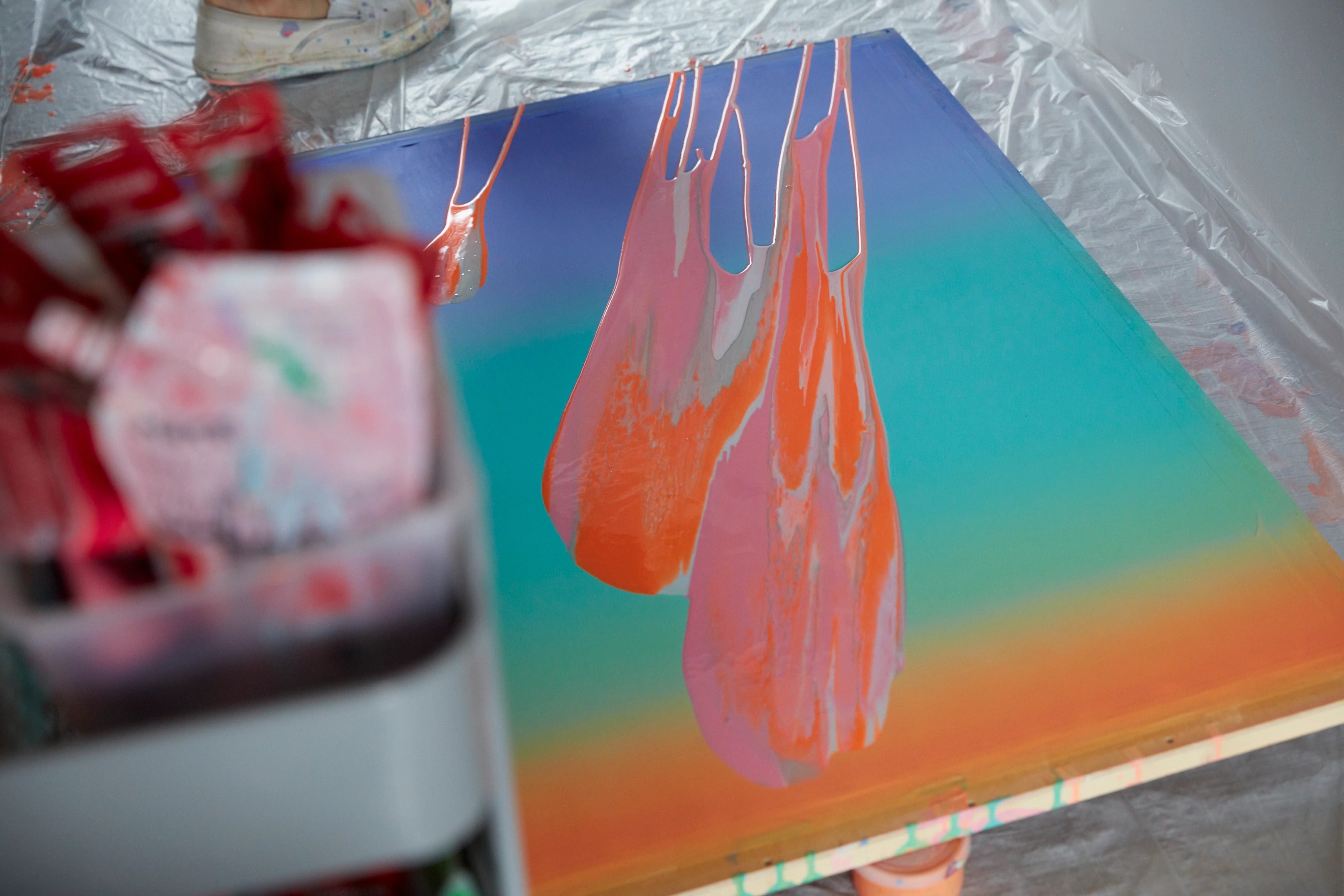
Kohei Kyomori (Studio View 4)
Mineral pigments and UV resin on canvas

Kohei Kyomori (Studio View 5)
Mineral pigments and UV resin on canvas

Kohei Kyomori (Studio View 6)
Mineral pigments and UV resin on canvas

Kohei Kyomori (Studio View 7)
Mineral pigments and UV resin on canvas