Biography
Koichi Ebizuka is a Japanese artist who works across printmaking, sculpture, and installation, bringing a sculptor's spatial awareness to the traditionally two-dimensional world of the print. Born in 1951 in Yokohama, in Kanagawa Prefecture, Ebizuka has built a career that bridges the worlds of fine art printmaking and contemporary installation art, with each discipline informing and enriching the other.
Ebizuka is affiliated with Tama Art University, one of Japan's leading art schools and a longstanding center of printmaking education. His prints are characterized by a contemplative engagement with natural forms, as evidenced in works with titles such as Kazemachigusa (a plant name meaning "wind-waiting grass"), Floating Clouds and Stream, and Furosou (another botanical reference). His edition sizes are notably small, typically limited to twenty-six impressions, reflecting the care and attention he brings to each print.
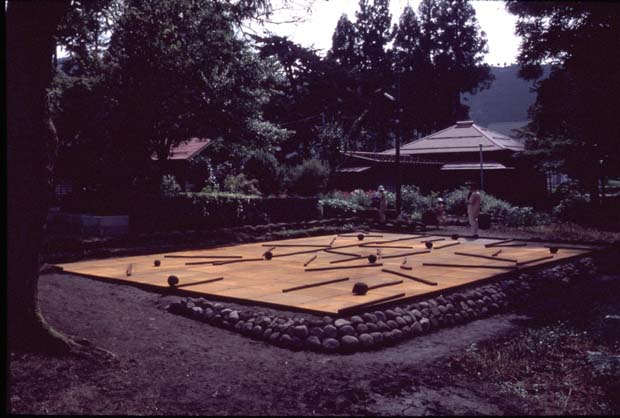
Ebizuka first gained significant international attention at the nineteenth Bienal de São Paulo in 1987, establishing his reputation on the global stage early in his career. He has since exhibited at major venues including the Los Angeles County Museum of Art (LACMA) and the Echigo-Tsumari Art Triennial in Niigata Prefecture, where his outdoor installation Skin of Water and Wind demonstrates his ability to work at architectural scale while maintaining the sensitivity to surface and texture that characterizes his prints.
The Setagaya Art Museum in Tokyo mounted a dedicated exhibition pairing Ebizuka's work with that of print artist Ikeda Ryoji in its Two Artists' Works Series, recognizing both as important voices in contemporary Japanese printmaking. His work has also been featured by galleries specializing in contemporary Japanese prints, including Kyoto Prints.
Ebizuka's dual practice as printmaker and sculptor gives his graphic work a distinctive quality. His prints often seem to inhabit a space between the two-dimensional and three-dimensional, with embossed surfaces, subtle relief effects, and compositions that suggest depth and physical presence beyond the picture plane. This cross-pollination between disciplines has made him a distinctive figure in contemporary Japanese art.
Key Facts
- Active Period
- 1951
- Nationality
- 🇯🇵Japan
- Movement
- Contemporary Mokuhanga
- Subjects
- NatureFood & Drink
- Works Indexed
- 3
Frequently Asked Questions
Koichi Ebizuka is a Japanese artist who works across printmaking, sculpture, and installation, bringing a sculptor's spatial awareness to the traditionally two-dimensional world of the print. Born in 1951 in Yokohama, in Kanagawa Prefecture, Ebizuka has built a career that bridges the worlds of fine art printmaking and contemporary installation art, with each discipline informing and enriching the other.
Koichi Ebizuka was active born in 1951. They were associated with the Contemporary Mokuhanga movement.
Koichi Ebizuka's work was shaped by the Contemporary Mokuhanga tradition in Japanese woodblock printmaking. Contemporary Mokuhanga: Contemporary mokuhanga (literally "wood-block print") encompasses artists working from approximately 1970 to the present who continue or reinvent traditional Japanese woodblock printing techniques.
Koichi Ebizuka's prints frequently feature nature, food & drink.