Yasuo Kuniyoshi
国吉康雄
1889–1953
Japan
Biography
Yasuo Kuniyoshi (国吉康雄, 1889–1953) was one of the most prominent Japanese-born artists of twentieth-century American Modernism, a painter, lithographer, photographer, and political organizer whose career bridged the worlds of Japan, Paris, and New York and whose work was honored with the Whitney Museum of American Art's first-ever retrospective of a living artist in 1948. He arrived in the United States as a teenager in 1906, trained in the New York art schools that defined the early-twentieth-century American avant-garde, and went on to produce a body of paintings, drawings, and lithographs that combined the linear discipline of his East Asian background with the figural and modernist vocabularies he absorbed in Paris and New York, marked throughout by a melancholy lyricism, a complicated relationship to American national identity, and an instinct for fable and circus imagery that set his work apart from any of the schools to which he was attached.
Kuniyoshi was born on September 1, 1889, in Okayama, a castle town near the Inland Sea on the island of Honshū, into a modest household. He received the standard elementary education of the late Meiji period and briefly attended a technical school in Okayama, where he trained in textile design. In 1906, still a teenager, he sailed alone from Yokohama to Seattle and joined the wave of young Japanese men coming to the American West Coast in the years before the 1908 Gentlemen's Agreement and the eventual closing of the Japanese-American labor pipeline. He worked his way down the Pacific Coast — the standard immigrant trajectory of his generation — and reached Los Angeles around 1907, where he enrolled in the Los Angeles School of Art and Design while supporting himself with menial jobs and amateur photography. In 1910 he moved east to New York, the city that would remain his base for the rest of his life.
His serious artistic training took place at the National Academy of Design, the Independent School of Art, and ultimately and most importantly at the Art Students League, where he studied from 1916 to 1920 under Kenneth Hayes Miller. Miller was the central teacher of what is sometimes called the Fourteenth Street School — a circle of American figural Modernists, including Reginald Marsh, Edward Laning, and Isabel Bishop, who took the realist street life of Lower Manhattan and the figural traditions of Renaissance Italy as their twin sources. Kuniyoshi absorbed Miller's emphasis on the deliberate, structured construction of the human figure and on the lessons of Old Master drawing, and he combined them with a private, lyric subject matter — children, cows, milkmaids, dreaming nudes, circus performers — that owed as much to remembered Japanese folk imagery as to anything he saw on Fourteenth Street. He also worked extensively as a photographer, supporting himself for much of his life by photographing the work of other artists for catalogues and reproduction, a quiet trade that put him in close professional contact with the entire New York gallery world.
Kuniyoshi's first solo exhibition opened at the Daniel Gallery in New York in 1922, and from that point onward he was a recognized presence in American Modernism. His earliest mature works — the paintings of cows, children, and farm subjects produced in the early 1920s in Ogunquit, Maine, where he and his wife Katherine Schmidt summered in the artists' colony there — drew on memories of rural Okayama and on his own birth year, the Year of the Ox in the East Asian zodiac, to which he repeatedly returned as a personal totem. Reviewers responded to the strange flatness, the simplified shapes, the slightly off-kilter scale, and the quiet melancholy of the figures; one cow, with her sideways stare, appeared and reappeared across his early paintings until she became almost a self-portrait. The Whitney Studio Club, the predecessor of the Whitney Museum, took an early interest in his work, and Gertrude Vanderbilt Whitney's patronage shaped his career from its first years.
In 1925 he and Katherine traveled to Paris on her family's support, the first of two extended European trips (1925 and 1928) that decisively shaped his pictorial language; he would also make a return journey to Japan in 1931. In Paris he encountered the painting of Jules Pascin — whose mournful brothels and circuses would echo through Kuniyoshi's work for the rest of his life — and the wider School of Paris with its post-Fauve, post-Cubist tonal experiments. He came back to New York with an enlarged sense of color and a darker, more atmospheric tonality, and the paintings of the later 1920s and early 1930s — bouquets and stoves, women reclining on couches, circus performers at rest, café interiors — combine the structured Miller-school figure construction with the smoky Pascin tonality, the long pictorial silences, and the lonely female figures that would become his trademark. The 1925 painting Strong Woman and Child, made in Paris and now at the Smithsonian American Art Museum, is one of the touchstones of this period: a circus strongwoman holds her child against a backdrop of French flags, encoding in symbolic form Kuniyoshi's own immigrant predicament — his exclusion from American citizenship under the 1924 Immigration Act, the strain his marriage to a white American woman placed on her family, and the protective tenderness he brought to the figures who stood in for both Katherine and himself.
It was in Paris that Kuniyoshi also took up lithography, the medium in which he made his most important contribution to American graphic art. He had first experimented with zinc-plate lithography around 1922, but it was during his 1928 Paris trip, working with the celebrated Desjobert atelier, that he committed himself to the medium; through the late 1920s, 1930s, and 1940s he expanded into a substantial body of lithographs printed in New York by printers such as George C. Miller and his friend the printmaker Emil Ganso. The Kuniyoshi lithographs typically pair a quiet, often nocturnal subject — a woman alone at a café table, a still life on an iron chair, a circus performer in costume waiting between acts — with a tonal richness that owes more to Pascin and to Whistler than to the harder-edged realism of many of his contemporaries. A large group of his prints entered the Whitney Museum of American Art through the Katherine Schmidt Shubert Bequest — a gift from his first wife, who had remarried after their divorce in 1932 — and the Whitney remains among the principal repositories of his graphic work.
The 1930s deepened the political and emotional difficulty of Kuniyoshi's position. He was an active organizer in the New York artists' left, a founding member of the American Artists' Congress in 1936 and later of the Artists Equity Association, and a vocal opponent of fascism in both Europe and Japan. His own homeland's invasion of China, and ultimately the attack on the United States at Pearl Harbor in December 1941, placed him in an extraordinary bind: as a Japanese national permanently barred from American naturalization, he was technically an enemy alien after December 1941, subject to a curfew and to travel restrictions in New York, while at the same time being publicly enlisted by the Office of War Information to produce anti-Japanese propaganda imagery for the American war effort. Several of his most disturbing wartime works were made in this contradictory capacity. The strain of the period emerges most sharply in the painting I'm Tired (1938) and in a series of compositions of exhausted, dishevelled, or weeping women that occupied him through the early 1940s.
After 1945 the obstacles to Kuniyoshi's American citizenship were gradually removed — the Immigration and Nationality Act of 1952 finally allowed naturalization for Japanese immigrants — and he was a leading public figure in the New York art world's postwar reconstruction, but his health was failing. In 1948 the Whitney Museum mounted what it described as its first-ever retrospective of a living artist, a major exhibition of his paintings and lithographs, and the show stood for many observers as a quiet rebuke to the policy of internment and exclusion that had hung over Japanese-Americans through the war years. Kuniyoshi died of cancer in New York on May 14, 1953, at the age of sixty-three, before he could obtain the American citizenship that had been denied him for nearly half a century.
His late paintings are dominated by lone female figures, often half-hidden in shadow and frequently set in circus or theatrical surroundings, and many art historians read them as encoded autobiography from the years in which Kuniyoshi was simultaneously the most celebrated Japanese-American artist of his generation and a man legally barred from full American belonging. His work has been the subject of major exhibitions including the Whitney's 1948 retrospective and the Smithsonian American Art Museum's 2015 survey The Artistic Journey of Yasuo Kuniyoshi, and significant holdings are now distributed across the Whitney, the Smithsonian American Art Museum, the Hirshhorn Museum and Sculpture Garden, the Brooklyn Museum, the Museum of Modern Art, the Metropolitan Museum of Art, the National Gallery of Art, the Crystal Bridges Museum of American Art, and, in Japan, the collections of his native Okayama, which holds an especially concentrated body of his work. For the history of the print, his lithographs of the late 1920s through the 1940s remain his most concentrated graphic legacy, and connect his career, by way of his lifelong attention to drawing and to the printed line, to the broader world of twentieth-century printmaking on both sides of the Pacific.
Key Facts
- Active Period
- 1889–1953
- Nationality
- 🇯🇵Japan
- Subjects
- ChildrenBirds & Flowers
- Works Indexed
- 16
Frequently Asked Questions
Yasuo Kuniyoshi (国吉康雄, 1889–1953) was one of the most prominent Japanese-born artists of twentieth-century American Modernism, a painter, lithographer, photographer, and political organizer whose career bridged the worlds of Japan, Paris, and New York and whose work was honored with the Whitney Museum of American Art's first-ever retrospective of a living artist in 1948. He arrived in the United States as a teenager in 1906, trained in the New York art schools that defined the early-twentieth-century American avant-garde, and went on to produce a body of paintings, drawings, and lithographs that combined the linear discipline of his East Asian background with the figural and modernist vocabularies he absorbed in Paris and New York, marked throughout by a melancholy lyricism, a complicated relationship to American national identity, and an instinct for fable and circus imagery that set his work apart from any of the schools to which he was attached.
Yasuo Kuniyoshi was active from 1889 to 1953.
Yasuo Kuniyoshi's prints frequently feature children, birds & flowers.
Original prints by Yasuo Kuniyoshi can be found in collections including Whitney Museum of American Art (81.43.17), Crystal Bridges Museum of American Art (via Wikimedia Commons), Whitney Museum of American Art (31.757), Whitney Museum of American Art (81.43.25).
Woodblock Prints by Yasuo Kuniyoshi (16)
Landscape
1920
Oil on canvas

Baby and Toy Cow
circa 1921
Ink, pen, and drybrush on paper

Milking Girl
乳しぼりの娘
1922-23
Oil on canvas
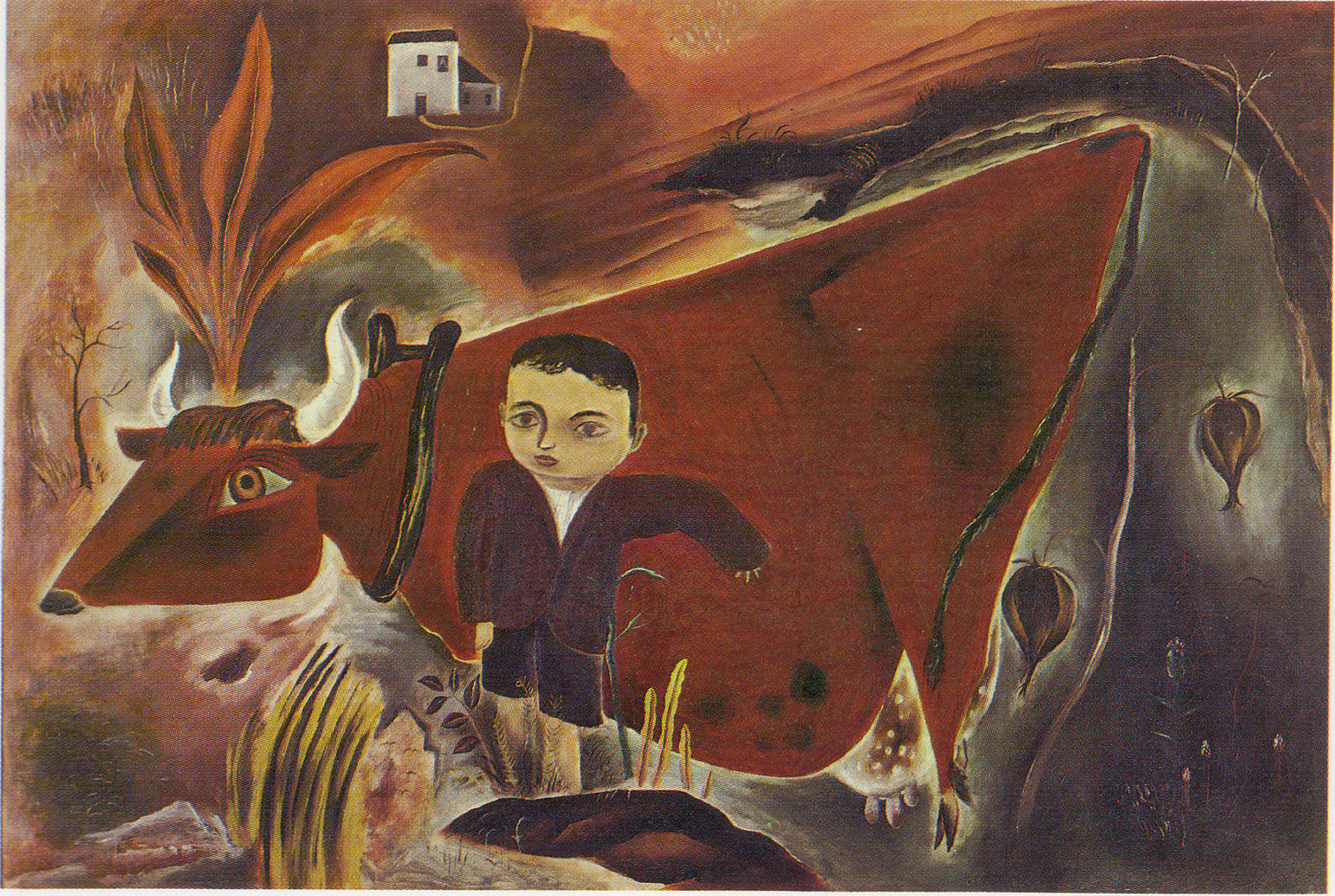
Little Joe with the Cow
1923
Oil on canvas

Life Saver
水難救助員
1924
Oil on canvas
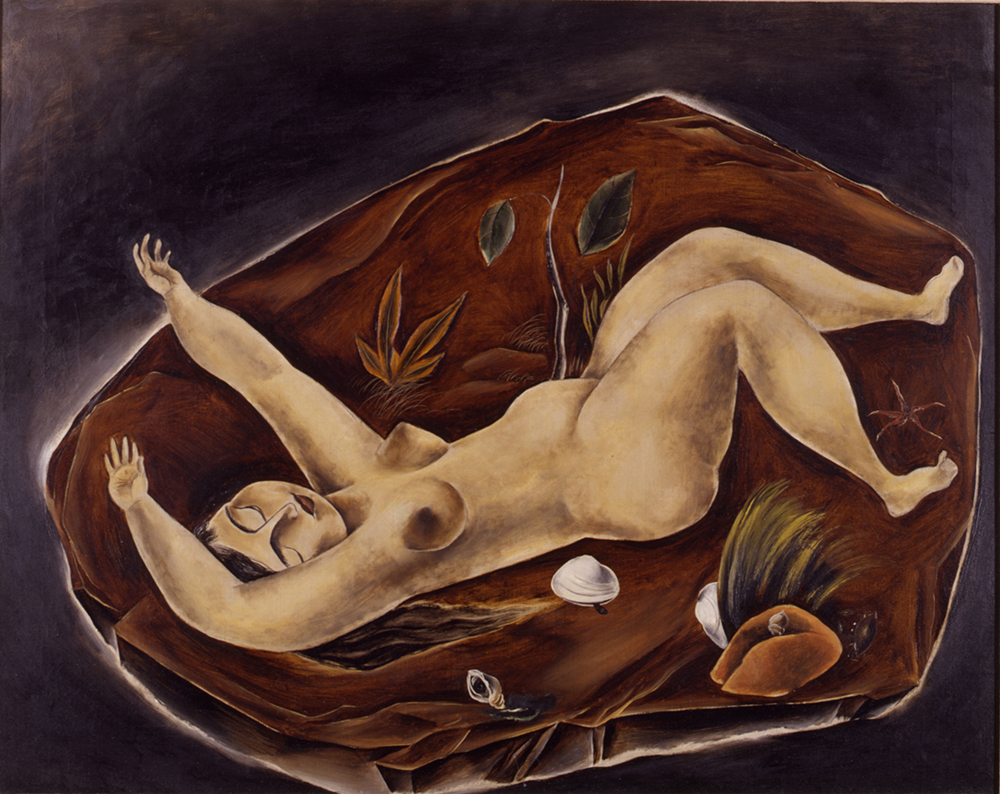
Island of Happiness
1924
Oil on canvas
Strong Woman and Child
1925
Oil on canvas
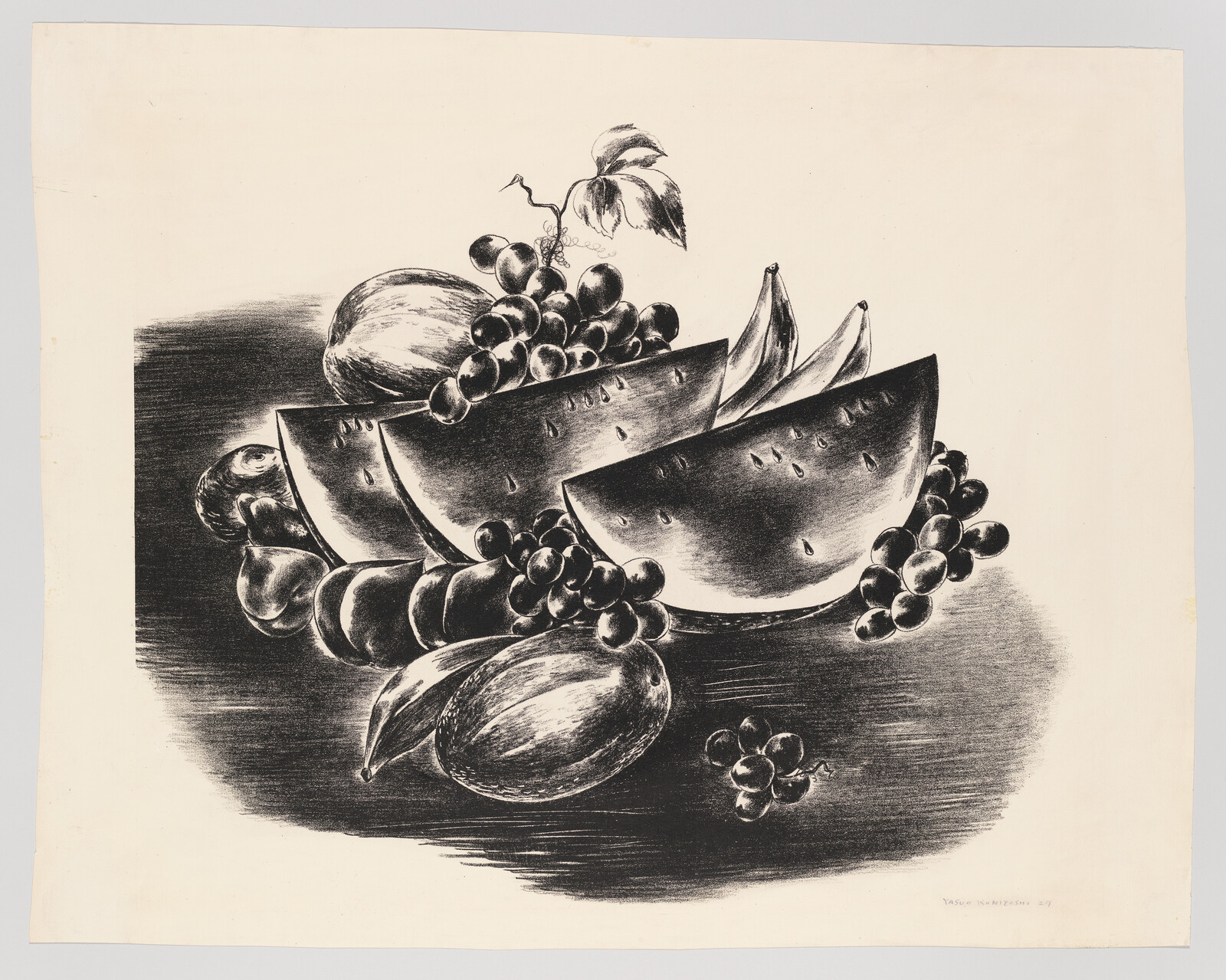
Watermelon
1927
Lithograph
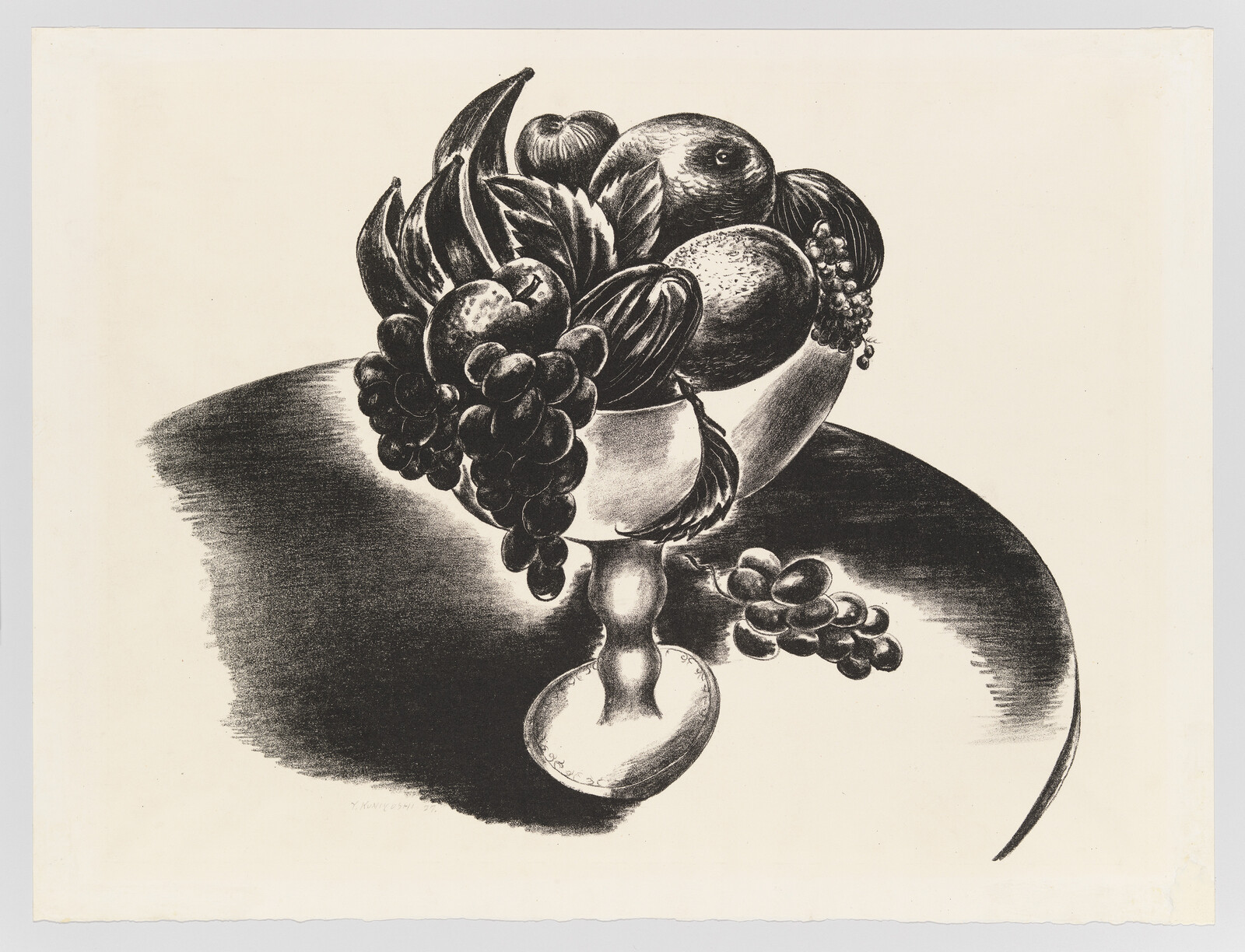
Fruit in White Bowl
1927
Lithograph
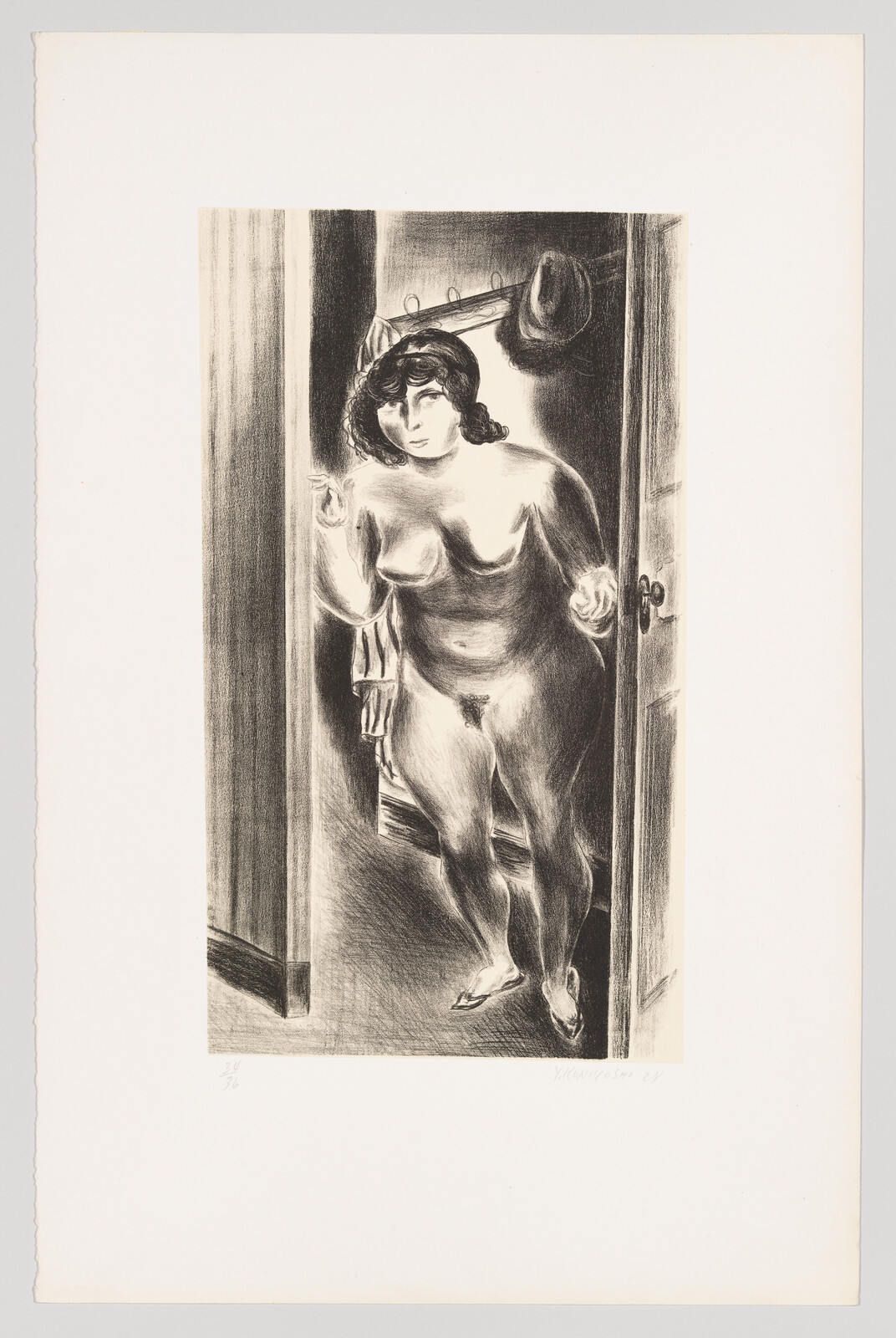
Nude at Door
1928
Lithograph with chine-collé

Bouquet and Stove
1929
Oil on canvas
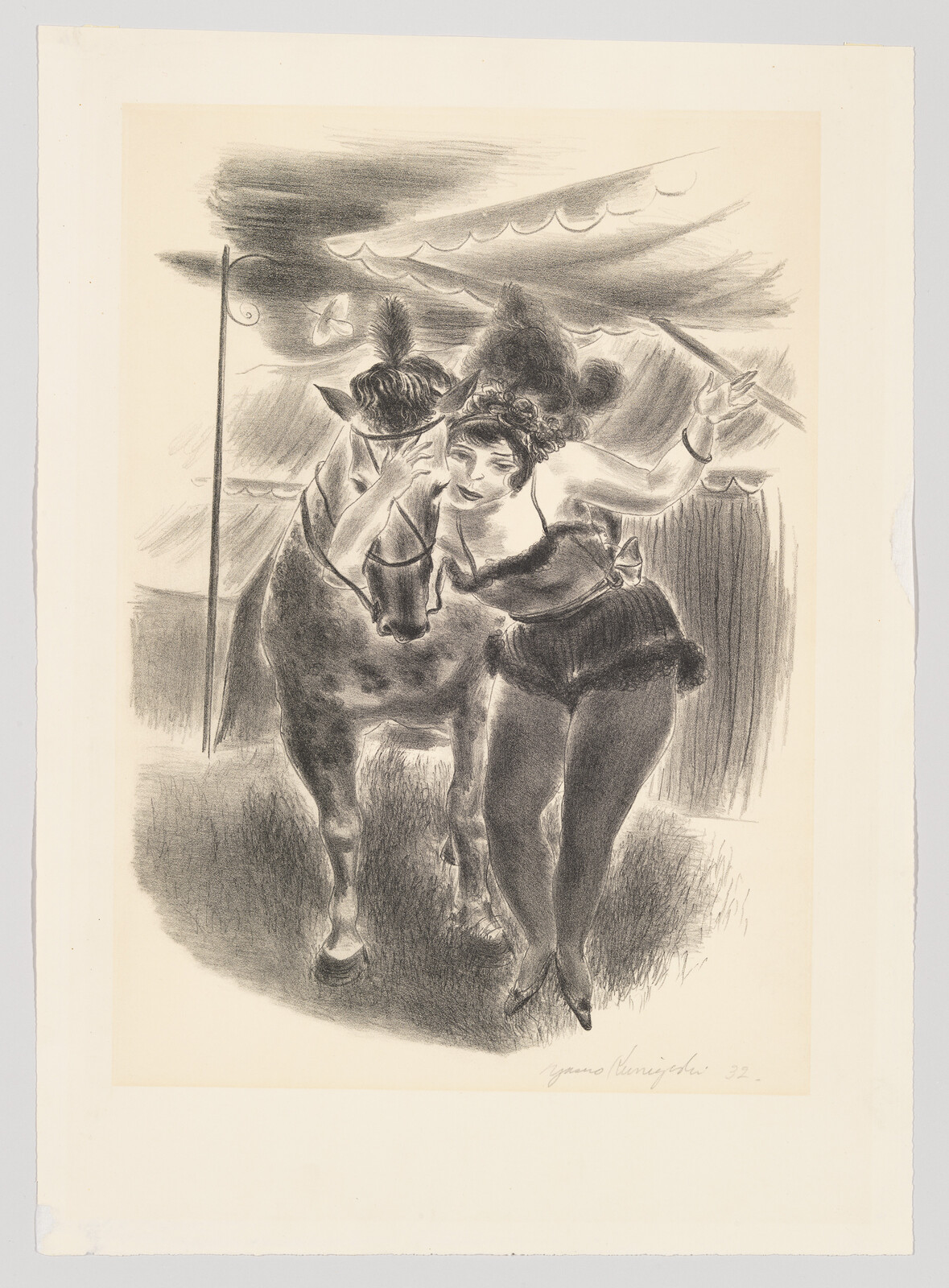
Before the Act
1932
Lithograph
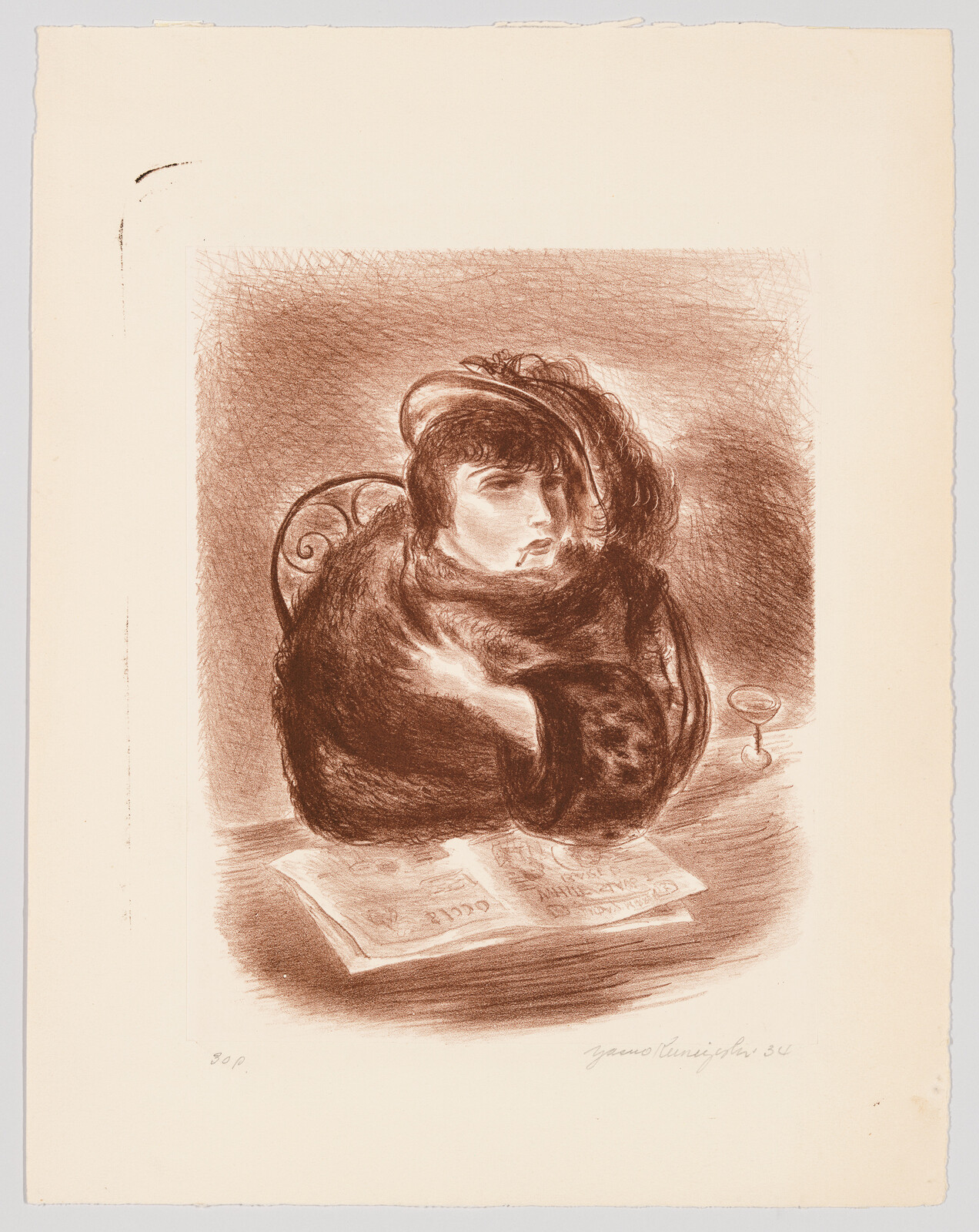
Cafe
1934
Lithograph with chine-collé
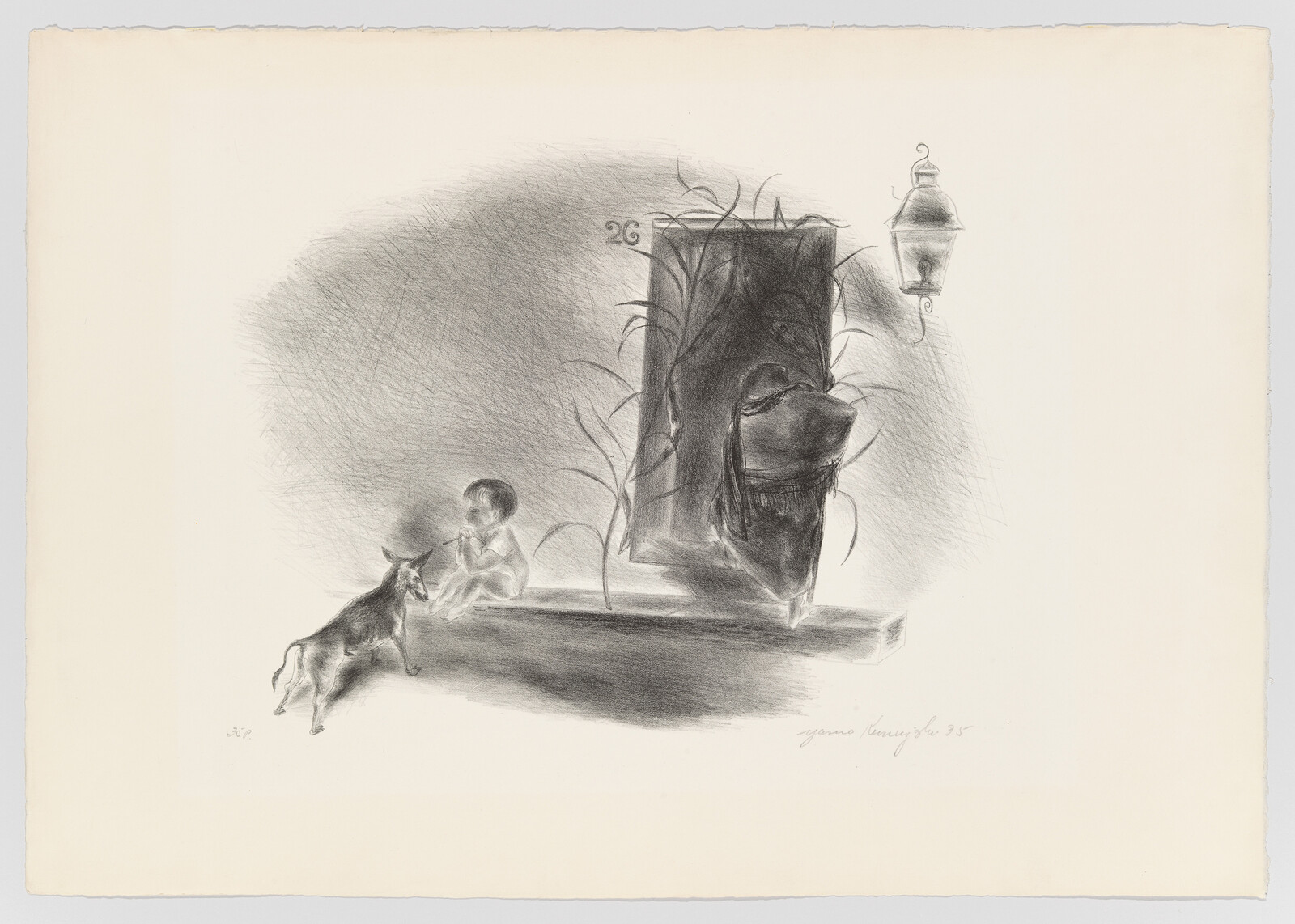
Taxco, Mexico
1935
Lithograph
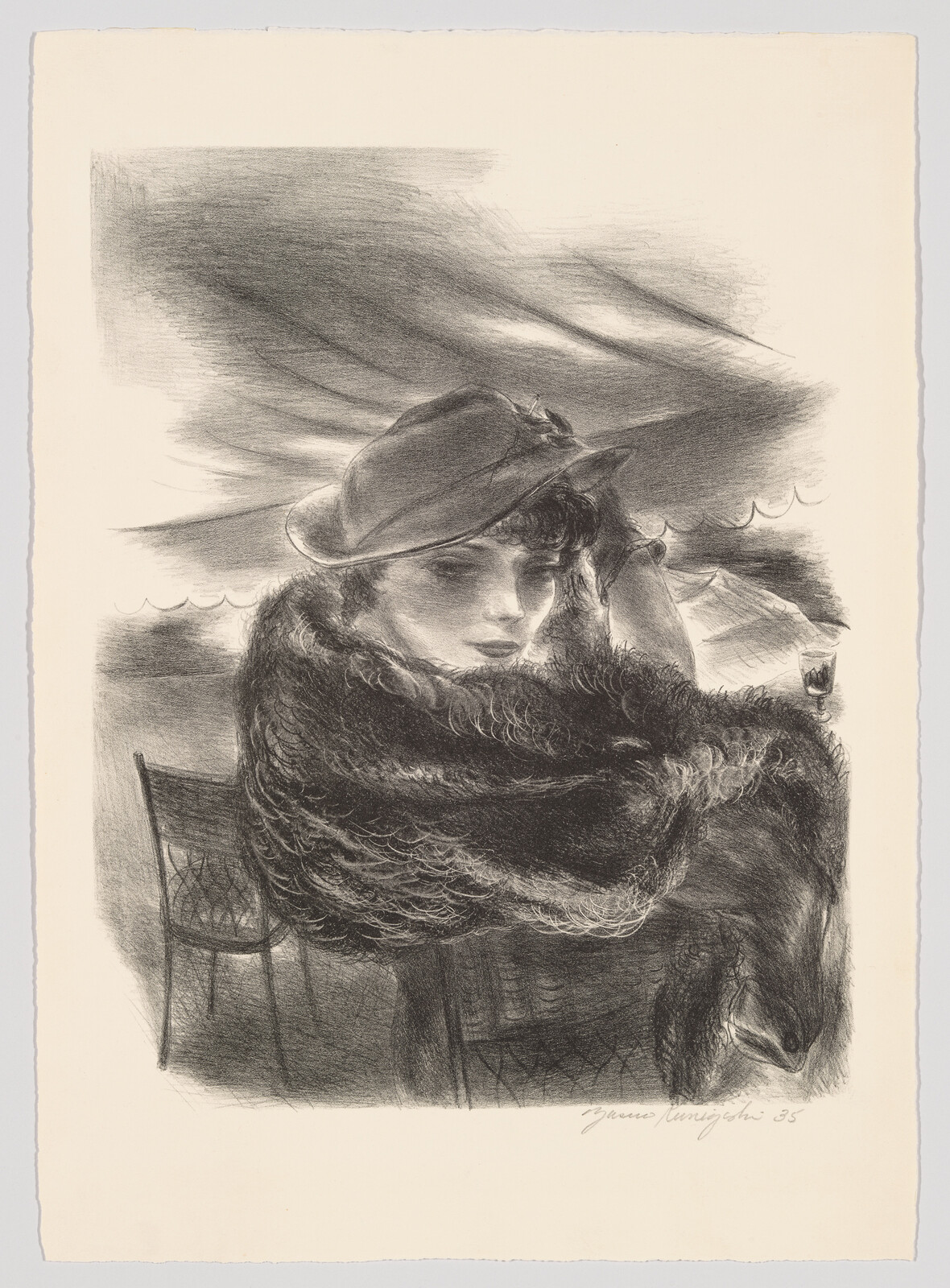
Cafe No. 2
1935
Lithograph
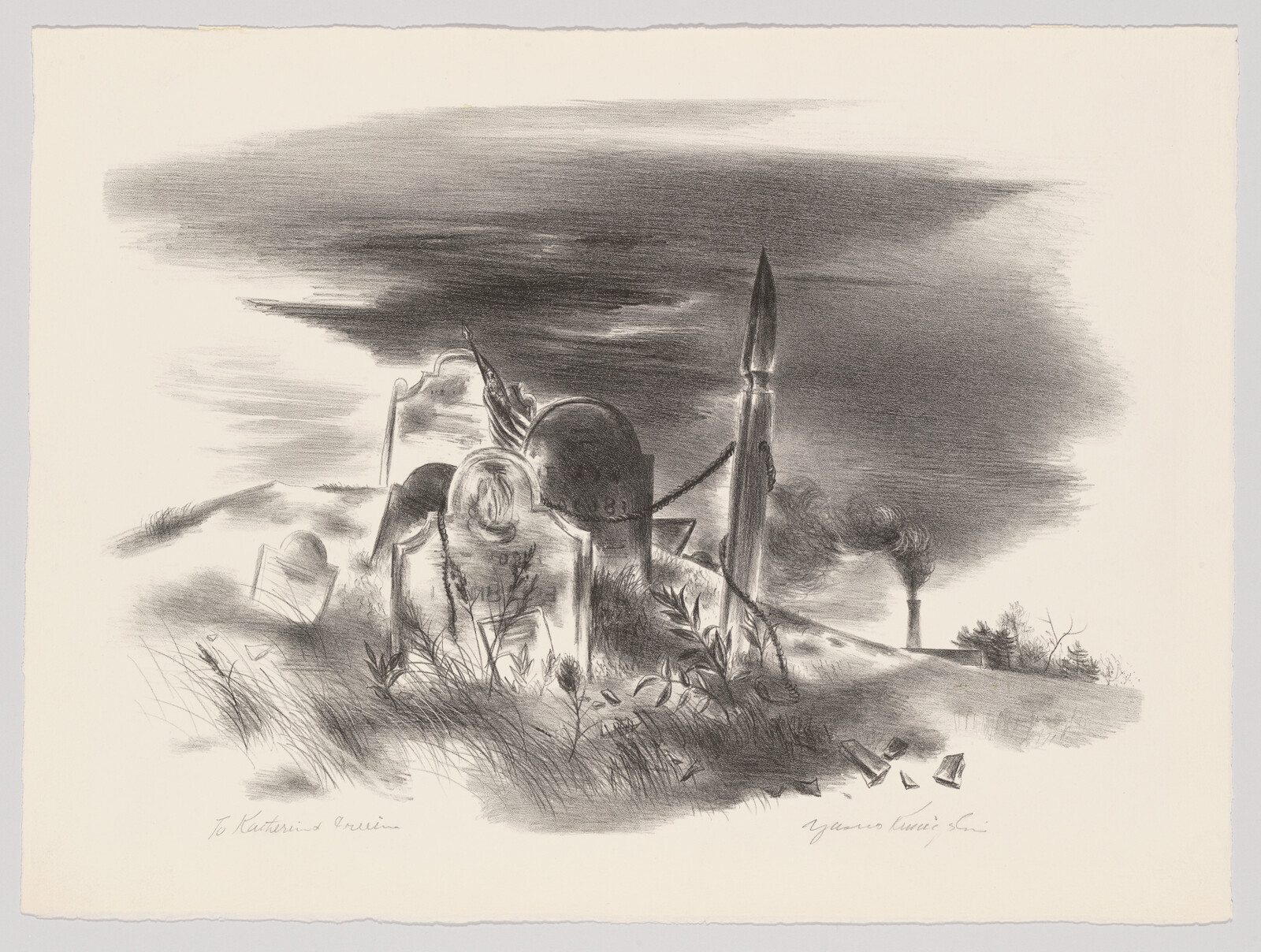
New England Landscape
1941
Lithograph