Biography
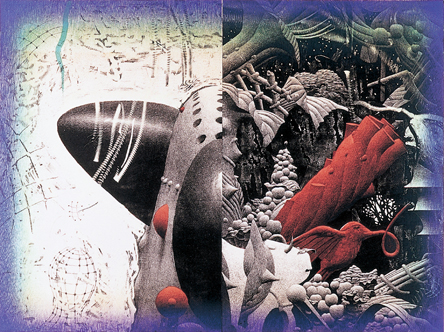
Hisashi Kurachi (born 1961, Aichi Prefecture) is a Japanese printmaker whose work merges lithography, etching and photographic image-making within a single sheet. He trained at Aichi University of the Arts (Aichi Prefectural University of Fine Arts and Music), earning a B.F.A. in oil painting in 1984 and completing his M.F.A. in oil painting in 1986. From that base he developed a print practice that crosses intaglio and lithographic registers — a distinctive litho-etching (relief-intaglio) method — and that increasingly incorporates photographic and digital transfer to produce uncannily three-dimensional, photograph-like imagery.
Kurachi's career has been marked by sustained international recognition on the print-biennial circuit. In 1999 he won a Silver Prize at the Taiwan International Print Biennial and a prize at the Norway International Print Triennial in the same year, and that year he also lectured at Silpakorn University in Thailand. He went on to receive a Director's Prize at the 2005 Kraków International Print Triennial in Poland, a Special Prize at the 2007 Split Graphic Biennial in Croatia, and an Excellence Award at the 2009 Bangkok International Print Triennial. Closer to home, he was awarded the Nagoya City Art Encouragement Prize in 2006. The Kraków Triennial in particular is among the most competitive juried print exhibitions in the field.
His prints are held in collections across Israel, Taiwan, Thailand, Bangladesh, Norway, Poland, Hungary and China, reflecting the international reach of his biennial participation. Kurachi is a professor in the Department of Oil Painting at Aichi University of the Arts and continues to live and work in the Aichi region, where his combination of regional training with wide international recognition is characteristic of the printmaking cohort that has emerged from the university.
Key Facts
- Active Period
- 1961
- Nationality
- 🇯🇵Japan
- Movement
- Contemporary Mokuhanga
- Works Indexed
- 2
Frequently Asked Questions
Hisashi Kurachi (born 1961, Aichi Prefecture) is a Japanese printmaker whose work merges lithography, etching and photographic image-making within a single sheet. He trained at Aichi University of the Arts (Aichi Prefectural University of Fine Arts and Music), earning a B.F.A. in oil painting in 1984 and completing his M.F.A. in oil painting in 1986. From that base he developed a print practice that crosses intaglio and lithographic registers — a distinctive litho-etching (relief-intaglio) method — and that increasingly incorporates photographic and digital transfer to produce uncannily three-dimensional, photograph-like imagery.
Hisashi Kurachi was active born in 1961. They were associated with the Contemporary Mokuhanga movement.
Hisashi Kurachi's work was shaped by the Contemporary Mokuhanga tradition in Japanese woodblock printmaking. Contemporary Mokuhanga: Contemporary mokuhanga (literally "wood-block print") encompasses artists working from approximately 1970 to the present who continue or reinvent traditional Japanese woodblock printing techniques.
