
Biography
Liao Shiou-Ping (Liao Shiou-ping; 廖修平; born 1936, Taipei) is widely recognized as the father of modern Taiwanese printmaking — the founding figure who brought contemporary printmaking back to Taiwan in the 1970s and seeded a generation of younger Taiwanese printmakers through his teaching and his founding of the Taipei International Biennial Print and Drawing Exhibition. His own practice, sustained across more than six decades, fuses Chinese folk-religious imagery — temple gates, festival icons, lantern motifs, gold leaf — with Western intaglio and silkscreen techniques learned in Tokyo, Paris, and New York.
Liao was born in Taipei in 1936, the fourth of ten sons in the family of the civil engineer Liao Qinfu. He attended Datong Middle School in Taipei, where he studied painting under Wu Dongcai, before entering the Fine Arts Department at National Taiwan Normal University in 1954. There he trained under several of the senior figures of postwar Taiwanese painting — Huang Junbi, Lin Yu-shan, Liao Jichun, and Chen Huikun — and earned his B.A. in Fine Arts in 1959. In 1962 he travelled to Japan to study at Tokyo University of Education (the predecessor of the present University of Tsukuba), majoring in painting and studying graphic design under Masato Takahashi. It was during these Tokyo years that he was first exposed to printmaking as a serious artistic medium.
In 1965 he moved to Paris and continued his studies, first at the École des Beaux-Arts and then at Atelier 17, the legendary print studio run by Stanley William Hayter that had previously worked with Joan Miró, Pablo Picasso, and many of the major postwar printmakers. The same year he won a silver medal at the Paris Spring Salon Exhibition, and in 1966 he became the first Chinese artist granted residency at the Cité Internationale des Arts. From 1968 he was based in the New York area, where he held an assistantship at the Pratt Graphics Center and took first prize at the 28th Audubon Artists' Exhibition. His print La Fête was acquired by the Musée d'Art Moderne in Paris during this period, and major museum acquisitions began to follow.
In 1973 Liao returned to Taiwan and began the teaching career that has shaped contemporary Taiwanese printmaking. He has taught at National Taiwan Normal University, Chinese Culture University, and the National Taiwan University of the Arts, and from 1977 to 1979 he taught at Tsukuba University in Japan. In 1974 he published The Art of Printmaking, a foundational Chinese-language print textbook, and in 1983 he initiated the Taipei International Biennial Print and Drawing Exhibition, which has since become one of the principal print biennials in East Asia.
Liao's mature visual programme is divided across long-running series: Gate Gods (early 1960s, oil); Gate (mid 1960s, intaglio and lithography); Temple (1960s-1970s, silkscreen and photography); Symbols (1970s, silkscreen and geometric pattern); Seasons (late 1970s); Gathering and Chat (1980s); Manikin (1986, silkscreen, critiquing mechanized society); Garden Party (1980s-1990s, with alcohol containers); Knots (2000); Life Symbols (2000-present, oil, acrylic, gold leaf, wood); Dreams (2003-present, on mortality after his wife's death in a 2002 birdwatching accident); Timeless (2005); Speechless (2008, installation); and Double Wealth (2008). The persistent thread is the temple-gate motif — a square architectural form filled with red, gold, vermilion, and folk-religious iconography — which appears in compositions across all the print and painting series.
His works are held in the British Museum (London), the Metropolitan Museum of Art (New York), the National Museum of Modern Art (Tokyo), the Taipei Fine Arts Museum, and the Musée d'Art Moderne in Paris, among many other public collections. He has had numerous solo exhibitions internationally, in cities including Tokyo, Paris, New York, Hong Kong, San Francisco, Seoul, and Taipei. He has been the recipient of the Wu San-lien Award and the National Literature and Art Achievement Award in Taiwan, and was named one of ten outstanding young people in Taiwan in 1974. He has held a chair professorship at National Taiwan Normal University.
Liao's role in twentieth-century East Asian printmaking is foundational: he was the principal channel through which postwar Western print methodology — Atelier 17 intaglio, embossed-gold-leaf collagraph, photographic-silkscreen — entered Taiwanese contemporary art, and the printmaker through whose teaching at Tsukuba and Taipei the next two generations of Taiwanese, mainland Chinese, and Japanese printmakers were trained.
Key Facts
- Active Period
- 1936
- Nationality
- 🇹🇼Taiwan
- Movement
- Contemporary Mokuhanga
- Subjects
- ReligiousBirds & Flowers
- Works Indexed
- 11
Frequently Asked Questions
Liao Shiou-Ping (Liao Shiou-ping; 廖修平; born 1936, Taipei) is widely recognized as the father of modern Taiwanese printmaking — the founding figure who brought contemporary printmaking back to Taiwan in the 1970s and seeded a generation of younger Taiwanese printmakers through his teaching and his founding of the Taipei International Biennial Print and Drawing Exhibition. His own practice, sustained across more than six decades, fuses Chinese folk-religious imagery — temple gates, festival icons, lantern motifs, gold leaf — with Western intaglio and silkscreen techniques learned in Tokyo, Paris, and New York.
Liao Shiou-Ping was active born in 1936. They were associated with the Contemporary Mokuhanga movement.
Liao Shiou-Ping's work was shaped by the Contemporary Mokuhanga tradition in Japanese woodblock printmaking. Contemporary Mokuhanga: Contemporary mokuhanga (literally "wood-block print") encompasses artists working from approximately 1970 to the present who continue or reinvent traditional Japanese woodblock printing techniques.
Liao Shiou-Ping's prints frequently feature religious, birds & flowers.
Woodblock Prints by Liao Shiou-Ping (11)

Work A
1962
Oil on canvas

Worship
1963
Oil on canvas

Praying
1966
Oil on canvas

Gate of Wisdom
1967
Oil and gold leaf on canvas
Blessing
祈求
c. 1970
Color intaglio on BFK Rives wove paper

Counterpart
1972
Etching

Four Seasons
1997
Oil and gold leaf on canvas

Silent Image
2000
Oil on canvas

Prayer
2004
Mixed media

Gate of Wealth IV
2014
Acrylic and gold leaf on canvas
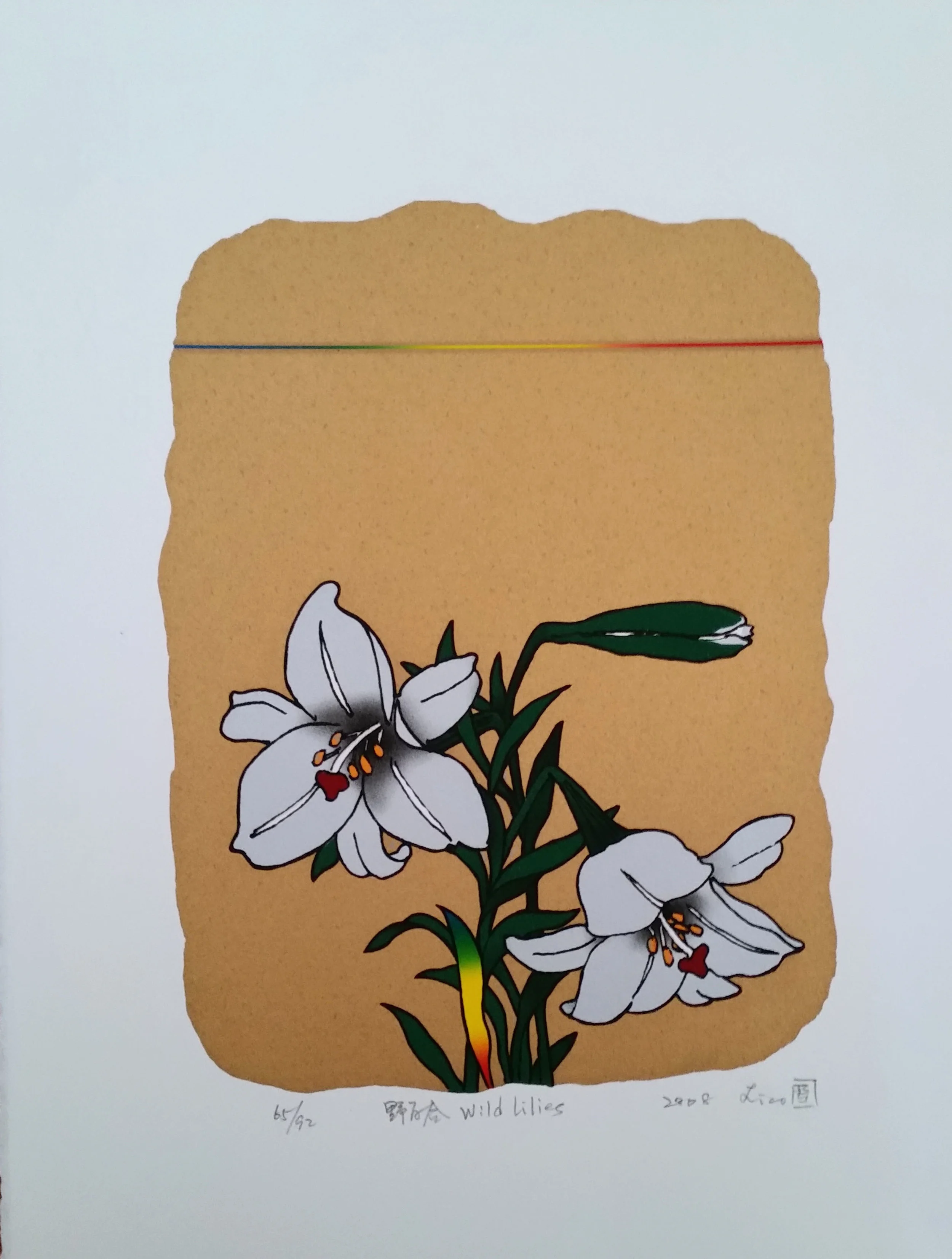
Wild Lilies
Mixed media