
Migishi Kōtarō
三岸好太郎
1903–1934
Japan
Biography
Migishi Kōtarō (三岸好太郎, 1903–1934) was a Japanese yōga (Western-style) painter whose brief career carried him from beginnings in Sapporo through the post-impressionist and Fauvist experiments of the late Taishō era to the lyrical proto-surrealism of his final months — a body of work that has come to define the romantic, short-lived modernism of the early Shōwa period. Working almost entirely in oil, Migishi belonged to no academy and never attended the Tokyo School of Fine Arts; his development was largely that of a self-directed painter who learned in the exhibition halls and studios of Taishō Tokyo. By the end of his life he was one of the founding members of the Dokuritsu Bijutsu Kyōkai (Independent Art Association), a central society of early Shōwa yōga, and he is remembered as one of the first Japanese painters to move decisively toward Surrealism — his 1934 sequence of shells, butterflies, and luminous seascapes bringing Japanese painting close to the reverie of Yves Tanguy. He died on 1 July 1934 in Nagoya, aged thirty-one, leaving a small but influential body of work whose reputation has only grown across the decades since.
Migishi was born on 18 April 1903 in Sapporo, Hokkaidō; his elder half-brother, by the same mother, was the novelist Shimozawa Kan (born Umetani Matsutarō). Kōtarō grew up in Sapporo and attended Sapporo First Middle School (now Hokkaidō Sapporo Minami High School), where he became interested in oil painting and received early instruction from a local painter, Hayashi Takejirō. Around 1920–21 he moved to Tokyo, where the paintings of Cézanne and Van Gogh that he saw at an exhibition mounted by the Shirakaba-ha literary circle left a lasting impression. He did not enter the Tokyo School of Fine Arts or any formal art academy; instead he began exhibiting with the Shun'yōkai (Spring Sun Society), one of the principal non-academic Western-style painting societies of the period.
His first significant success came at the Shun'yōkai, where his Girl Holding a Lemon was accepted in 1923 and, the following year, he took the society's top prize with a group of works that included Elder Brother and His Eldest Daughter — a family portrait that established him, at twenty-one, as a painter of unusual psychological subtlety and a Cézannist sense of structure. He continued to draw subjects from Hokkaidō on return visits north, applying the post-impressionist palette of contemporary Tokyo yōga to the cold colours and long horizons of his birthplace. In 1924 he married the painter Yoshida Setsuko — later known professionally as Migishi Setsuko (1905–1999) — and the two maintained a precarious but productive household in Tokyo while both continued to exhibit. Setsuko's own career flourished after her husband's death; she lived until 1999 and became one of the central figures of postwar yōga.
The late 1920s and early 1930s were Migishi's first mature phase, a sequence of densely worked figural compositions on circus, clown, and marionette themes — among them The Man with a Mask — that placed him within a broadly European fascination with masked, performing figures, the painterly territory of Rouault's clowns and the late Cézanne's harlequins. In these years the influence of Georges Rouault's Fauvism grew increasingly marked, while a related group of nudes shows him working through the Paris-school treatment of the figure associated with Tsuguharu Foujita. With their dark-toned grounds, stiff marionette-like figures, and flattened patterned costumes, these paintings are among the most distinctive products of late-Taishō and early-Shōwa yōga, and they established the iconographic territory — performance, fantasy, melancholy childhood — that would carry through into his surrealist final period.
In November 1930 Migishi became one of the fourteen founding members of the Dokuritsu Bijutsu Kyōkai (Independent Art Association, 独立美術協会) — the youngest of the group — alongside such painters as Fukuzawa Ichirō, Kojima Zenzaburō, Hayashi Takeshi, Kawaguchi Kigai, and Itō Ren. The Dokuritsuten, its annual exhibition, became a principal venue for non-academic, anti-Teiten yōga in the 1930s, and Migishi's submissions there document the rapid evolution of his late style. His encounter with the 1932 Paris–Tokyo New Art Alliance exhibition proved a catalyst, pushing his painting swiftly toward the avant-garde; his Orchestra compositions of this period, one of which is held by the Miyagi Museum of Art, mark a break with the dense, illustrative figural mode of the clown years, their unmoored figures and ambiguous interior spaces registering the arrival of French surrealism in Tokyo.
The final year, 1934, is the period for which Migishi is principally remembered. He produced a series of shells, butterflies, and luminous seascapes — often read as evoking an afterworld — whose best-known painting is Sea and Light (Umi to shakō); that year he also published an illustrated narrative poem, Butterflies and Shells. Executed in a high-keyed palette against luminous open grounds, these works replace the dark interiors of his earlier painting with infinite, Tanguy-like horizons populated only by detached natural fragments, and they count among the most fully realised surrealist paintings produced in Japan to that date; they were shown posthumously at the Independent Art Association's exhibition that autumn. At the time of his death Migishi had been overseeing a new studio, near completion. In late June 1934, returning from a trip to the Kansai region, he stopped in Nagoya, where on 1 July he collapsed from a hemorrhaging gastric ulcer, complicated by a heart attack, and died; he was thirty-one. In 1967 the Hokkaidō prefectural government opened a memorial museum devoted to him — now the Migishi Kōtarō Museum of Art — which holds the largest single concentration of his paintings; his work is also represented in other major Japanese public collections, including the National Museum of Modern Art, Tokyo, and the Miyagi Museum of Art.
Key Facts
- Active Period
- 1903–1934
- Nationality
- 🇯🇵Japan
- Works Indexed
- 14
Frequently Asked Questions
Migishi Kōtarō (三岸好太郎, 1903–1934) was a Japanese yōga (Western-style) painter whose brief career carried him from beginnings in Sapporo through the post-impressionist and Fauvist experiments of the late Taishō era to the lyrical proto-surrealism of his final months — a body of work that has come to define the romantic, short-lived modernism of the early Shōwa period. Working almost entirely in oil, Migishi belonged to no academy and never attended the Tokyo School of Fine Arts; his development was largely that of a self-directed painter who learned in the exhibition halls and studios of Taishō Tokyo. By the end of his life he was one of the founding members of the Dokuritsu Bijutsu Kyōkai (Independent Art Association), a central society of early Shōwa yōga, and he is remembered as one of the first Japanese painters to move decisively toward Surrealism — his 1934 sequence of shells, butterflies, and luminous seascapes bringing Japanese painting close to the reverie of Yves Tanguy. He died on 1 July 1934 in Nagoya, aged thirty-one, leaving a small but influential body of work whose reputation has only grown across the decades since.
Migishi Kōtarō was active from 1903 to 1934.
Original prints by Migishi Kōtarō can be found in collections including Hongō Shin Memorial Museum of Sculpture, Sapporo, Miyagi Museum of Art, Location unknown (former Gōra Hotel collection), Menard Art Museum, Komaki.
Woodblock Prints by Migishi Kōtarō (14)
Elder Brother and his Eldest Daughter
兄とその長女
1924
Oil on canvas

Suburban in Sapporo
札幌郊外
c. 1927
Oil on canvas

Clown Boy
少年道化
1929
Oil on canvas
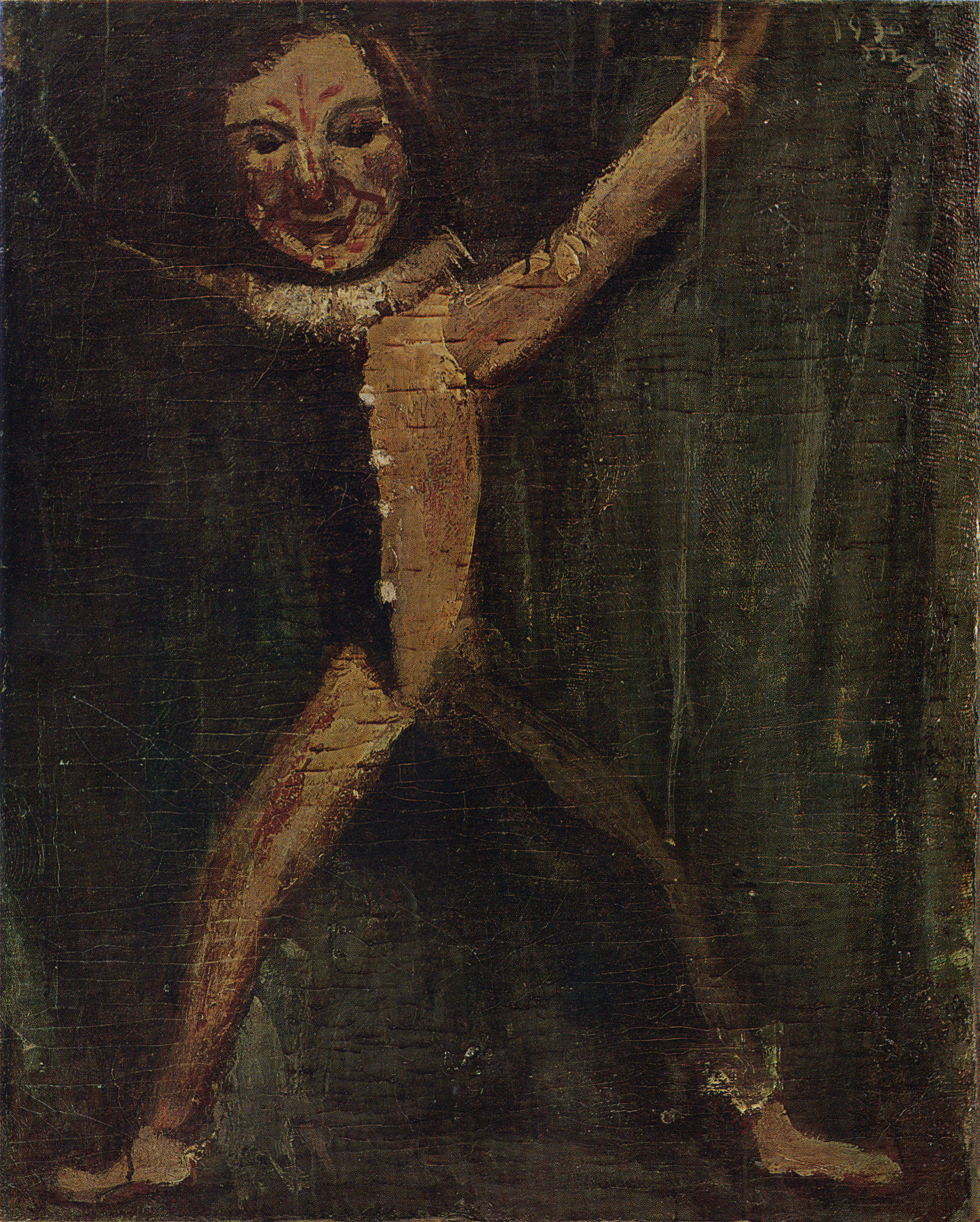
Marionette
マリオネット
1930
Oil on canvas

A White Horse and a Clown
白馬と道化
1932
Oil on canvas

Composition (Still Life with a Fireplace)
構図(暖炉のある静物)
1933
Oil on canvas

Orchestra
オーケストラ
1933
Oil on canvas

Sea and Light
海と光
1934
Oil on canvas

Butterflies Crossing the Ocean
海洋を渡る蝶
1934
Oil on canvas

Flying Butterfly
飛ぶ蝶
1934
Oil on board
Sea and Oblique Light
海と斜光
1934
Oil on canvas

Loneliness on Journey
旅愁
1934
Oil on canvas

Butterflies Flying above Clouds
雲の上を飛ぶ蝶
1934
Oil on canvas

A Shell and Butterflies
貝殻と蝶
1934
Oil on canvas