
Nakagawa Hachirō
中川八郎
1877–1922
Japan
Biography
Nakagawa Hachirō (中川八郎, 1877-1922) was a Meiji- and Taishō-era yōga (Western-style) painter whose short career placed him among the second generation of Japanese watercolourists trained in the wake of the country's accelerated absorption of European academic painting after the Meiji Restoration. Born in Ehime prefecture, on the island of Shikoku, in 1877, he made his way to Tokyo to pursue an artistic vocation and studied under the yōga painters Matsubara Sangorō and Koyama Shōtarō (1857-1916), the latter at the Fudōsha (不同舎), the private Western-style painting school run by Koyama. Fudōsha was, alongside the Hakubakai (White Horse Society) of Kuroda Seiki, one of the principal training grounds for early twentieth-century Western-style painters in Japan, and Koyama — himself a pupil of the foreign-employed Italian painter Antonio Fontanesi at the Kōbu Bijutsu Gakkō (Technical Fine Arts School) in the 1870s — passed on to his students a sober, drawing-led approach to Western pictorial method that owed as much to Barbizon naturalism and the Italian academy as to French Impressionism.
Nakagawa emerged from this training as a watercolourist of distinct sensibility, though he worked in oil as well. Watercolour was the medium through which Western pictorial techniques were most rapidly disseminated to a Japanese audience in the late nineteenth century — through textbooks, through visiting British and Continental artists, and through the early yōga curriculum — and it remained for many young painters the more affordable, more portable, and more idiomatically expressive vehicle. In Nakagawa's hands the medium produced a body of work that joined the open, atmospheric handling of late-Victorian English watercolour with subjects firmly rooted in the Japanese countryside: village streets in winter snow, sailing vessels on coastal mudflats, temples half-hidden in bamboo groves, rain-darkened cherry trees, irises along suburban canals, autumn fields, and the daily traffic of farmers and travellers. He often signed his work in roman letters as 'H. Nakagawa,' a habit that reflects the international as well as domestic audience his career came to reach.
The defining episodes of his career were his journeys to the United States alongside the watercolourist Yoshida Hiroshi (1876-1950), later a foundational figure of the shin-hanga print movement and Nakagawa's close friend and travelling companion. The pair first exhibited in America in 1899, showing at the Detroit Museum of Art, and in 1900 held a joint exhibition at the Museum of Fine Arts, Boston. Nakagawa returned to the United States with Yoshida in 1903, and their watercolours were shown at the 1904 Louisiana Purchase Exposition (the St. Louis World's Fair), where Yoshida was awarded a bronze medal. These largely self-organised exhibition tours placed a substantial body of Nakagawa's watercolours into American private collections, where they still surface, more than a century later, in regional American auctions — most signed in the artist's hand.
On his return to Japan, Nakagawa continued to exhibit through the principal Tokyo salons of the late Meiji and Taishō period. In 1902 he was among the founders of the Taiheiyō Gakai (Pacific Painting Society), and he became a frequent exhibitor and prize-winner at the government Bunten exhibitions, later showing at the Teiten as well; he also travelled to Europe for study at points in his career. Working in a romantic academic manner touched by Impressionism, he returned repeatedly to the same vocabulary of motifs: the low, broad shoreline of the inland-sea coast; the temple gate seen through bamboo or maple; the small farming village under rain or snow; the handful of figures on a road or in a boat, never individualised but rendered with the loose, summary stroke characteristic of watercolour at speed; and the carefully observed sky, often slate-grey or rose-tinted, that sets the dominant tonal register of each composition. His palette tended toward the muted greens, slate blues, ochres, and burnt sienna of late-nineteenth-century English watercolour, and his draughtsmanship retained the underlying academic discipline of Koyama's teaching.
Nakagawa's working life was cut short in his mid-forties; he died in 1922 at the age of forty-five, before the full ambition of his watercolour idiom could be carried into the more experimental currents of late-Taishō and early-Shōwa painting. The eclipse of watercolour by oil paint as the dominant Western medium in Japanese art schools from the 1910s onward, together with art history's concentration on the great oil painters of the Hakubakai and on the print-makers of the shin-hanga movement, contributed to his relative invisibility in twentieth-century surveys. His name is now most often encountered in connection with Yoshida Hiroshi, whose own watercolour and print career was shaped by the American journeys the two men made together. His paintings are held by the National Museum of Modern Art, Tokyo, and his landscapes were the subject of a centennial exhibition at the Museum of Art, Ehime, in his home prefecture — leaving him best understood as one of the more cosmopolitan and accomplished of the early Japanese watercolourists, a painter who carried the discipline of Koyama Shōtarō's academic training into a relaxed, atmospheric idiom and who, through his American journeys with Yoshida Hiroshi, helped establish modern Japanese painting as a presence in early-twentieth-century American collections.
Key Facts
- Active Period
- 1877–1922
- Nationality
- 🇯🇵Japan
- Works Indexed
- 9
Frequently Asked Questions
Nakagawa Hachirō (中川八郎, 1877-1922) was a Meiji- and Taishō-era yōga (Western-style) painter whose short career placed him among the second generation of Japanese watercolourists trained in the wake of the country's accelerated absorption of European academic painting after the Meiji Restoration. Born in Ehime prefecture, on the island of Shikoku, in 1877, he made his way to Tokyo to pursue an artistic vocation and studied under the yōga painters Matsubara Sangorō and Koyama Shōtarō (1857-1916), the latter at the Fudōsha (不同舎), the private Western-style painting school run by Koyama. Fudōsha was, alongside the Hakubakai (White Horse Society) of Kuroda Seiki, one of the principal training grounds for early twentieth-century Western-style painters in Japan, and Koyama — himself a pupil of the foreign-employed Italian painter Antonio Fontanesi at the Kōbu Bijutsu Gakkō (Technical Fine Arts School) in the 1870s — passed on to his students a sober, drawing-led approach to Western pictorial method that owed as much to Barbizon naturalism and the Italian academy as to French Impressionism.
Nakagawa Hachirō was active from 1877 to 1922.
Nakagawa Hachirō's prints frequently feature spring, birds & flowers, autumn foliage, rain.
Original prints by Nakagawa Hachirō can be found in collections including Wikimedia Commons, Japanese Art Open Database (JAODB) via ukiyo-e.org.
Woodblock Prints by Nakagawa Hachirō (9)
Temple in a Bamboo Wood
1899
Watercolor on paper

Figures in a Boat
1903
Watercolor on paper

Sailing Vessels Pulled Ashore
before 1923
Watercolor on paper

Autumn Village with Figure
before 1923
Watercolor on paper

Sailing Ship on Shore
before 1923
Watercolor on paper
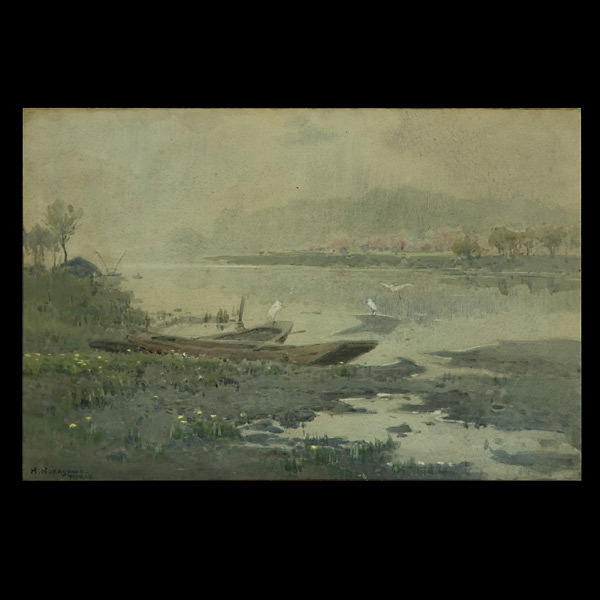
Spring Rain
before 1923
Watercolor on paper

Winter Village with Figures and Horses
before 1923
Watercolor on paper
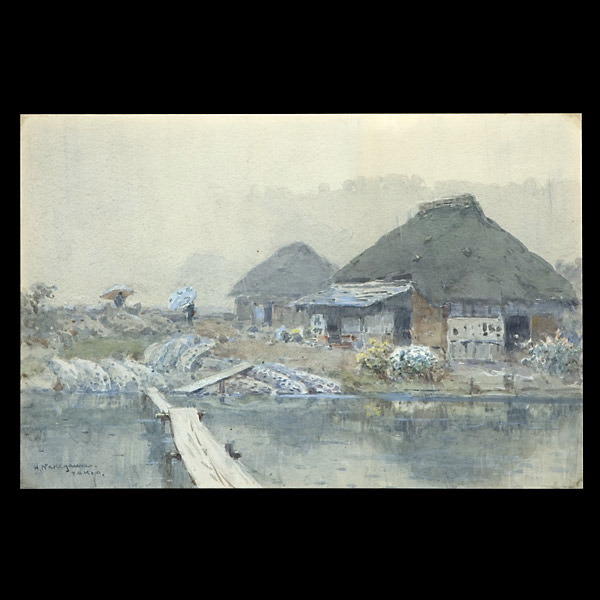
Japanese Village Scene with Figures
before 1923
Watercolor on paper

Iris Pavilion (Tokyo)
before 1923
Watercolor on paper