Biography
Takehiro Nikai (二階武宏, born 1980, Nagoya, Aichi Prefecture) is a Japanese printmaker whose practice is anchored in wood engraving (kiguchi mokuhan / 木口木版) — the technique of engraving on the dense end-grain of hardwood, a European-derived method sustained in Japan by a small community of dedicated specialists. Nikai is among the more prolific and frequently prize-recognized wood-engraving artists of his generation in Japan; his small, densely worked black-and-white prints have been honored at major Japanese print competitions and are held in public collections in Japan and China.
Nikai graduated from the Printmaking Division of Kyoto Seika University in 2004. The Kyoto Seika printmaking program is one of the principal Japanese training centers for both relief and intaglio printmaking, and Nikai's wood-engraving specialization reflects the program's commitment to maintaining Western-derived techniques alongside indigenous mokuhanga. He is based in Kyoto.
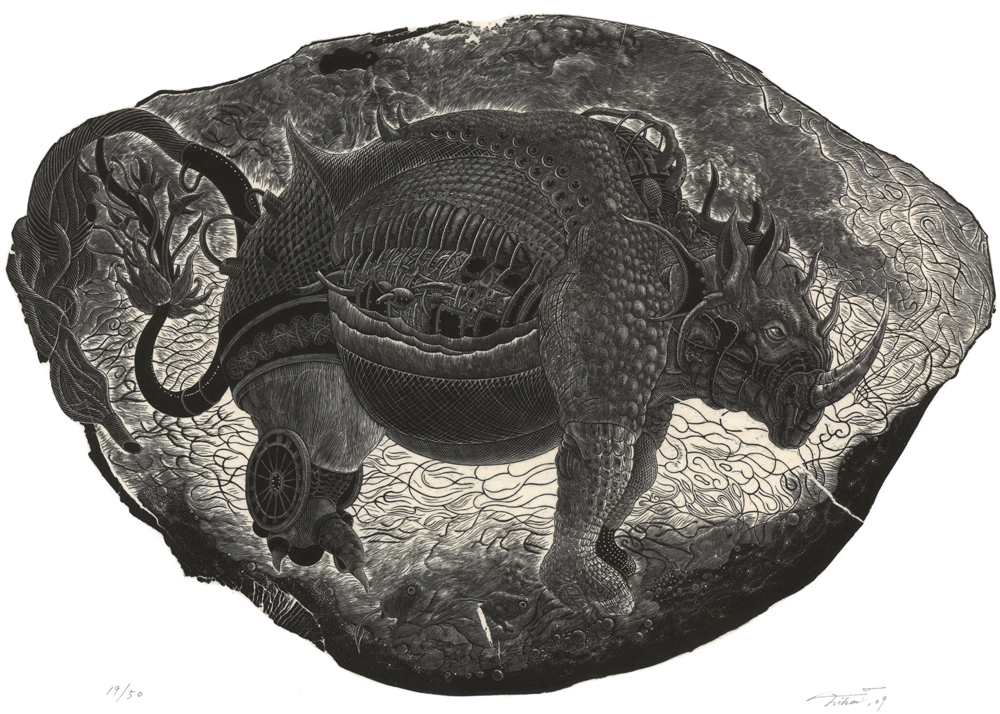
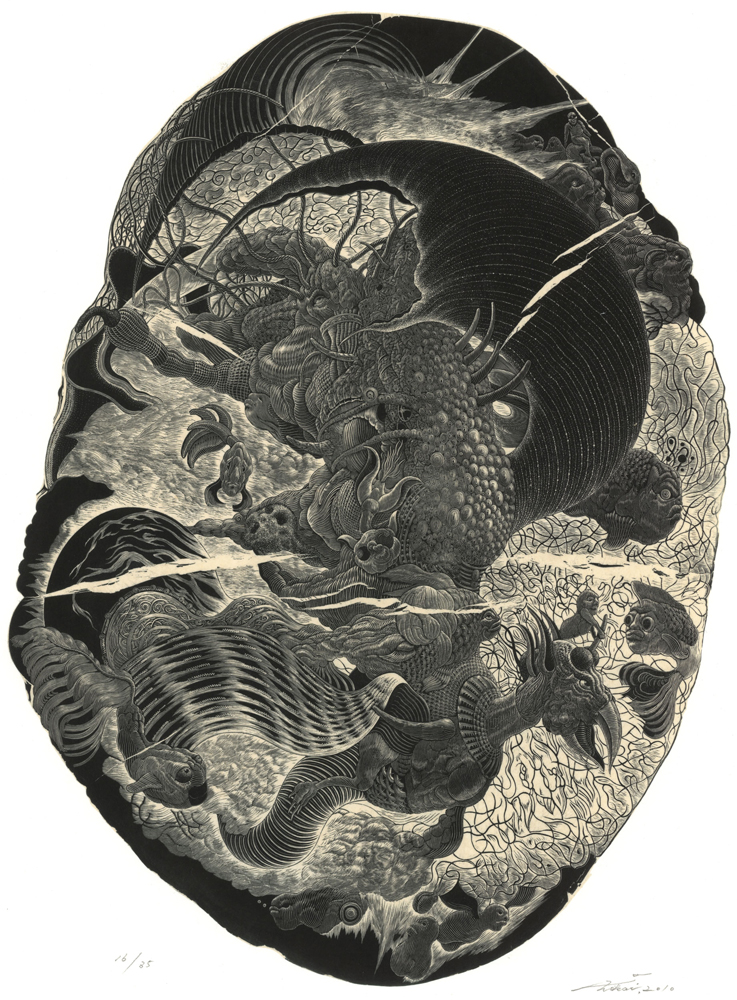
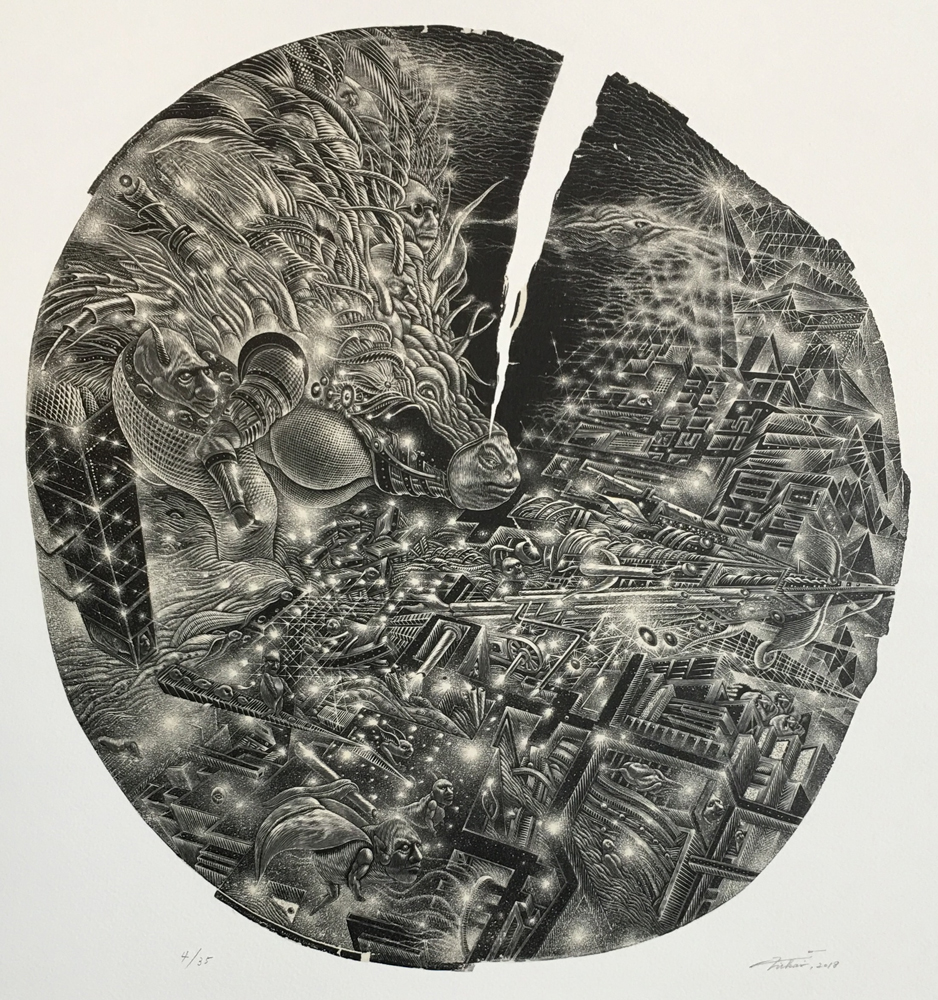
The technical commitment of Nikai's mature practice is to wood engraving as both an aesthetic and a discipline: the small format imposed by the size of available end-grain plates, the tight cross-hatched line vocabulary, the high-contrast monochrome register, and the slow physical effort of cutting against end-grain together produce a body of work that is dense, intricate, and methodologically rigorous. His imagery is distinctive for its intricate hybrid creatures that merge animal forms with machinery. Works that have circulated through Yamada Shoten in Tokyo include the wood engravings 'Cloud' (2006) and 'Whip' (鞭, 2009).
Nikai's award record traces his early-career emergence and subsequent recognition: at the Japan Print Association Exhibition he received the Yamaguchi Gen Newcomer's Prize in 2004 and an Encouragement Prize in 2005; he was recognized at the 7th Kochi International Print Triennial in 2008 and again at the 9th in 2014; and at the Kanuma City Kawakami Sumio Woodcut-Print Grand-Prix he took the runner-up prize (Quasi-Grand-Prix) in 2010 and a Judges' Special Prize in 2012. The Kawakami Sumio Grand-Prix is a Japanese award devoted specifically to woodcut and wood engraving, situating Nikai within a sub-community that distinguishes itself from broader 'print' awards.
Nikai's solo exhibitions are concentrated at Shinobazu Gallery in Tokyo, which represents him and has hosted shows in 2014, 2018, and 2019, among other years. He was selected for the 3rd PATinKyoto Print Art Triennale in 2022, placing him within the contemporary print-triennial circuit. His prints are held in the public collections of the Kanuma City Kawakami Sumio Art Museum in Tochigi — the principal woodcut-specific museum in Japan — and the Zhejiang Provincial Art Museum in Hangzhou, China.
Key Facts
- Active Period
- 1980
- Nationality
- 🇯🇵Japan
- Movement
- Contemporary Mokuhanga
- Works Indexed
- 3
Frequently Asked Questions
Takehiro Nikai (二階武宏, born 1980, Nagoya, Aichi Prefecture) is a Japanese printmaker whose practice is anchored in wood engraving (kiguchi mokuhan / 木口木版) — the technique of engraving on the dense end-grain of hardwood, a European-derived method sustained in Japan by a small community of dedicated specialists. Nikai is among the more prolific and frequently prize-recognized wood-engraving artists of his generation in Japan; his small, densely worked black-and-white prints have been honored at major Japanese print competitions and are held in public collections in Japan and China.
Takehiro Nikai was active born in 1980. They were associated with the Contemporary Mokuhanga movement.
Takehiro Nikai's work was shaped by the Contemporary Mokuhanga tradition in Japanese woodblock printmaking. Contemporary Mokuhanga: Contemporary mokuhanga (literally "wood-block print") encompasses artists working from approximately 1970 to the present who continue or reinvent traditional Japanese woodblock printing techniques.