Biography
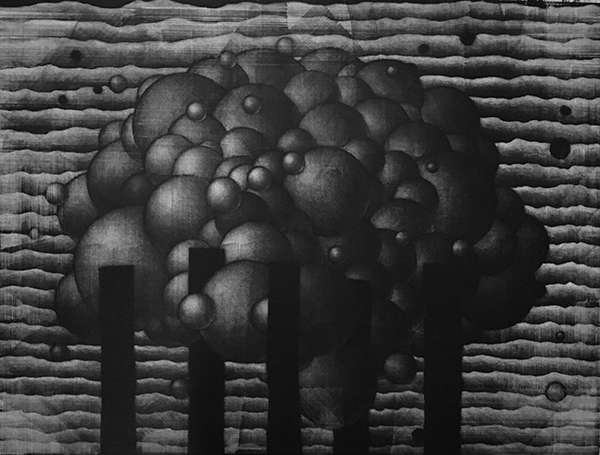
Hiroyuki Omori (born 1991, Ibaraki Prefecture) is a Japanese intaglio printmaker who works primarily in mezzotint, with sustained additional practice in aquatint and combined etching-mezzotint techniques. Among the most decorated of the youngest generation of Japanese printmakers, his prints place small natural subjects — clouds, water droplets, grass — into the deep velvety blacks that mezzotint as a medium uniquely produces. Based in Yamagata Prefecture, he has been a sustained presence in Japanese print exhibitions and prizes since the mid-2010s.
Omori trained at the Tohoku University of Art and Design in Yamagata, completing the Graduate School of Art Engineering Master's Program in Western Painting in 2016. His instructors included the senior printmakers Wakatsuki Kohei (若月公平) and Nakamura Keiko (中村桂子). The Tohoku University of Art and Design printmaking program, while smaller than Tokyo Geidai or Tama Art University, has consistently produced prize-winning printmakers, and Omori's emergence at the start of his career placed him at the front of his cohort.
The early prize record is extraordinarily compact: in 2015 he received the CWAJ 60th Anniversary Commemorative Grand Prize Exhibition Jury Special Award and the 40th National University Print Exhibition Collection Prize at the Machida City International Print Museum, the principal print museum in greater Tokyo. In 2016 he won the CWAJ Young Printmaker Award and was selected for the 84th Japan Print Association Exhibition at the Tokyo Metropolitan Art Museum. The CWAJ Young Printmaker Award is one of the most direct paths into the contemporary Japanese print scene; the same award, in earlier and later years, has been won by many of the printmakers who have gone on to define their generation.
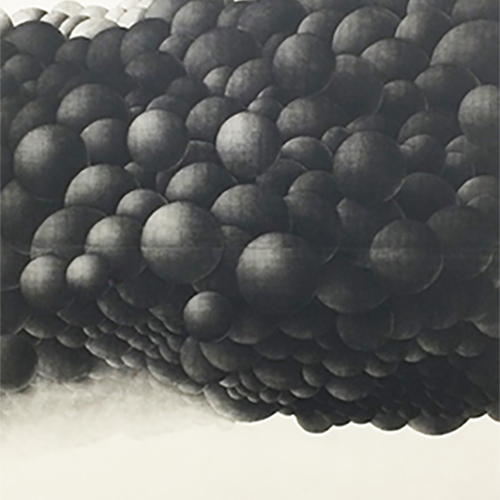
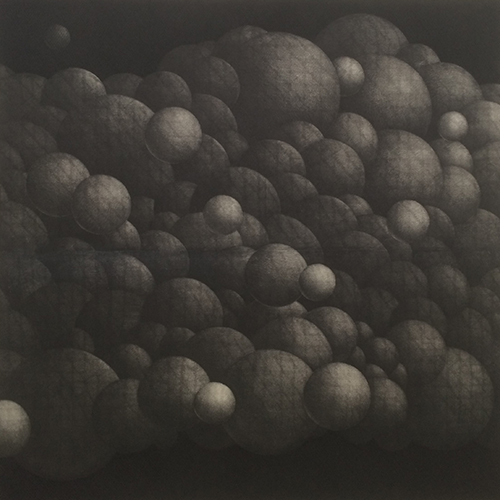
His early prints were large-format mezzotints. 'Black Clouds' (2015) and 'Clouds in the Shadow' (2016) — both 121.2 × 121.2 cm — are unusually large for mezzotint, which because of its laborious roughening of the plate surface (rocking the metal with a serrated rocker tool to produce a uniform burr that prints as solid black) is normally produced at smaller sizes. The square format and the uniform deep-black field, with subject barely emerging from shadow, became his signature visual register.
The later sequence shifted toward water as motif. 'A Drop of Water' (2020), an aquatint on a 36.6 × 26.0 cm plate, and 'The Destination of Water' (2021), a smaller 17 × 10.5 cm plate, mark the beginning of a sustained water series. The 2023 mezzotint 'Listen to the Voiceless' (29 × 21 cm) and the 2025 mezzotint 'They Will Definitely Catch the Light' (33 × 27 cm) — the latter selected for the 68th CWAJ Print Show — continue this development. The water-themed prints retain the mezzotint vocabulary's tonal seriousness while opening up small figured incidents: a single drop, a meniscus, light caught on a surface.
Omori is held in the collections of the Machida City Museum of Graphic Arts (Tokyo) and the National Taiwan Museum of Fine Arts. He is a member of the Japan Print Association and the Print Saurus International Print Exchange Association of Japan, the latter a network for the exchange of contemporary print between Japan and other Asian print communities. He is represented by +Y Gallery and exhibits regularly through CWAJ and Kyoto Prints.
Key Facts
- Active Period
- 1991
- Nationality
- 🇯🇵Japan
- Movement
- Contemporary Mokuhanga
- Works Indexed
- 5
Frequently Asked Questions
Hiroyuki Omori (born 1991, Ibaraki Prefecture) is a Japanese intaglio printmaker who works primarily in mezzotint, with sustained additional practice in aquatint and combined etching-mezzotint techniques. Among the most decorated of the youngest generation of Japanese printmakers, his prints place small natural subjects — clouds, water droplets, grass — into the deep velvety blacks that mezzotint as a medium uniquely produces. Based in Yamagata Prefecture, he has been a sustained presence in Japanese print exhibitions and prizes since the mid-2010s.
Hiroyuki Omori was active born in 1991. They were associated with the Contemporary Mokuhanga movement.
Hiroyuki Omori's work was shaped by the Contemporary Mokuhanga tradition in Japanese woodblock printmaking. Contemporary Mokuhanga: Contemporary mokuhanga (literally "wood-block print") encompasses artists working from approximately 1970 to the present who continue or reinvent traditional Japanese woodblock printing techniques.