
Ōoka Shunboku
大岡春卜
1680–1763
Japan
Biography
Ōoka Shunboku (大岡春卜, 1680–1763) was an Osaka-based painter whose lasting reputation rests almost entirely on the woodblock-printed picture books (ehon) and painting manuals (gafu) he designed in the first half of the eighteenth century. Born in the Kansai region, he lived and worked for most of his career in Osaka, at the moment when the Kanō academic tradition — long the painting style of the shogunate and provincial daimyō — was being repackaged for the rising commercial print market of Kamigata (the Osaka–Kyoto region). Described in museum biographies as largely self-taught, he worked in the Kanō figural and brush idiom, ran a busy Osaka studio, and collaborated with the city's leading book publishers to produce multi-volume printed compendia that reproduced famous paintings and functioned as model books for amateur and professional artists alike.
His first major publication, Ehon tekagami (絵本手鑑, “Illustrated Hand Mirror of Pictures”), a six-volume album, appeared from the Osaka publisher Bunkidō — the establishment of Ōtsuya Yoemon — in Kyōho 5 (1720), and announced the project that would define his career: a printed anthology in which the characteristic brush style of individual masters, both Chinese and Japanese, was systematically demonstrated through reproduction. The genre was not entirely new (Kanō-school painters had long circulated workshop sketchbooks), but Shunboku's innovation was to publish such sketchbooks at scale in printed form, with credible attributions, so that any reader with a few momme of silver could study the manner of painters whose actual works otherwise hung only in temples and elite collections.
Over the following decades he extended the formula across a disciplined series of titles. Gakō senran (画巧潜覧, 1740) reproduced further model compositions, including designs after Kanō Tan'yū. Wakan meigaen (和漢名画苑, “A Garden of Celebrated Japanese and Chinese Paintings”), issued in six volumes in 1750, broadened the survey to encompass the full sweep of the East Asian painting canon as Edo connoisseurs then understood it. Ranma zushiki (欄間図式, “Designs for Decorative Transoms,” 1734) supplied patterns for the carved transoms (ranma) of Japanese interiors and circulated widely as a craftsman's model book.
The cumulative effect of these books was to make Kanō-school brush conventions — and a great deal else — available to a broad audience of provincial painters, craftsmen, and amateurs whose access to the original tradition would otherwise have been limited. His printed compendia served as manuals for later artists, among them the painter Itō Jakuchū and the Osaka polymath and collector Kimura Kenkadō; pattern designers drew on Ranma zushiki for woodwork; and later eighteenth-century painters studied his reproductions of Chinese masters. He died in 1763, and his books continued to be reprinted after his death, often by publishers other than Bunkidō. Substantial holdings of his ehon are today preserved in major collections including the Metropolitan Museum of Art, the Museum of Fine Arts Boston, and the British Museum, documenting the central place his publications occupied in eighteenth-century Japanese print culture.
Key Facts
- Active Period
- 1680–1763
- Nationality
- 🇯🇵Japan
- Works Indexed
- 5
Frequently Asked Questions
Ōoka Shunboku (大岡春卜, 1680–1763) was an Osaka-based painter whose lasting reputation rests almost entirely on the woodblock-printed picture books (ehon) and painting manuals (gafu) he designed in the first half of the eighteenth century. Born in the Kansai region, he lived and worked for most of his career in Osaka, at the moment when the Kanō academic tradition — long the painting style of the shogunate and provincial daimyō — was being repackaged for the rising commercial print market of Kamigata (the Osaka–Kyoto region). Described in museum biographies as largely self-taught, he worked in the Kanō figural and brush idiom, ran a busy Osaka studio, and collaborated with the city's leading book publishers to produce multi-volume printed compendia that reproduced famous paintings and functioned as model books for amateur and professional artists alike.
Ōoka Shunboku was active from 1680 to 1763.
Original prints by Ōoka Shunboku can be found in collections including The Metropolitan Museum of Art, Art Institute of Chicago.
Woodblock Prints by Ōoka Shunboku (5)
Book of Famous Japanese and Chinese Paintings
1720
Twenty-five illustrated pages (5 originally black and white have been colored); ink and color on paper

Gakō senran
画𫝓潜覧
1740
Woodblock-printed book; 6 vols.
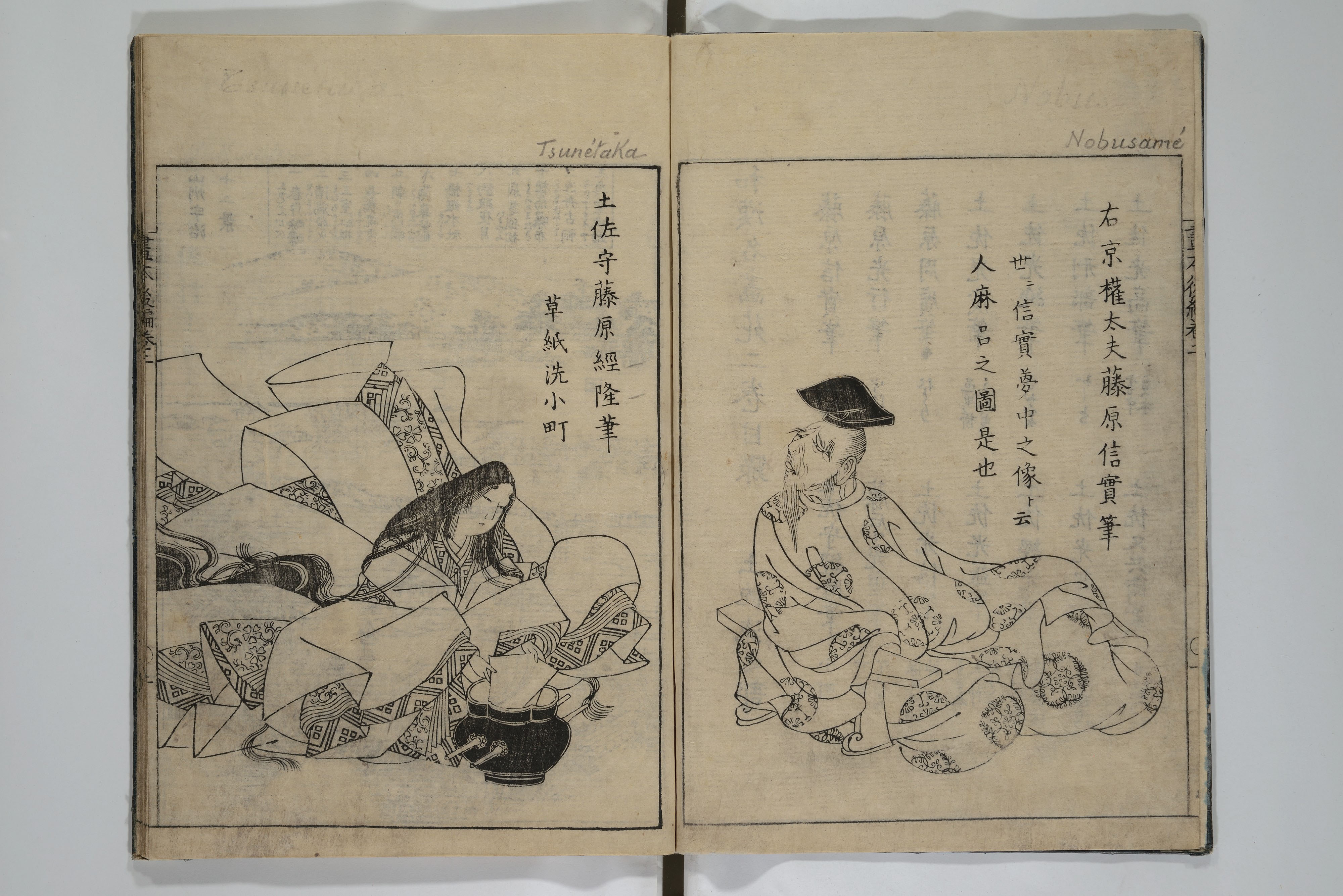
A Garden of Celebrated Japanese and Chinese Paintings (Wakan meigaen)
和漢名画苑
1750
Set of six woodblock-printed books bound as one, with additional volume; ink on paper

Ehon Tekagami (An Illustrated Book of Model Paintings)
絵本手鑑
n.d. (after 1720)
Woodblock-printed book; 6 vols.

Wakan Meigaen (A Garden of Celebrated Japanese and Chinese Paintings)
和漢名画苑
17th to 18th century
Woodblock-printed book; 6 vols.