Biography
Paul Binnie (born 1967) is a Scottish artist who has established himself as one of the most accomplished contemporary practitioners of traditional Japanese woodblock printmaking, creating works that engage directly with the great themes and techniques of ukiyo-e and shin-hanga while bringing a fresh, sometimes provocative contemporary perspective. His prints — which encompass bijin-ga (beautiful women), kabuki actors, landscapes, and figure studies — are remarkable in that Binnie designs, carves, and prints them entirely himself, a rare command of all three roles that in the classical Japanese system were divided among separate specialists.
Born in Scotland in 1967, Binnie studied art history at the University of Edinburgh and painting and etching at Edinburgh College of Art, where he received a thorough grounding in drawing, painting, and printmaking. His encounter with Japanese woodblock prints proved transformative, and he became deeply engaged with the tradition, studying its history, techniques, and aesthetic principles with scholarly intensity. Unlike many Western artists who draw superficial inspiration from Japanese prints, Binnie committed himself to working within the tradition at the highest technical level, learning to create designs that fully exploit the possibilities of the woodblock medium.
Binnie's relationship with Japan deepened through an extended period of residence and training. Moving to Tokyo in 1993, he apprenticed under the master carver and printer Seki Kenji, acquiring the specialist skills of both block-cutting and printing, and remained in Japan until 1998. This hands-on command of the full process — designer, carver, and printer combined in a single artist — distinguishes him from most contemporary printmakers, Western or Japanese, and aligns his working method with the sōsaku-hanga ('creative print') tradition even as his subjects and aesthetic pay homage to the earlier shin-hanga movement of the early twentieth century.
His bijin-ga prints are among his most acclaimed works. These images of beautiful women draw on the grand tradition of Japanese figure prints while introducing contemporary subjects and sensibilities. His women are rendered with the elegant line work and careful color harmonies of classical bijin-ga, but they are often contemporary figures in modern settings, creating a provocative dialogue between traditional aesthetics and present-day life. His kabuki actor prints similarly engage with classical conventions while bringing a fresh perspective to a venerable genre.
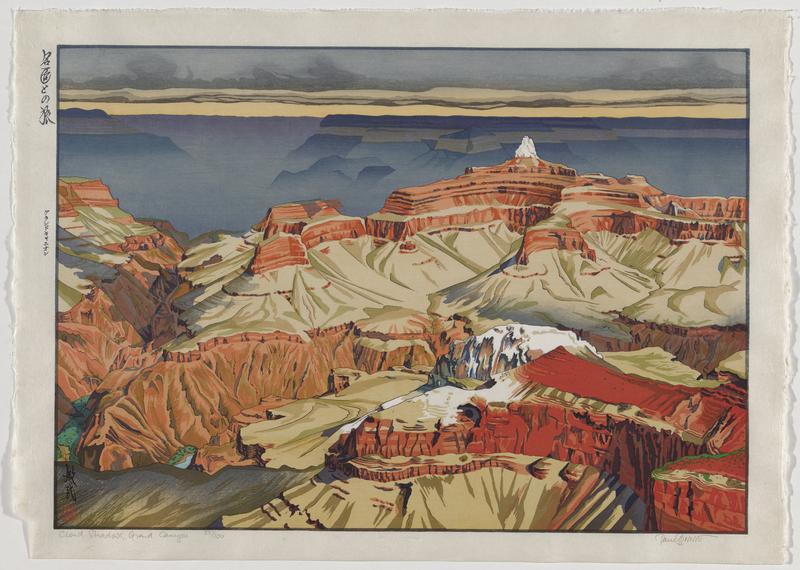
Binnie's landscape prints demonstrate his mastery of atmospheric effects and his deep appreciation for Japan's scenic beauty. Views of mountains, coastlines, and urban scenes are rendered with the luminous color and graduated tonal effects that characterize the finest shin-hanga landscapes, while his compositional choices and color sensibility reflect his contemporary artistic intelligence.
His prints are published in limited editions and are sold through galleries in Japan, the United Kingdom, and the United States. His work is held in major public collections including the British Museum, the Metropolitan Museum of Art, the Brooklyn Museum, the National Museum of Scotland, and the Smithsonian's National Museum of Asian Art. He has exhibited widely in Japan and internationally, and his prints are recognized by both Japanese and Western connoisseurs as among the finest contemporary contributions to the Japanese woodblock tradition.
Key Facts
- Active Period
- 1967
- Nationality
- 🇬🇧United Kingdom
- Movement
- Contemporary Mokuhanga
- Works Indexed
- 94
Frequently Asked Questions
Paul Binnie (born 1967) is a Scottish artist who has established himself as one of the most accomplished contemporary practitioners of traditional Japanese woodblock printmaking, creating works that engage directly with the great themes and techniques of ukiyo-e and shin-hanga while bringing a fresh, sometimes provocative contemporary perspective. His prints — which encompass bijin-ga (beautiful women), kabuki actors, landscapes, and figure studies — are remarkable in that Binnie designs, carves, and prints them entirely himself, a rare command of all three roles that in the classical Japanese system were divided among separate specialists.
Paul Binnie was active born in 1967. They were associated with the Contemporary Mokuhanga movement.
Paul Binnie's work was shaped by the Contemporary Mokuhanga tradition in Japanese woodblock printmaking. Contemporary Mokuhanga: Contemporary mokuhanga (literally "wood-block print") encompasses artists working from approximately 1970 to the present who continue or reinvent traditional Japanese woodblock printing techniques.
Original prints by Paul Binnie can be found in collections including Scholten Japanese Art, Japanese Art Open Database, Art Institute of Chicago, ukiyo-e.org.