Biography
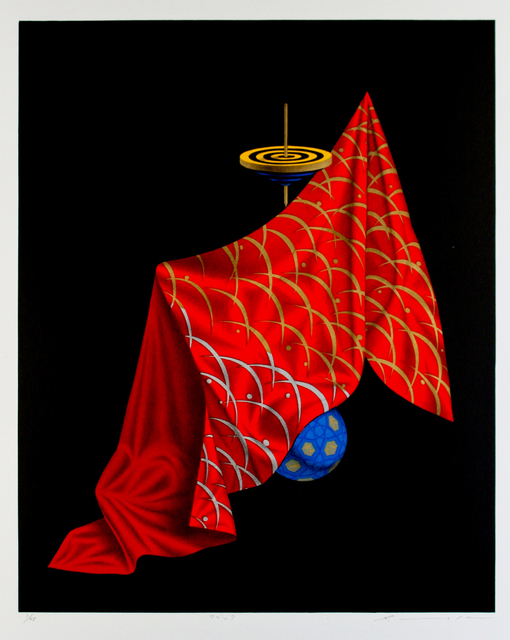
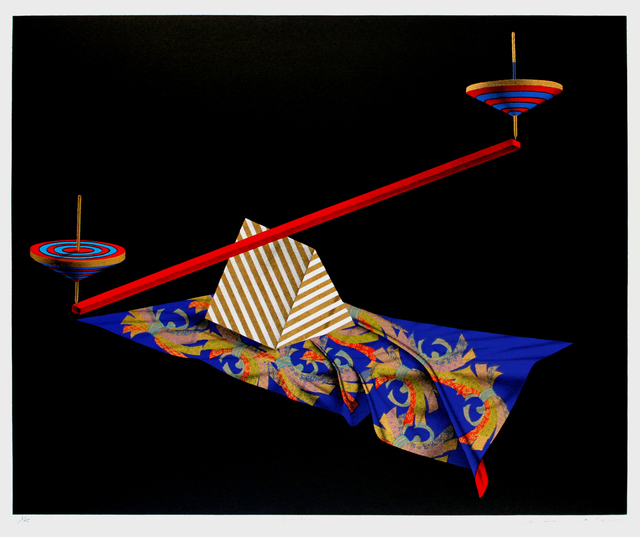
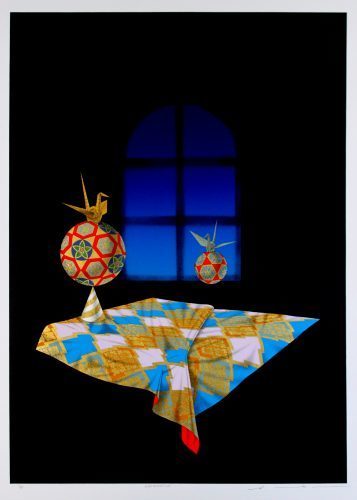
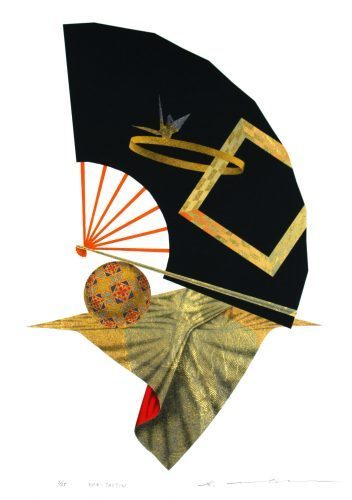
Shuji Wako is a contemporary Japanese lithographer celebrated for his richly detailed prints that portray traditional Japanese objects — origami cranes, wooden tops, puzzle boxes, and textile patterns — against deep, velvety black backgrounds. Born in 1953 in Sendai, Japan, Wako studied at Tokyo University of Art and Design (Tokyo Zokei University), where he trained under Japan's leading lithographer Takeshi Hara, whose mastery of the medium profoundly shaped Wako's own technical development.
After graduating in 1977, Wako taught at Tokyo Zokei University before transitioning to full-time printmaking in his Tokyo studio. His chosen medium is lithography, and his technical command of the process allows him to achieve extraordinary levels of detail and tonal range — from the deepest blacks to the most delicate gradations of color. His compositions characteristically combine images of sumptuous Japanese fabrics, folded paper (origami) creations, and traditional handicraft objects rendered with near-photographic precision.
Wako describes his artistic philosophy as 'expressing the inner sense of Japanese tradition, but seen through my modern eyes.' His work reveals a deep reverence for the aesthetic heritage of Japan — the geometry of folded paper, the play of pattern against pattern in layered kimono fabrics, the satisfying logic of wooden puzzle boxes — while presenting these subjects with a contemporary sophistication that transcends nostalgia.
Wako is not a particularly prolific artist, typically producing fewer than ten different editions each year. This deliberate pace reflects his meticulous approach to each print. He reached his one-hundredth print in the year 2000, a milestone celebrated by his collectors. He works under an exclusive arrangement with the Tolman Collection of Tokyo, which serves as the sole distributor of his prints to collectors and dealers worldwide.
Wako won the Japan Print Association Prize in both 1980 and 1983, and has exhibited at the Cincinnati Art Museum, the Taiwan International Print Biennial, the Pusan Biennial in Korea, and the Retretti exhibition in Finland. He has participated annually in the CWAJ Print Show in Tokyo. His works are held in the permanent collections of the British Museum in London, the Cincinnati Art Museum, the Gallery of New South Wales in Australia, the Rockefeller Foundation in New York, the Singapore National Museum, and museums in Germany.
Key Facts
- Active Period
- 1953
- Nationality
- 🇯🇵Japan
- Movement
- Contemporary Mokuhanga
- Subjects
- LithographNight Scenes
- Works Indexed
- 9
Frequently Asked Questions
Shuji Wako is a contemporary Japanese lithographer celebrated for his richly detailed prints that portray traditional Japanese objects — origami cranes, wooden tops, puzzle boxes, and textile patterns — against deep, velvety black backgrounds. Born in 1953 in Sendai, Japan, Wako studied at Tokyo University of Art and Design (Tokyo Zokei University), where he trained under Japan's leading lithographer Takeshi Hara, whose mastery of the medium profoundly shaped Wako's own technical development.
Shuji Wako was active born in 1953. They were associated with the Contemporary Mokuhanga movement.
Shuji Wako's work was shaped by the Contemporary Mokuhanga tradition in Japanese woodblock printmaking. Contemporary Mokuhanga: Contemporary mokuhanga (literally "wood-block print") encompasses artists working from approximately 1970 to the present who continue or reinvent traditional Japanese woodblock printing techniques.
Shuji Wako's prints frequently feature lithograph, night scenes.