Sō Shizan
宋紫山
1733–1805
Japan
Biography
Sō Shizan (1733–1805), born Kusumoto Hakkei, was a late Edo period painter who carried forward the Chinese-influenced realist bird-and-flower tradition of the Nagasaki school, working in the same Sinophile literati orbit as the nanga painters of his generation. He was the adopted son and most accomplished pupil of Sō Shiseki (1715–1786), the Edo master who had himself studied in Nagasaki under the Qing-dynasty Chinese painter Song Ziyan, and through this lineage Shizan inherited a practice that explicitly bridged Chinese and Japanese painting and treated the careful observation of nature as a form of scholarly cultivation.
Shizan trained in the workshop of his adoptive father, who had established himself in Edo as a leading proponent of the bird-and-flower style that Chinese masters such as Shen Nanpin had introduced to Nagasaki in the early 1730s. The Sō family studio taught a generation of painters the meticulous, brightly colored realism that characterized the Nagasaki school, and Shizan emerged as Shiseki's principal artistic heir, becoming one of the leading painters of the Nagasaki manner in Edo after his father's death in 1786 and signing his works in the literati Chinese fashion with a seal reading Shizan. Sō Shiseki had also published influential woodblock-printed painting manuals, and Shizan continued the family's Nagasaki-school style into the following generation.
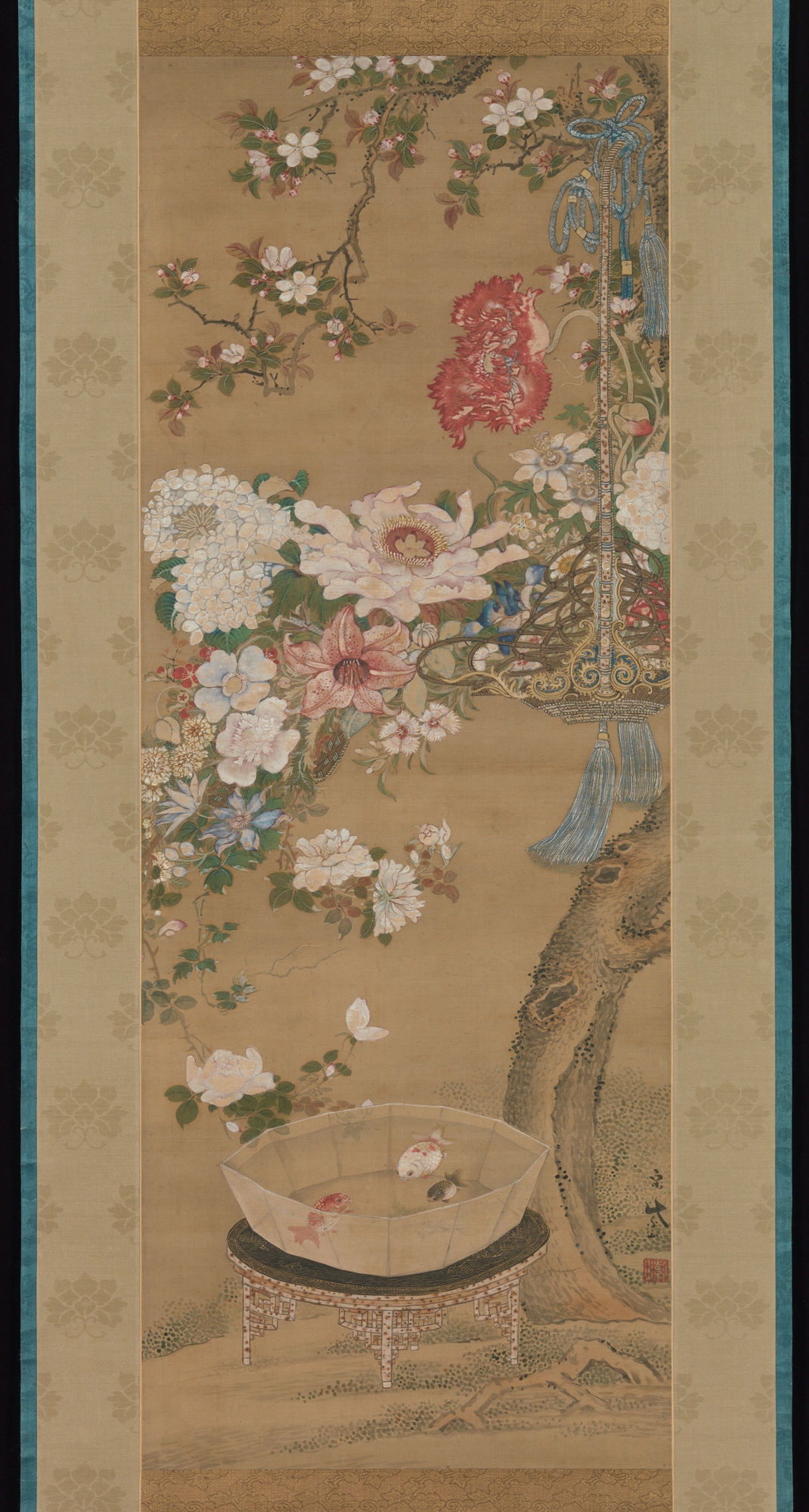
The paintings that survive from Shizan's mature decades show how his personal manner departed from his father's more rigorous Chinese-derived style. Where Shiseki's work tends toward dense, encyclopedic compositions of birds among carefully observed botanical specimens, Shizan's brushwork is lighter, his compositions more open, and his mood more playful, with a decorative emphasis that recalls the contemporary sensibilities of the Maruyama and Shijō painters in Kyoto. His Rooster in a Storm at the Metropolitan Museum of Art, dated 1783, is among his best-known works, deploying ink with great sensitivity to depict bamboo leaves blown by gusting wind while brilliant mineral pigments render blue morning glories and the magnificent plumage of the rooster itself. His Flowers and Goldfish, also at the Metropolitan, presents a profusion of pink blossoms above a glass goldfish bowl, an image saturated with the auspicious and exotic motifs that wealthy Edo collectors had come to associate with the cosmopolitan Nagasaki style.
Shizan also worked in smaller, more intimate formats, including the folding fans and album leaves favored by literati painters across the late eighteenth century. His Crabs and Tortoises at the Minneapolis Institute of Art, executed in ink on fan paper, shows the quick, witty brushwork he brought to such commissions, the creatures sketched in spontaneous strokes that capture their characteristic motion. His Pink and White Plum Blossoms in Moonlight, a hanging scroll also at the Minneapolis Institute, demonstrates his command of the full formal vocabulary of the bird-and-flower tradition, with carefully graded ink washes establishing a night sky behind a flowering plum branch rendered in delicate color.
Shizan died in 1805. His paintings entered Japanese, European, and American museum collections through the late nineteenth and twentieth centuries, with the Metropolitan Museum of Art and the Minneapolis Institute of Art holding some of the strongest examples in North America. Within the broader history of late Edo painting he occupies a transitional position: heir to the Chinese-derived Nagasaki school but increasingly attuned to the decorative sensibilities of contemporary Kyoto painters, and a transmitter of the Sō family bird-and-flower style into the early nineteenth century, when later Edo painters absorbed its lessons into their own synthetic practices.
Key Facts
- Active Period
- 1733–1805
- Nationality
- 🇯🇵Japan
- Works Indexed
- 1
Frequently Asked Questions
Sō Shizan (1733–1805), born Kusumoto Hakkei, was a late Edo period painter who carried forward the Chinese-influenced realist bird-and-flower tradition of the Nagasaki school, working in the same Sinophile literati orbit as the nanga painters of his generation. He was the adopted son and most accomplished pupil of Sō Shiseki (1715–1786), the Edo master who had himself studied in Nagasaki under the Qing-dynasty Chinese painter Song Ziyan, and through this lineage Shizan inherited a practice that explicitly bridged Chinese and Japanese painting and treated the careful observation of nature as a form of scholarly cultivation.
Sō Shizan was active from 1733 to 1805.
Original prints by Sō Shizan can be found in collections including Minneapolis Institute of Art.
