Biography
Takeshi Hara is one of Japan's foremost lithographers, known for prints that distill the essence of calligraphic gesture into luminous fields of color and light. Born in 1942 in Nagoya, Hara studied oil painting at the Tokyo University of Fine Arts (Tokyo Geidai), earning his Bachelor of Arts in 1967 and his Master of Arts in 1969. Though trained in Western-style painting, he was increasingly drawn to Japanese aesthetic traditions, and in time turned from painting toward the lithographic printmaking for which he became known.
Hara gained international attention through the major print exhibitions of the early 1970s, participating in the Paris Biennale in 1971. In 1973 he joined the faculty of Tokyo Zokei University (Tokyo University of Art and Design), where he taught lithography and eventually became a full professor. In 1975-76, supported by a grant from Japan's Agency for Cultural Affairs to study abroad, Hara spent time in Germany, England, and the United States — travels that exposed him to diverse visual cultures while deepening his commitment to a distinctly Japanese mode of artistic expression. He later became a visiting scholar at Nagoya Zokei University of Art and Design.
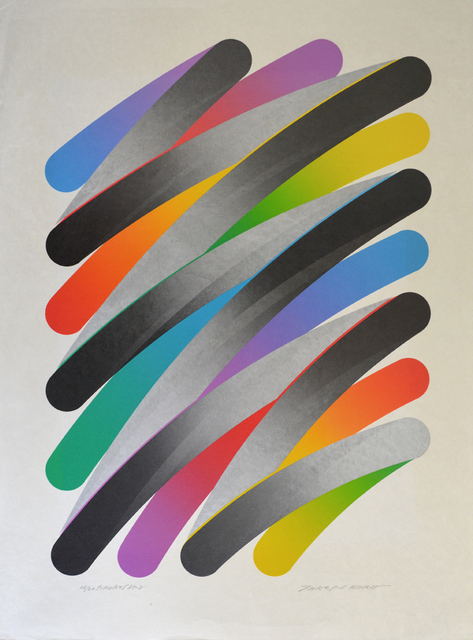
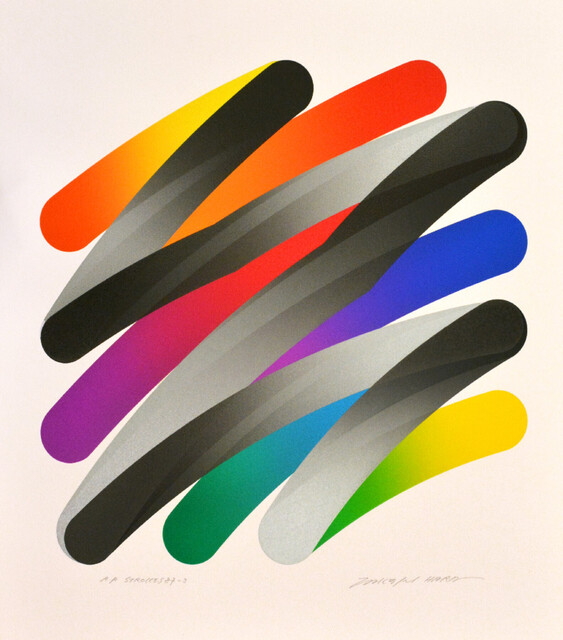
Hara's mature artistic language centers on decisive brush strokes applied with precision and restraint, creating controlled interactions of light, shadow, and color gradation. While lithography is his primary medium, he has also worked with etching, silkscreen, and other graphic techniques. His prints achieve a remarkable balance between spontaneity and control — the gestural energy of Japanese calligraphy disciplined by the technical demands of lithographic printing.
Hara's work has been exhibited internationally at biennales, galleries, and museums, and he is represented in numerous institutional collections. He continues to be recognized as a leading figure in contemporary Japanese lithography.
Key Facts
- Active Period
- 1942
- Nationality
- 🇯🇵Japan
- Movement
- Contemporary Mokuhanga
- Subjects
- Lithograph
- Works Indexed
- 3
Frequently Asked Questions
Takeshi Hara is one of Japan's foremost lithographers, known for prints that distill the essence of calligraphic gesture into luminous fields of color and light. Born in 1942 in Nagoya, Hara studied oil painting at the Tokyo University of Fine Arts (Tokyo Geidai), earning his Bachelor of Arts in 1967 and his Master of Arts in 1969. Though trained in Western-style painting, he was increasingly drawn to Japanese aesthetic traditions, and in time turned from painting toward the lithographic printmaking for which he became known.
Takeshi Hara was active born in 1942. They were associated with the Contemporary Mokuhanga movement.
Takeshi Hara's work was shaped by the Contemporary Mokuhanga tradition in Japanese woodblock printmaking. Contemporary Mokuhanga: Contemporary mokuhanga (literally "wood-block print") encompasses artists working from approximately 1970 to the present who continue or reinvent traditional Japanese woodblock printing techniques.
Takeshi Hara's prints frequently feature lithograph.
Original prints by Takeshi Hara can be found in collections including Art Institute of Chicago.