
Biography
Taniguchi Shigeru (谷口茂, born 1948) is a Japanese printmaker and painter whose primary medium was silkscreen with photographic and collage elements, and whose place in a database of Japanese print artists derives from the broader interwar-to-postwar tradition in which Japanese printmaking includes both relief (woodblock and linocut) and intaglio, lithography, and screen techniques under the umbrella term hanga. He was born in 1948 in Fukuoka on Kyūshū. After finishing high school he relocated to Tokyo, where he pursued his art training part-time alongside book-illustration work and employment at a commercial printing company — an itinerary characteristic of the self-taught and workshop-trained route that produced a sizable share of the postwar generation of Japanese print artists. He settled into silkscreen as his principal medium. His silkscreen practice is described in catalogues as combining traditional printmaking techniques with photographic imagery and a deliberately international visual idiom, and he is documented as admiring Man Ray and Jasper Johns alongside continuing engagement with the contemporary Japanese print scene. Subjects in his finished editions are deliberately varied rather than concentrated in a single signature image: international postage stamps, airline baggage tags, old newspapers, customs forms, brushes, and Noh-theatre motifs appear in collage and overprinted compositions, often with photographically derived elements and with brushstrokes that deliberately extend off the edge of the picture plane. Exhibition activity from 1973 through the early 1980s places him within the international print-biennial circuit of the period: the Japan Print Association annual exhibitions in Tokyo (1973–74), the group show Graphic Images of Japan (Tokyo, 1974), the Bradford International Print Biennial in England (1976 and 1982), the Ljubljana International Print Exhibition in Slovenia (1977 and 1979), solo exhibitions in Tokyo (1977 and 1982) and Sapporo (1978), and the Krakow International Print Biennial in Poland (1980), with a prize at the 1979 Japan Art Festival in Osaka. His work is held in the Museum of Modern Art in New York, the Cincinnati Art Museum, the National Museum of Art in Osaka, the Honolulu Museum of Art, the Warsaw Museum of Modern Art, and other institutions. The middle and late phases of his career are less well documented. Standard sources note that after achieving prominence in silkscreen he turned to painting; that a 2005 studio fire destroyed a substantial portion of his work; that he subsequently produced a series of black-and-white paintings; and that he disappeared at the end of 2008. He has been represented for much of his career by the Tolman Collection in Tokyo, which continues to hold and circulate his editions, and the Ren Brown Collection Gallery has also handled his prints. His work belongs to the international-style Japanese print generation that operated principally through silkscreen rather than through the woodblock idiom of the older sōsaku-hanga and shin-hanga traditions.
Key Facts
- Active Period
- 1948
- Nationality
- 🇯🇵Japan
- Movement
- Contemporary Mokuhanga
- Works Indexed
- 8
Frequently Asked Questions
Taniguchi Shigeru (谷口茂, born 1948) is a Japanese printmaker and painter whose primary medium was silkscreen with photographic and collage elements, and whose place in a database of Japanese print artists derives from the broader interwar-to-postwar tradition in which Japanese printmaking includes both relief (woodblock and linocut) and intaglio, lithography, and screen techniques under the umbrella term hanga. He was born in 1948 in Fukuoka on Kyūshū. After finishing high school he relocated to Tokyo, where he pursued his art training part-time alongside book-illustration work and employment at a commercial printing company — an itinerary characteristic of the self-taught and workshop-trained route that produced a sizable share of the postwar generation of Japanese print artists. He settled into silkscreen as his principal medium. His silkscreen practice is described in catalogues as combining traditional printmaking techniques with photographic imagery and a deliberately international visual idiom, and he is documented as admiring Man Ray and Jasper Johns alongside continuing engagement with the contemporary Japanese print scene. Subjects in his finished editions are deliberately varied rather than concentrated in a single signature image: international postage stamps, airline baggage tags, old newspapers, customs forms, brushes, and Noh-theatre motifs appear in collage and overprinted compositions, often with photographically derived elements and with brushstrokes that deliberately extend off the edge of the picture plane. Exhibition activity from 1973 through the early 1980s places him within the international print-biennial circuit of the period: the Japan Print Association annual exhibitions in Tokyo (1973–74), the group show Graphic Images of Japan (Tokyo, 1974), the Bradford International Print Biennial in England (1976 and 1982), the Ljubljana International Print Exhibition in Slovenia (1977 and 1979), solo exhibitions in Tokyo (1977 and 1982) and Sapporo (1978), and the Krakow International Print Biennial in Poland (1980), with a prize at the 1979 Japan Art Festival in Osaka. His work is held in the Museum of Modern Art in New York, the Cincinnati Art Museum, the National Museum of Art in Osaka, the Honolulu Museum of Art, the Warsaw Museum of Modern Art, and other institutions. The middle and late phases of his career are less well documented. Standard sources note that after achieving prominence in silkscreen he turned to painting; that a 2005 studio fire destroyed a substantial portion of his work; that he subsequently produced a series of black-and-white paintings; and that he disappeared at the end of 2008. He has been represented for much of his career by the Tolman Collection in Tokyo, which continues to hold and circulate his editions, and the Ren Brown Collection Gallery has also handled his prints. His work belongs to the international-style Japanese print generation that operated principally through silkscreen rather than through the woodblock idiom of the older sōsaku-hanga and shin-hanga traditions.
Taniguchi Shigeru was active born in 1948. They were associated with the Contemporary Mokuhanga movement.
Taniguchi Shigeru's work was shaped by the Contemporary Mokuhanga tradition in Japanese woodblock printmaking. Contemporary Mokuhanga: Contemporary mokuhanga (literally "wood-block print") encompasses artists working from approximately 1970 to the present who continue or reinvent traditional Japanese woodblock printing techniques.
Taniguchi Shigeru's prints frequently feature silkscreen, religious, trees, architecture, abstract, summer.
Original prints by Taniguchi Shigeru can be found in collections including Art Institute of Chicago, ukiyo-e.org.
Woodblock Prints by Taniguchi Shigeru (8)
Tree of Knowledge
1977
Color silkscreen; edition 14/32
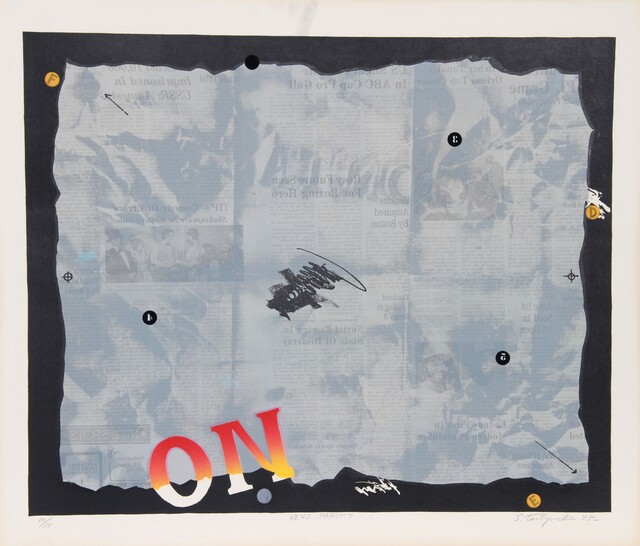
News March 7th
1975
Screenprint
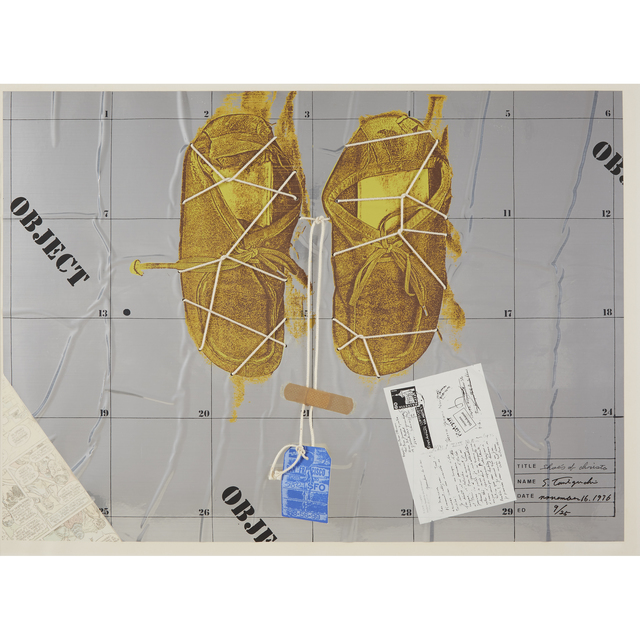
Shoes of Christo
1976
Color screenprint and mixed media multiple on wove paper
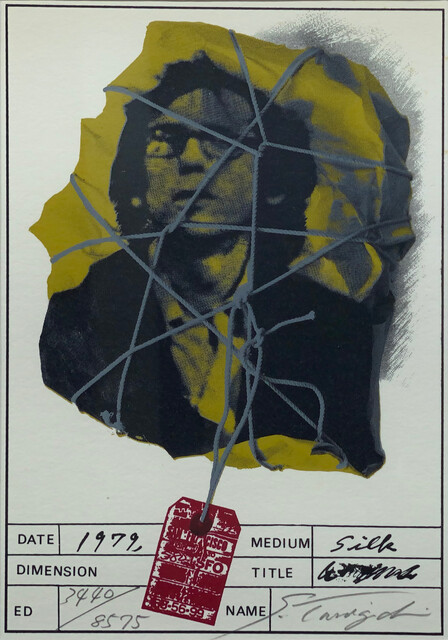
Captured Christ
1979
Silkscreen with 4 plate (4 color)
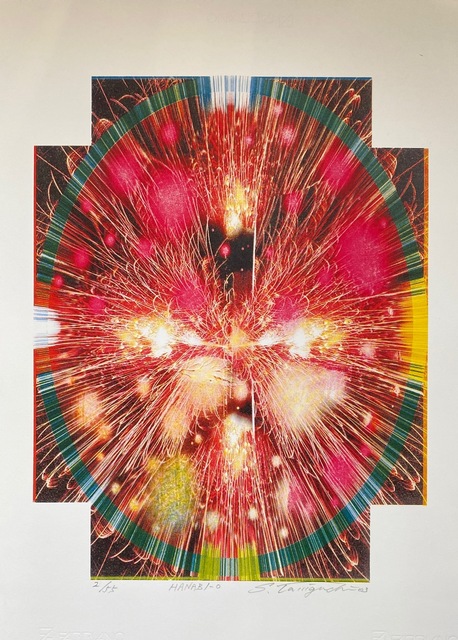
Hanabi (Fireworks)
2003
Silkscreen
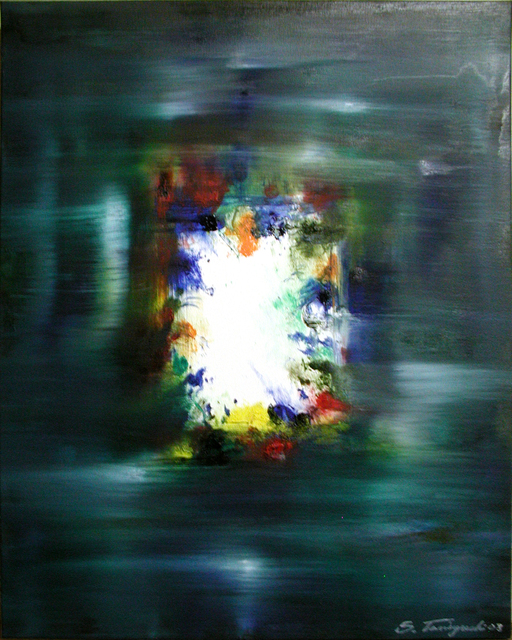
Gateway
2008
Acrylic paint on canvas

Air Mail, 1977
