Biography
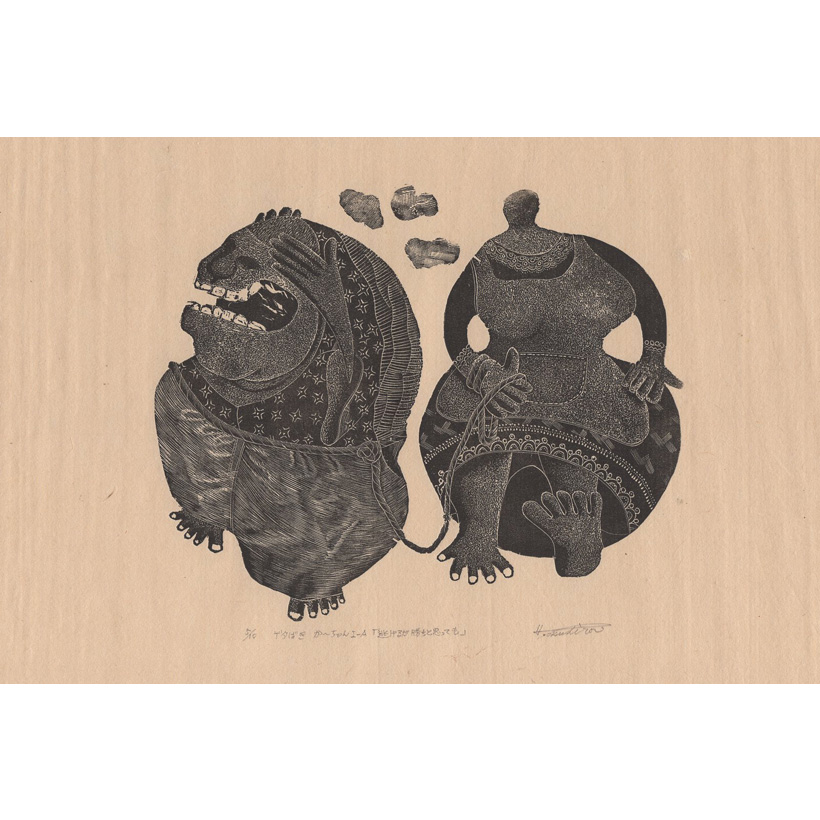
Hidemitsu Tokuhiro (徳廣 秀光) is a Japanese printmaker working in wood engraving (kiguchi mokuhan, 木口木版) — a small-scale relief printing technique that uses the end-grain of hardwood blocks rather than the side-grain plank used in traditional Japanese ukiyo-e mokuhanga. The end-grain block accepts very fine carved detail at the scale of book illustration, and Tokuhiro's prints occupy this small-format register, with figural imagery centered on a recurring stout maternal character he calls 'Geta-baki Kā-chan' ("Mom in Geta"), a humorous everyday-life figure rendered with affectionate caricature.
Tokuhiro received the Keisei Kobayashi Jurors' Prize at the 2019 Awagami International Miniature Print Exhibition for his print Geta-baki Kā-chan I-A — Nigeruga Kachi to Omotte mo (ゲタばき か〜ちゃん I-A 「逃げるが勝ちと思っても」, "Mom in Geta I-A — Even though I think running is winning"), a wood engraving printed in oil-based ink in an edition of 10. The prize is named after Keisei Kobayashi (born 1944), a senior artist who has been one of the leading figures in postwar Japanese wood engraving and who served as a juror of the exhibition. Receipt of this prize represents a meaningful recognition within the small but active Japanese wood-engraving community.
The prize-winning print's title follows a series-and-variant naming convention — a Roman-numeral series number ("I") with an alphabetic plate variant ("A") — attached to the recurring Geta-baki Kā-chan character. The phrase 逃げるが勝ち (nigeru ga kachi, "running away is winning") in the subtitle is a Japanese idiom for tactical retreat, which the print renders visually through the Geta-baki Kā-chan figure with characteristic humor.
The Awagami International Miniature Print Exhibition is a biennial juried exhibition held at the Awagami Factory in Tokushima Prefecture, a major historical washi-paper–producing region, and draws submissions from many countries each cycle. In the 2019 cycle, Tokuhiro shared the Keisei Kobayashi Jurors' Prize with the printmaker Yoshinori Kurimoto, recognized for the woodcut flower I.
Detailed biographical information about Tokuhiro — year of birth, education, residence — is not consistently published in English-language sources. He works in the wood-engraving lineage that runs from late-19th-century Japan, where end-grain wood engraving was introduced from Europe by way of the Meiji-era illustrated press, through the postwar period in which Keisei Kobayashi and others established it as a fine-art medium in its own right. The technique remains rare in contemporary Japanese print practice — most younger Japanese printmakers working in relief print use plank-grain mokuhanga rather than end-grain wood engraving — and Tokuhiro is one of the small group continuing the kiguchi-mokuhan tradition into the twenty-first century. His commitment to the technically demanding end-grain method and to a sustained humorous-figural subject makes him a distinctive presence within that cohort.
Key Facts
- Nationality
- 🇯🇵Japan
- Movement
- Contemporary Mokuhanga
- Works Indexed
- 1
Frequently Asked Questions
Hidemitsu Tokuhiro (徳廣 秀光) is a Japanese printmaker working in wood engraving (kiguchi mokuhan, 木口木版) — a small-scale relief printing technique that uses the end-grain of hardwood blocks rather than the side-grain plank used in traditional Japanese ukiyo-e mokuhanga. The end-grain block accepts very fine carved detail at the scale of book illustration, and Tokuhiro's prints occupy this small-format register, with figural imagery centered on a recurring stout maternal character he calls 'Geta-baki Kā-chan' ("Mom in Geta"), a humorous everyday-life figure rendered with affectionate caricature.
Hidemitsu Tokuhiro's work was shaped by the Contemporary Mokuhanga tradition in Japanese woodblock printmaking. Contemporary Mokuhanga: Contemporary mokuhanga (literally "wood-block print") encompasses artists working from approximately 1970 to the present who continue or reinvent traditional Japanese woodblock printing techniques.