Wada Eisaku
和田英作
1874–1959
Japan
Biography
Wada Eisaku (和田英作, 1874–1959) was a central figure in the Meiji, Taishō and early Shōwa Western-style (yōga) painting establishment in Japan, occupying for more than half a century the institutional posts — president of the Tokyo School of Fine Arts, juror of the official government exhibitions (Bunten), founding member of the Hakubakai (White Horse Society), and Imperial Household Artist — through which Western oil painting was consolidated as a national art form. Although his early work belongs to the lyric naturalism of late Meiji yōga, he is principally remembered as a portraitist: his official likenesses of the statesmen, university heads, business leaders and aristocrats of the late nineteenth and early twentieth centuries form part of the visual record of the country's first generation of modernisers, and his 1920 portrait of Fukuzawa Yukichi is among the best-known images of the founder of Keio University.
Wada was born on 23 December 1874 at Tarumizu, in the Ōsumi region of Kagoshima prefecture — the southern Satsuma domain that produced so many of the Meiji oligarchs — and moved with his family to the Azabu district of Tokyo at the age of four or five, when his father took up a post at the Naval Academy. He entered the Protestant Meiji Gakuin in 1887, where he learned the rudiments of Western-style painting under Uesugi Kumatsu, leaving in 1891. From that year he studied under Soyama Sachihiko at the Daikōkan school; after Soyama's death in 1892 he continued under Harada Naojirō at the Shōbikan, and from the mid-1890s under Kuroda Seiki (1866–1924) and Kume Keiichirō at the Tenshin Dōjō. Kuroda, recently returned from nearly a decade in France where he had studied under Raphaël Collin, brought back the bright-palette, plein-air manner that would dominate late-Meiji yōga.
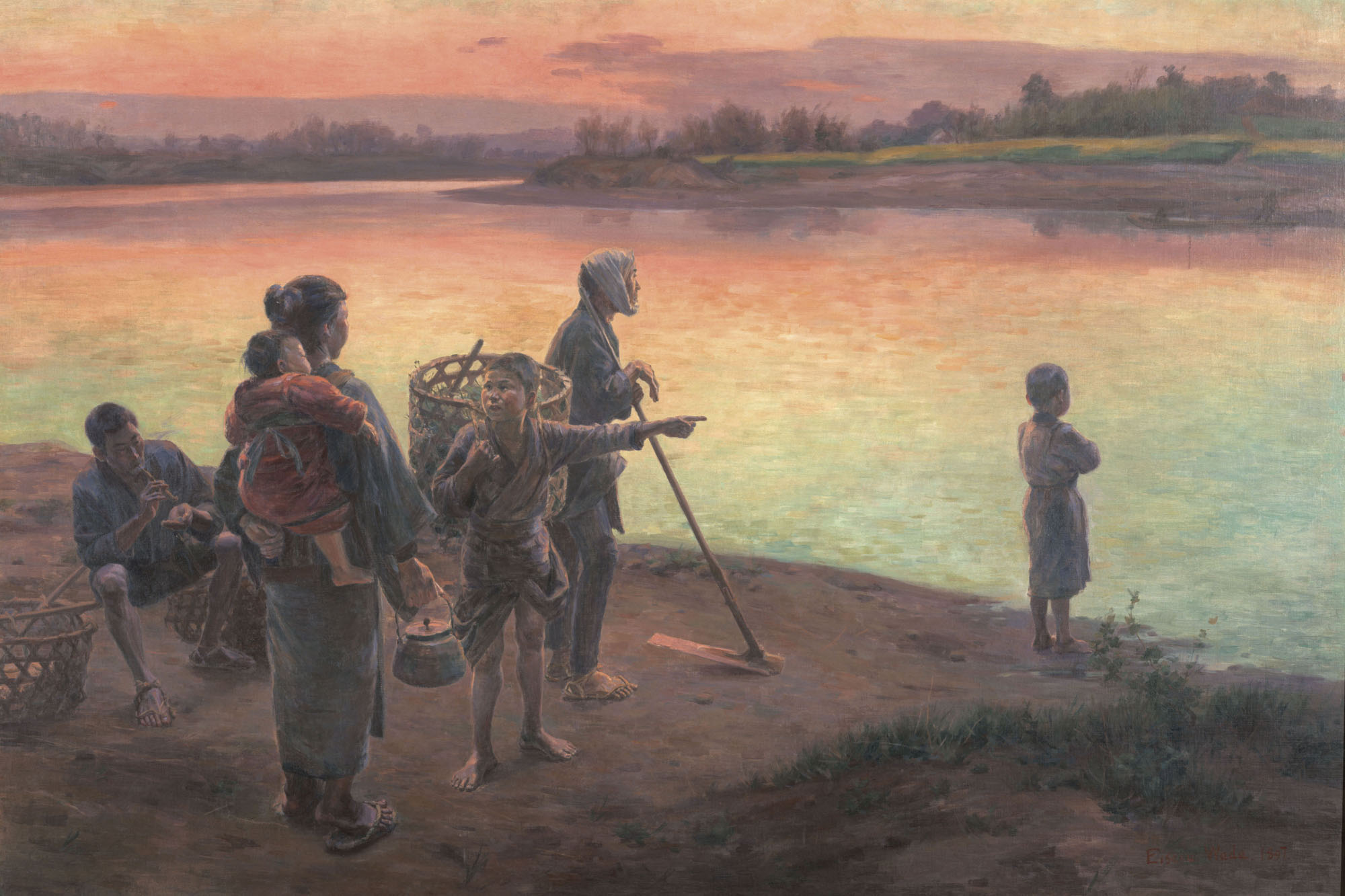
In 1896, when Kuroda took charge of the newly formed Western-painting department of the Tokyo School of Fine Arts (now Tokyo University of the Arts), Wada was appointed an assistant professor alongside Fujishima Takeji and Okada Saburōsuke; the following year he resigned that post to enrol as a student, and became the school's first graduate, his 1897 graduation work — the twilight landscape Evening at the Ferry Crossing — establishing him at twenty-two as one of the most promising painters of his generation. He was also among the founders of the Hakubakai (White Horse Society) in 1896, the artists' association around Kuroda that was the institutional centre of late-Meiji yōga and through whose annual exhibitions almost every major Meiji oil painter first showed his work.
In 1899 Wada travelled to Europe, reaching Berlin and then, in 1900, Paris, where he studied under Raphaël Collin — the teacher of Kuroda and a source-figure of the Tokyo yōga school — at the Académie Colarossi. He spent time at the artists' colony of Grez-sur-Loing, on the edge of the Forest of Fontainebleau, where Kuroda and Kume had painted in earlier years and where painters such as Frank O'Meara, Carl Larsson and William Stott of Oldham had established a tradition of evening river views; there, over the winter of 1901–02, he worked alongside Asai Chū. In 1902 he also studied decorative art under Eugène Grasset. He returned to Japan, by way of Italy, in 1903.
On his return Wada was appointed a professor at the Tokyo School of Fine Arts, where he taught oil painting for decades. From the inaugural Bunten (Ministry of Education exhibition) in 1907 he served as a juror, continuing through the final Bunten of 1918, and became a senior figure of its Western-painting section. He received many of the major decorative commissions of the period: the ceiling of the Imperial Theatre in 1911, and in 1914 murals for the Akasaka Detached Palace and for Tokyo Station. In 1932 he succeeded Masaki Naohiko as president of the Tokyo School of Fine Arts, an office he held until 1936, and in 1934 he was named an Imperial Household Artist (teishitsu gigeiin). In 1936 he completed the monumental Ceremony for the Promulgation of the Constitution for the Meiji Memorial Picture Gallery in the Meiji Shrine Outer Garden, depicting the promulgation of the Meiji Constitution on 11 February 1889. From 1940, over three years, he took part in the project to copy the celebrated seventh-century wall paintings of the Kondō (Golden Hall) of Hōryū-ji — work carried out before the 1949 fire that destroyed the originals and prompted Japan's modern cultural-property protection laws, giving the copies an irreplaceable documentary value.
Portraiture ran through Wada's whole career and constitutes his largest body of work. Beyond the portrait of Fukuzawa Yukichi, he painted university heads, statesmen, and business and academic leaders, helping to establish the Japanese institutional convention of the half-length oil portrait of the dark-suited modern gentleman against a neutral ground — a Tokyo counterpart to the contemporaneous American university portraiture of Sargent and Eakins — many examples of which survive in university offices and museum collections. Alongside the portraits he continued to paint flowers (roses became almost a sub-specialty), still lifes and landscapes, and in his later years returned again and again to Mount Fuji.
Wada was elected to the Imperial Art Academy in 1937 and received the Order of Culture (Bunka Kunshō) in 1943. He died at Shimizu, in Shizuoka prefecture, on 3 January 1959, aged 84. His works are held at the University Art Museum of Tokyo University of the Arts — which preserves his graduation painting Evening at the Ferry Crossing — as well as the National Museum of Modern Art, Tokyo, collections in his home prefecture of Kagoshima, and university and public collections across Japan; the Meiji Memorial Picture Gallery still displays his Constitution mural in its original cycle.
Key Facts
- Active Period
- 1874–1959
- Nationality
- 🇯🇵Japan
- Subjects
- Children
- Works Indexed
- 7
Frequently Asked Questions
Wada Eisaku (和田英作, 1874–1959) was a central figure in the Meiji, Taishō and early Shōwa Western-style (yōga) painting establishment in Japan, occupying for more than half a century the institutional posts — president of the Tokyo School of Fine Arts, juror of the official government exhibitions (Bunten), founding member of the Hakubakai (White Horse Society), and Imperial Household Artist — through which Western oil painting was consolidated as a national art form. Although his early work belongs to the lyric naturalism of late Meiji yōga, he is principally remembered as a portraitist: his official likenesses of the statesmen, university heads, business leaders and aristocrats of the late nineteenth and early twentieth centuries form part of the visual record of the country's first generation of modernisers, and his 1920 portrait of Fukuzawa Yukichi is among the best-known images of the founder of Keio University.
Wada Eisaku was active from 1874 to 1959.
Wada Eisaku's prints frequently feature children.
Original prints by Wada Eisaku can be found in collections including University Art Museum, Tokyo University of the Arts, Kagoshima City Museum of Art, Ishibashi Museum of Art (Ishibashi Foundation Collection), Private collection.
Woodblock Prints by Wada Eisaku (7)
Evening at the Ferry Crossing
渡頭の夕暮
1897
Oil on canvas

Girl Reading a Newspaper
新聞を読む少女
1897
Oil on canvas

Evening at Grez
夕暮(グレー)
1902
Oil on canvas
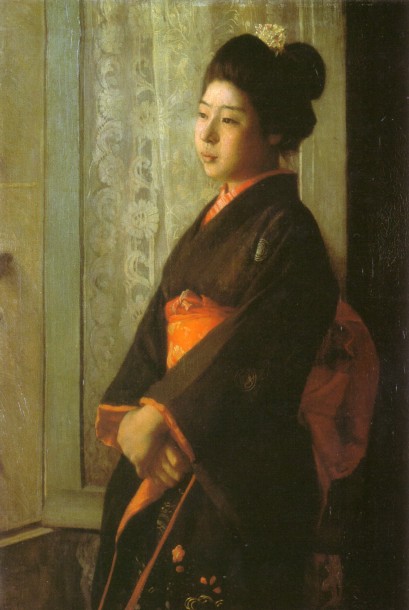
Thoughts of Home (Portrait of a Japanese Lady)
思郷(日本婦人の肖像)
1902
Oil on canvas

Reading
読書
1902
Oil on canvas

Portrait of Madame Sitter
マダム・シッテル像
1903
Oil on canvas

Old Woman
おうな
1908
Oil on canvas