Biography
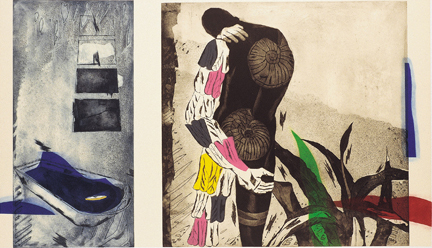
Noriko Yanagisawa (born 1940, Hamamatsu, Shizuoka Prefecture) is one of the senior Japanese intaglio printmakers, known for richly atmospheric mixed-technique sheets that combine etching and mezzotint with hand-dyeing on Japanese gampi paper. She completed graduate study at Tokyo University of the Arts (Tokyo Geidai), where she trained under Tetsurō Komai — the pioneering figure of postwar Japanese intaglio — after an earlier grounding in oil painting. That training placed her close to the source of the modern Japanese etching tradition, and her own subsequent work has extended it into a quieter, more iconographically loaded register.
Early in her career Yanagisawa received the Japan Print Association Prize and became the youngest member of the association. From 1971 through 1975 she was based in New York, working at the Printmaking Workshop in Manhattan and absorbing the experimental American intaglio practice of the period. After returning to Japan she settled in Shizuoka Prefecture, where she maintains a studio in Kakegawa.
The iconographic vocabulary she has developed across the 1990s and 2000s is unmistakable: wings, birds, half-human and half-beast figures, ammonites, and other forms drawn from natural-history illustration and mythology, rendered through meticulous intaglio line and atmospheric tonal aquatint. In 1992 she spent a period in London under the Agency of Cultural Affairs' Overseas Study Program for Artists.
Following her 2015 visit to Chernobyl, Yanagisawa's recent work has shifted toward direct response to ecological catastrophe. The Words Spoken by Animals series — including Words Spoken by Animals: Life II (2024), a 62 × 60 cm etching-and-mezzotint sheet with hand-dyeing on gampi, shown in the CWAJ Print Show in Tokyo — addresses the animals left behind in the Fukushima exclusion zone after the 2011 Tōhoku earthquake and the legacy of nuclear testing on non-human life. Her solo exhibition Words Spoken by Animals at Art Front Gallery (Tokyo) in 2024 consolidated this thematic turn.
Yanagisawa is a member of the Japan Print Association and the Japan Artists Association. Her prints are held in the collections of the National Gallery of Bulgaria, the Tikotin Museum of Japanese Art (Israel), and Japanese institutions including the University Art Museum of Tokyo University of the Arts, the Museum of Modern Art, Saitama, and the Museum of Modern Art, Shizuoka.
Within contemporary Japanese intaglio she occupies a distinctive position as one of the senior women printmakers carrying the Komai tradition forward, and as one of the very few Japanese printmakers whose practice has explicitly incorporated post-Fukushima ecological themes into a sustained body of intaglio work.
Key Facts
- Active Period
- 1940
- Nationality
- 🇯🇵Japan
- Movement
- Contemporary Mokuhanga
- Subjects
- Figures
- Works Indexed
- 2
Frequently Asked Questions
Noriko Yanagisawa (born 1940, Hamamatsu, Shizuoka Prefecture) is one of the senior Japanese intaglio printmakers, known for richly atmospheric mixed-technique sheets that combine etching and mezzotint with hand-dyeing on Japanese gampi paper. She completed graduate study at Tokyo University of the Arts (Tokyo Geidai), where she trained under Tetsurō Komai — the pioneering figure of postwar Japanese intaglio — after an earlier grounding in oil painting. That training placed her close to the source of the modern Japanese etching tradition, and her own subsequent work has extended it into a quieter, more iconographically loaded register.
Noriko Yanagisawa was active born in 1940. They were associated with the Contemporary Mokuhanga movement.
Noriko Yanagisawa's work was shaped by the Contemporary Mokuhanga tradition in Japanese woodblock printmaking. Contemporary Mokuhanga: Contemporary mokuhanga (literally "wood-block print") encompasses artists working from approximately 1970 to the present who continue or reinvent traditional Japanese woodblock printing techniques.
Noriko Yanagisawa's prints frequently feature figures.