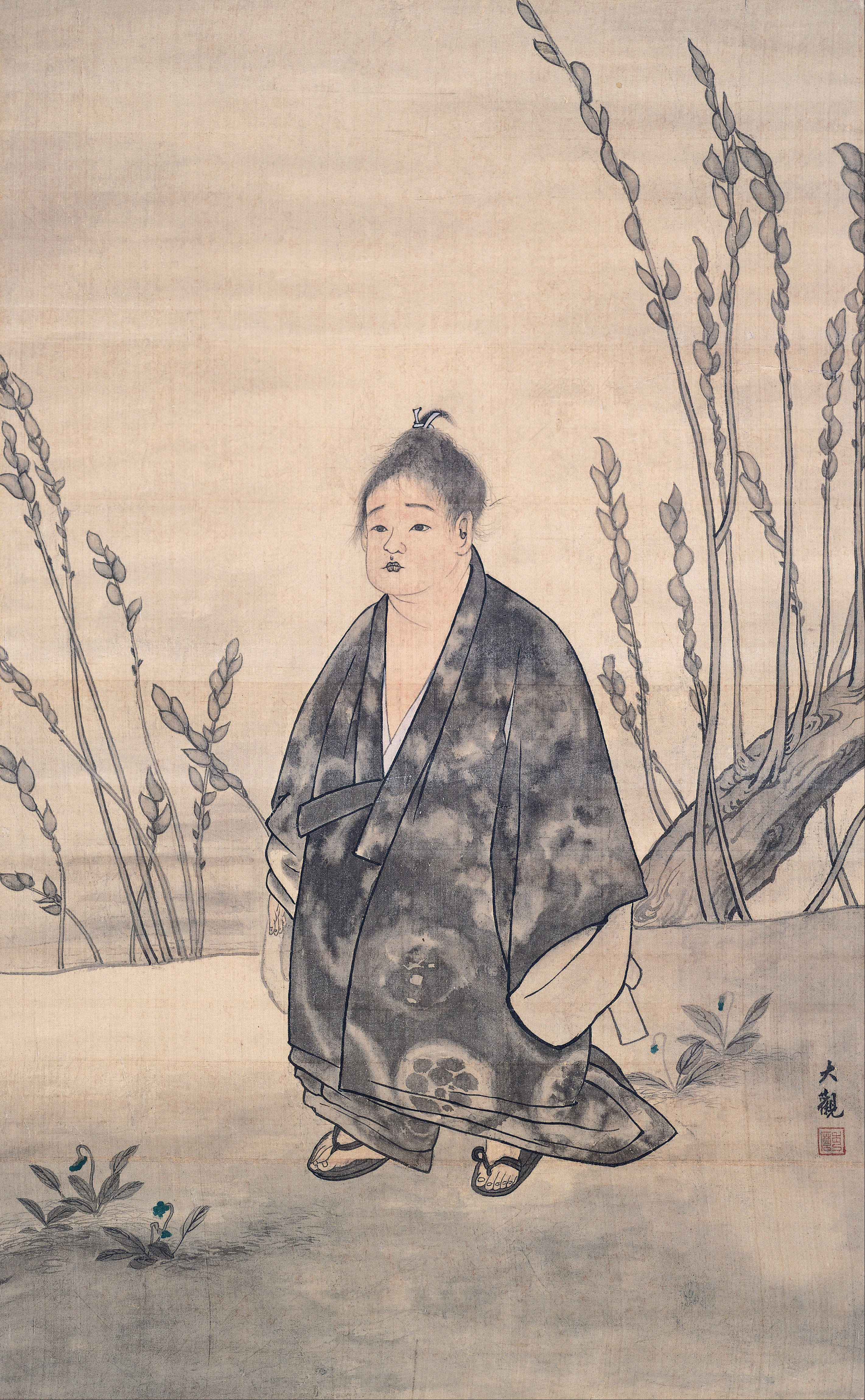
Yokoyama Taikan
横山大観
1868–1958
Japan
Biography
Yokoyama Taikan (横山大観, 1868-1958) was the most influential nihonga painter of the Meiji, Taishō, and Shōwa periods, the principal disciple of Okakura Kakuzō (Tenshin), a founder and lifelong sustainer of the Nihon Bijutsuin (Japan Fine Arts Academy), the co-creator with Hishida Shunsō of the controversial mōrōtai ("vague style"), and, in his late career, the foremost national painter of Mount Fuji — a subject he is said to have rendered more than 1,500 times. For sixty years he stood at the institutional center of Japanese-style painting in opposition to yōga (Western oil painting).
He was born Sakai Hidemaro on 2 November 1868 into a samurai family in Mito (Ibaraki Prefecture) that had served the Mito-Tokugawa branch; the family moved to Tokyo in 1878. After early instruction in pencil drawing from Watanabe Fumisaburō, he enrolled in 1889 in the inaugural class of the Tōkyō Bijutsu Gakkō (Tokyo School of Fine Arts), the first state-chartered art school in Japan, founded by Okakura Kakuzō and Ernest Fenollosa as a deliberate counter-institution to the yōga establishment. There he studied under the Kanō-school master Hashimoto Gahō alongside the classmates with whom his career would be inseparably entwined: Hishida Shunsō and Shimomura Kanzan. He took the art name Taikan ("Great Vision") and, after a brief teaching stint in Kyoto, returned to his alma mater as an assistant professor.
The defining institutional break came in 1898, when Okakura was forced out of the Tokyo School of Fine Arts in a bureaucratic struggle over its direction. Taikan, Shunsō, Kanzan, and many leading younger nihonga painters resigned in solidarity and joined him in founding the Nihon Bijutsuin at Yanaka in Tokyo. The first Bijutsuin was a financially fragile experiment that effectively went dormant after relocating to Izura around 1906. Around the turn of the century Taikan and Shunsō developed mōrōtai, a technique that suppressed traditional outline in favor of soft, blended color washes; the Japanese critical establishment savaged it as un-Japanese and structureless, and the term itself was originally a slur. During 1903-1905 the two traveled to India — where Taikan met Abanindranath Tagore and the wider Bengal-renaissance circle — as well as the United States and Europe, absorbing Western academic painting and late-symbolist European atmosphere. The works of this formative period, among them Innocence (Muga, 1897) and Waves in Moonlight (1904-1905), are now read as foundational to modern nihonga.
After Okakura's death in 1913, Taikan led the 1914 revival of the Bijutsuin as the Saikō Nihon Bijutsuin ("Reorganized Japan Fine Arts Academy"), centered on its annual jury-free Inten exhibition — still one of the most important nihonga exhibition societies outside the official Bunten/Nitten system. From this platform Taikan presided over Japanese-style painting for four decades. His major works include Eight Views of the Xiao and Xiang Rivers (1912, Tokyo National Museum, Important Cultural Property) and, shown at the tenth Inten in 1923, Metempsychosis (Seisei ruten, MOMAT, Important Cultural Property) — a handscroll some forty metres long, executed entirely in modulated ink, that traces the life-cycle of water from a mountain stream through a great river to the sea and skyward again as vapor.
In the 1930s and 1940s Taikan was elevated to the highest ranks of cultural authority: appointed to the Imperial Arts Academy (Teikoku Bijutsuin) in 1935 and named one of the first recipients of the Order of Culture (Bunka Kunshō) at its establishment in 1937. Closely identified with Mount Fuji as a national emblem, he painted the mountain through the wartime years and donated proceeds from his painting sales to the war effort. In the 1950s he produced the late masterpiece A Day in the Pacific Ocean (1952, MOMAT). He died in Tokyo on 26 February 1958, aged eighty-nine, and was posthumously awarded the Grand Cordon of the Order of the Rising Sun.
Taikan's surviving works are concentrated in the major Japanese museums: the Tokyo National Museum, the National Museum of Modern Art, Tokyo (MOMAT), and the Adachi Museum of Art in Yasugi, which holds one of the most comprehensive Taikan collections in the world, together with the Yokoyama Taikan Memorial Hall at his former Ikenohata residence. A smaller body entered Western collections, notably Waves in Moonlight at the Museum of Fine Arts, Boston, a souvenir of his 1904-1905 tour of the United States. Although Taikan was primarily a painter rather than a printmaker, his role as institutional anchor of nihonga makes him indispensable to any account of modern Japanese pictorial art and its relationship to the parallel histories of shin-hanga and sōsaku-hanga printmaking.
Key Facts
- Active Period
- 1868–1958
- Nationality
- 🇯🇵Japan
Frequently Asked Questions
Yokoyama Taikan (横山大観, 1868-1958) was the most influential nihonga painter of the Meiji, Taishō, and Shōwa periods, the principal disciple of Okakura Kakuzō (Tenshin), a founder and lifelong sustainer of the Nihon Bijutsuin (Japan Fine Arts Academy), the co-creator with Hishida Shunsō of the controversial mōrōtai ("vague style"), and, in his late career, the foremost national painter of Mount Fuji — a subject he is said to have rendered more than 1,500 times. For sixty years he stood at the institutional center of Japanese-style painting in opposition to yōga (Western oil painting).
Yokoyama Taikan was active from 1868 to 1958.