
Moonwave
by Fukami Gashu
- Medium:
- Mokuhanga (Japanese woodblock)
- Image courtesy of
- Saru Gallery
Description
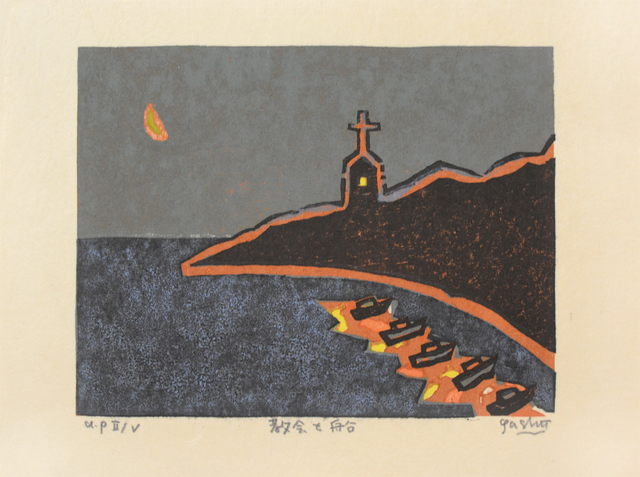
Moonwave joins two of the most enduring motifs in Japanese landscape printmaking: the moon (tsuki) and the cresting wave. The pairing belongs to a long meisho-e and kacho-e tradition in which a single celestial element anchors a scene of water, evoking nocturnal stillness or the rhythmic energy of the sea. Prints of this kind often place a circular moon high in the composition, sometimes reserved as uncolored paper to read as luminous against a graded indigo sky achieved with bokashi. Wave forms below are typically articulated through the keyblock's curling line — a vocabulary refined by Hokusai and inherited by later printmakers — with crests picked out in white and troughs deepened by overprinted blues. Working in a Kuniyoshi-adjacent idiom, Fukami would have had access to this established repertoire of moon-and-water imagery while treating it at an intimate, contemplative scale.
More Prints by Fukami Gashu


Frequently Asked Questions
Moonwave was created by Fukami Gashu (深見画秀).