
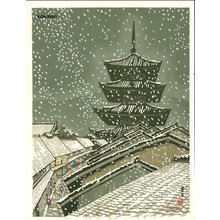
House In Kyôto
- Medium:
- Mokuhanga (Japanese woodblock)
- Image courtesy of
- Saru Gallery
Description
House In Kyôto depicts a traditional Kyoto townhouse, the machiya form characterized by a narrow street frontage, deep interior plan, latticed wood windows known as koshi, a tile roof with overhanging eaves, and often a noren curtain hung at the entrance. Kyoto machiya were a recurring subject for twentieth-century printmakers including Asano Takeji and Tokuriki Tomikichiro, who treated the city's surviving wooden streetscapes as a record of urban life under pressure from postwar redevelopment. A single-house print of this kind typically frames the building straight on or at a slight oblique, using the regular rhythm of koshi slats and roof tiles as a graphic element across the sheet. Color woodblock printing addresses such subjects through restrained palettes of brown, grey, and ochre, with bokashi available for sky areas and a key block carrying the linear definition of joinery. Paired with the artist's House in Shimoda, Izu, this print indicates a small group of architectural studies within Konishi Seiichiro's recorded output, treating distinct regional building types within a common compositional approach.
More Prints by Konishi Seiichiro


Frequently Asked Questions
House In Kyôto was created by Konishi Seiichiro (小西誠一郎).