
House In Shimoda, Izu
- Medium:
- Mokuhanga (Japanese woodblock)
- Image courtesy of
- Saru Gallery
Description
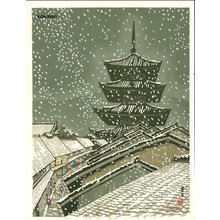
House In Shimoda, Izu portrays a domestic building in the small port town on the southern tip of the Izu Peninsula, a place historically associated with the 1854 arrival of Commodore Perry and the negotiation of the Treaty of Kanagawa. Shimoda's older houses are recognizable for their namako-kabe — fire-resistant walls of black tile set into raised plaster joints arranged in diamond patterns — alongside tile-clad roofs and weathered cedar siding. A print of a single house from this region typically isolates the building against a simple ground of road, low garden, or sea, allowing the textural contrast between tile, plaster, and timber to carry the composition. Polychrome woodblock printing handles such textures through carefully calibrated color blocks, sometimes supplemented by gauffrage or visible block grain to suggest weathered wood. Single-building studies were a recurring subject in mid-twentieth-century shin-hanga and shin-sosaku-hanga, drawing on the meisho-e tradition while narrowing the frame to a domestic scale. Konishi's House in Shimoda complements his House in Kyoto, indicating an interest in regional vernacular architecture across his output.
More Prints by Konishi Seiichiro


Frequently Asked Questions
House In Shimoda, Izu was created by Konishi Seiichiro (小西誠一郎).