
Nara Townhouse
- Medium:
- Mokuhanga (Japanese woodblock)
- Image courtesy of
- Saru Gallery
Description
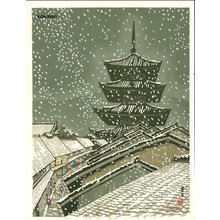
The print depicts a townhouse (machiya) in Nara, the former imperial capital that retains substantial stretches of Edo- and Meiji-period vernacular architecture. Nara machiya share the deep, narrow plan of their Kyoto counterparts but typically show simpler facades, with latticed kōshi windows, fired-tile roofs, and earthen walls under wooden eaves. A mid-twentieth-century mokuhanga treatment of such a subject would render the building in flat color planes, using the carved keyblock to describe roof tiles, lattice members, and signage with economy, occasionally introducing bokashi gradation in the sky or wall surfaces. The print belongs to the architectural and meisho-e (famous-place) tradition that postwar Japanese printmakers continued from the shin-hanga generation of Hasui and Yoshida, though sosaku-hanga practitioners tended toward more compressed, design-forward compositions. Within Konishi Seiichiro's attributed corpus, this print pairs with his other Nara and Kyoto subjects to indicate a sustained engagement with the vernacular townscapes of the Kansai region, recorded as postwar reconstruction was beginning to displace surviving wooden quarters.
More Prints by Konishi Seiichiro


Frequently Asked Questions
Nara Townhouse was created by Konishi Seiichiro (小西誠一郎).