
Itsukushima
by Ray Morimura
- Medium:
- Mokuhanga (Japanese woodblock)
- Image courtesy of
- Hanga Ten
Description
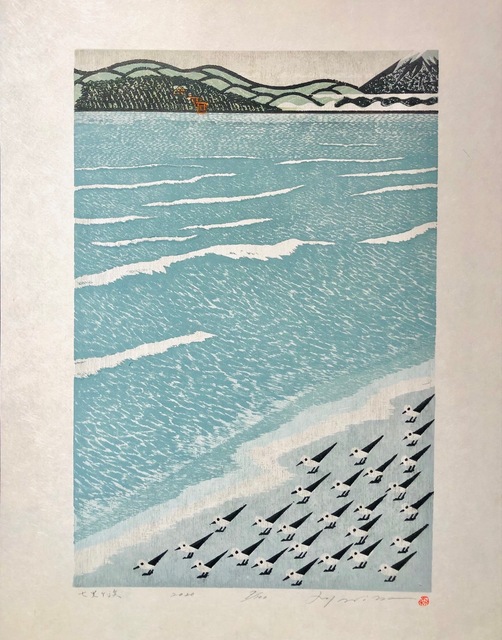
Itsukushima Shrine on Miyajima in the Inland Sea is famous for its vermilion otorii standing in the tidal flats and its over-water corridors of cinnabar-painted columns. Morimura's treatment likely isolates a section of the shrine's covered walkway or the great gate itself, reducing the structure to a rhythmic grid of red verticals against the flat plane of sea or sky. Where Hiroshige's earlier meisho-e of the same subject embraced atmospheric perspective, Morimura's mokuhanga is graphic and frontal, with reflections in the water suggested by horizontal banding rather than ripple. Vermilion in mokuhanga is notoriously difficult to print evenly, and the careful registration required to keep the temple's lattice work crisp across many impressions is characteristic of his self-carved, self-printed practice. Itsukushima sits among Morimura's set pieces of nationally famous religious sites — Kiyomizudera, Horyuji, the Ise shrines — where he renounces tourist iconography for a contemplative, almost diagrammatic view that emphasizes the geometry of sacred construction.
More Prints by Ray Morimura


Frequently Asked Questions
Itsukushima was created by Ray Morimura (森村玲).