
Sekitei
by Ray Morimura
- Medium:
- Mokuhanga (Japanese woodblock)
- Image courtesy of
- Hanga Ten
Description
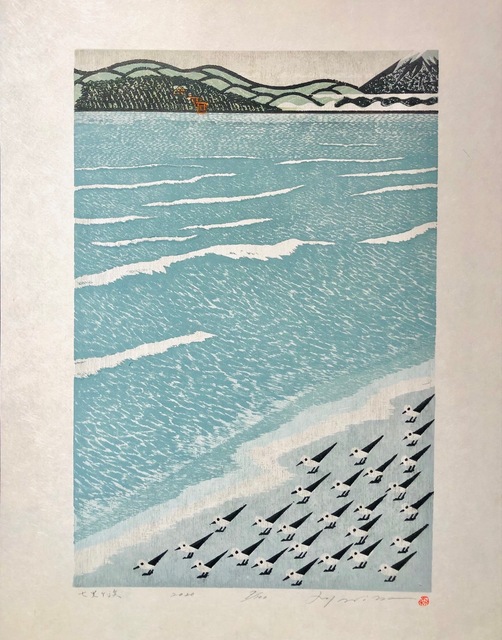
Sekitei (石庭) means 'stone garden,' the term used for the karesansui dry-landscape gardens of Zen temples, in which raked gravel evokes water and carefully placed stones suggest islands or mountains. Morimura's depiction almost certainly presents such a garden in plan-like flatness: parallel rake lines incised into the gravel as fine printed lines, weathered boulders rendered as irregular dark masses, and the surrounding earthen wall or veranda framing the composition. The reductive vocabulary of the karesansui—stone, gravel, moss, wall—aligns closely with Morimura's own pictorial economy, making it a natural subject for him. His technique relies on multiple precisely registered blocks to layer the slight tonal variations of weathered surfaces, while the broad gravel field offers an opportunity for subtle bokashi or fine-line carving across a large negative space. The print belongs to the strain of his work most concerned with garden architecture, where contemplative subject matter and graphic discipline reinforce one another.
More Prints by Ray Morimura


Frequently Asked Questions
Sekitei was created by Ray Morimura (森村玲).