
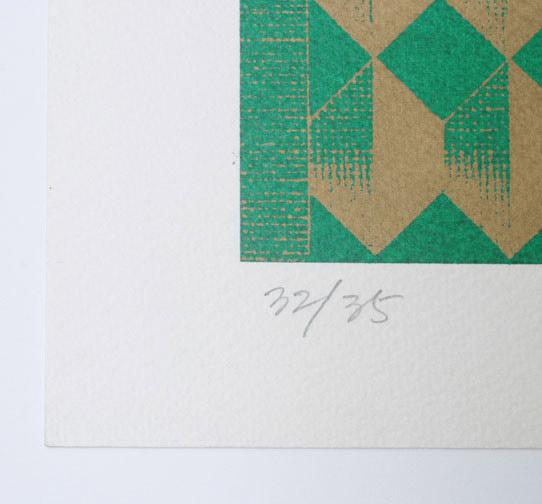
427-G (ed.32/35)
- Source:
- ukiyo-e.org
Description
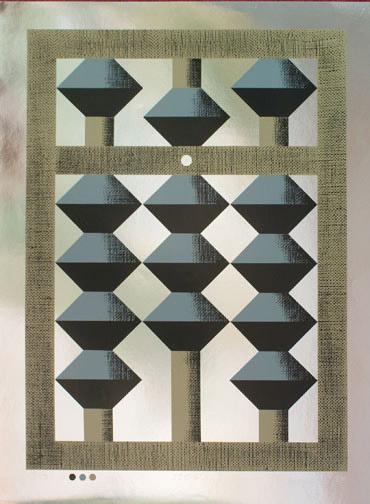
427-G (ed.32/35) is a numbered impression from one of Sekine Yoshio's tightly limited contemporary woodblock editions, with the inscription '32/35' indicating that only thirty-five impressions of this composition were pulled. Sekine Yoshio (born 1922) built his postwar career around a single, deeply Japanese subject — the soroban, or abacus — and treated it with the conceptual restraint of an artist working in dialogue with Gutai and other contemporary Japanese abstract movements rather than with the narrative traditions of ukiyo-e. The 'G' suffix in his numbering system points to a particular format or color state within his catalogue raisonné, while the leading number, 427, locates the print within the long serialized progression that organizes his output as if it were an inventory. In this impression, the abacus motif is pared back to its essential geometry: rails, frame, and rows of beads function as compositional armature, with color blocks reading as flattened rhythm rather than illusionistic depiction. The result is a print that operates simultaneously as still life, abstraction, and quiet commentary on counting itself — an object that historically organized commerce in Japan reframed as an instrument of visual order. The edition size of thirty-five is small even by contemporary woodblock standards, underscoring the close, almost workshop-scale relationship between artist, block, and impression. This impression is documented in the Robyn Buntin of Honolulu archive on ukiyo-e.org, the principal source through which Sekine Yoshio's numbered abacus prints have circulated to Western collectors. Together with his other 'G' and 'S' series prints, 427-G situates Sekine Yoshio as a focused practitioner of postwar Japanese contemporary woodblock who used a single domestic motif to sustain decades of disciplined abstraction.
More Prints by Sekine Yoshio
Frequently Asked Questions
427-G (ed.32/35) was created by Sekine Yoshio (関根義夫).