
511-S
- Source:
- ukiyo-e.org
Description
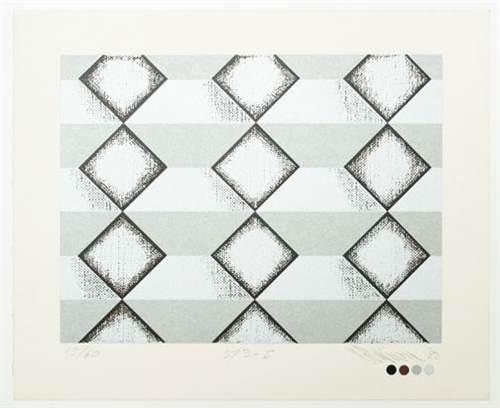
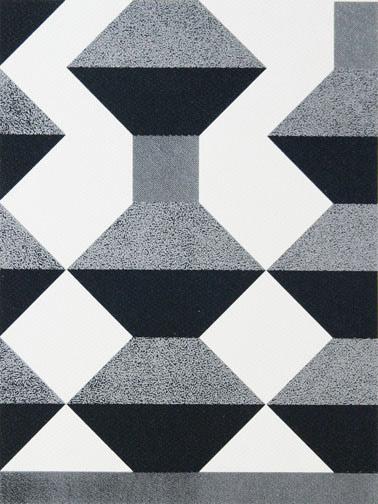
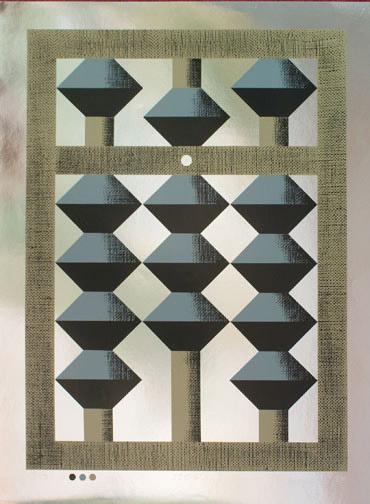
511-S by Sekine Yoshio belongs to the artist's long-running serialized body of work in which each print is identified not by a poetic title but by a number and a letter suffix, a system that aligns the production with the rigor of a registered ledger rather than the conventions of pictorial naming. Sekine Yoshio (born 1922) was a contemporary woodblock artist who came of age during the postwar period in which the sosaku-hanga (creative print) movement and the Gutai/contemporary avant-garde were dismantling the assumptions of ukiyo-e workshop production. Working with the abacus motif that became his lifelong signature, Sekine isolates a single object of everyday Japanese arithmetic and transforms it into a structural grid for abstract composition. The 'S' designation in 511-S refers to a smaller format within his numbered sequence; the impression catalogued by Robyn Buntin of Honolulu shows the artist's characteristic flat color fields, sharp registration, and emphasis on the lateral movement of beads along the wooden frame of the soroban. Sekine treats the abacus as a found geometry: its rails and beads supply ready-made horizontals and circles that allow him to operate in the same conceptual space as Gutai-era and contemporary Japanese abstraction while remaining committed to traditional woodblock technique. The reduction of subject to a single repeated object, the substitution of inventory numbers for titles, and the emphasis on subtle color shifts between editions all locate this print in the postwar avant-garde reconsideration of what a Japanese print could be. Documented by the Robyn Buntin gallery archive on ukiyo-e.org, 511-S is representative of the disciplined, almost taxonomic practice that made Sekine Yoshio a quietly distinctive voice in the contemporary woodblock field.
More Prints by Sekine Yoshio
Frequently Asked Questions
511-S was created by Sekine Yoshio (関根義夫).