Lake Towada (十和田湖)
1 print by 1 artist
About Lake Towada
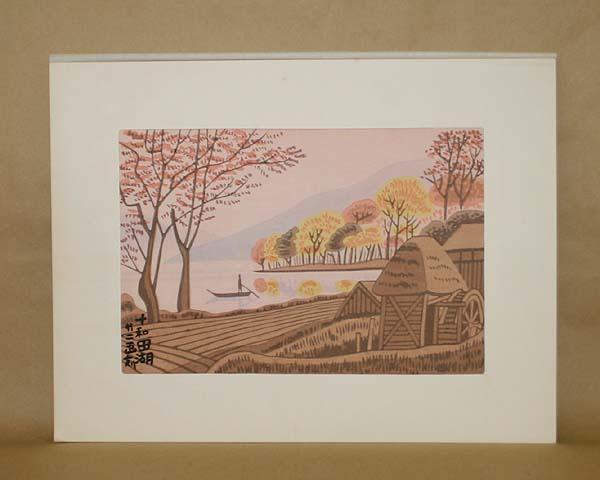
Lake Towada is a large caldera lake in the mountains on the boundary of Aomori and Akita Prefectures in the northern Tohoku region of Honshu, formed in a series of eruptions of the surrounding stratovolcano across the past two hundred thousand years, with the principal collapse forming the present lake basin approximately fifteen thousand years ago. The lake covers approximately 61 square kilometers at an elevation of 400 meters above sea level, with a maximum depth of 327 meters that makes it the third deepest lake in Japan, and it is surrounded by steep wooded slopes that turn brilliant orange, red, and gold in autumn. The lake is shaped roughly like a triangle, with the small Nakayama and Ogura peninsulas extending into its central area from the southern shore. The outflow runs north through the Oirase Gorge (Oirase Keiryu), a narrow stream-and-waterfall valley running approximately fourteen kilometers from the northern lake shore at Nenokuchi to the village of Yakeyama, which is celebrated for its seasonal foliage and cascade scenery and is one of the most heavily visited autumn destinations in Tohoku. The gorge contains numerous named cascades including Choshi-otaki, Kumoi-no-taki, Shiraito-no-taki, and the Ashura nagare. The lake and surrounding district were developed as a tourism destination from the late Meiji period through the prewar Showa period, with steamer service on the lake, hot spring lodges, and walking paths established along the shore and through the Oirase Gorge, principally as a result of promotion by the local poet and naturalist Omachi Keigetsu, who published widely on the beauty of the region in the late Meiji period and is sometimes credited with elevating Towada to national tourism prominence. The Towada-Hachimantai National Park was established in 1936 to protect the lake, the gorge, and the surrounding mountains. For Japanese printmaking Lake Towada is most prominently associated with Kawase Hasui, who treated the lake and the surrounding Tohoku region in numerous compositions including the celebrated Towada and Oirase Gorge sheets of his travel-based shin-hanga practice, with Hasui's Lake Towada in Autumn and Oirase Stream in Autumn among the most reproduced of his Tohoku subjects. The Towada subjects exemplify Hasui's engagement with northern Honshu, alongside his Aomori, Akita, and Hokkaido compositions, and he visited the region on multiple occasions across the 1930s. Other shin-hanga and sosaku-hanga artists treated the region, with Yoshida Hiroshi, Asano Takeji, and the postwar Tohoku-based creative-print artists including Munakata Shiko (working from his native Aomori) contributing further compositions of the lake and the surrounding forests. The visual character of Lake Towada in prints is built on the dark caldera water against the steep wooded shores, the autumn maple and beech of the Oirase Gorge in stages of color change from green through yellow to red, the white cascades of the gorge falls including Choshi Otaki and Kumoi Falls dropping through the dense forest, the still surface of the lake in early morning with the surrounding peaks reflected, and the diffused atmospheric conditions of the mountainous Tohoku setting. Contemporary visitors approach the lake principally via the Aomori or Akita prefectural roads, with the Oirase Gorge walking path running parallel to the stream from Nenokuchi to Yakeyama, the lakeside settlement at Yasumiya providing accommodation and boat services, and the Nenokuchi shore at the head of the gorge providing the principal photographic viewpoint, all served by bus from JR Hachinohe Station or JR Aomori Station.
Prints Depicting Lake Towada (1)
Artists Who Depicted Lake Towada (1)
Frequently Asked Questions
Lake Towada is a large caldera lake in the mountains on the boundary of Aomori and Akita Prefectures in the northern Tohoku region of Honshu, formed in a series of eruptions of the surrounding stratovolcano across the past two hundred thousand years, with the principal collapse forming the present lake basin approximately fifteen thousand years ago. The lake covers approximately 61 square kilometers at an elevation of 400 meters above sea level, with a maximum depth of 327 meters that makes it the third deepest lake in Japan, and it is surrounded by steep wooded slopes that turn brilliant orange, red, and gold in autumn. The lake is shaped roughly like a triangle, with the small Nakayama and Ogura peninsulas extending into its central area from the southern shore. The outflow runs north through the Oirase Gorge (Oirase Keiryu), a narrow stream-and-waterfall valley running approximately fourteen kilometers from the northern lake shore at Nenokuchi to the village of Yakeyama, which is celebrated for its seasonal foliage and cascade scenery and is one of the most heavily visited autumn destinations in Tohoku. The gorge contains numerous named cascades including Choshi-otaki, Kumoi-no-taki, Shiraito-no-taki, and the Ashura nagare. The lake and surrounding district were developed as a tourism destination from the late Meiji period through the prewar Showa period, with steamer service on the lake, hot spring lodges, and walking paths established along the shore and through the Oirase Gorge, principally as a result of promotion by the local poet and naturalist Omachi Keigetsu, who published widely on the beauty of the region in the late Meiji period and is sometimes credited with elevating Towada to national tourism prominence. The Towada-Hachimantai National Park was established in 1936 to protect the lake, the gorge, and the surrounding mountains. For Japanese printmaking Lake Towada is most prominently associated with Kawase Hasui, who treated the lake and the surrounding Tohoku region in numerous compositions including the celebrated Towada and Oirase Gorge sheets of his travel-based shin-hanga practice, with Hasui's Lake Towada in Autumn and Oirase Stream in Autumn among the most reproduced of his Tohoku subjects. The Towada subjects exemplify Hasui's engagement with northern Honshu, alongside his Aomori, Akita, and Hokkaido compositions, and he visited the region on multiple occasions across the 1930s. Other shin-hanga and sosaku-hanga artists treated the region, with Yoshida Hiroshi, Asano Takeji, and the postwar Tohoku-based creative-print artists including Munakata Shiko (working from his native Aomori) contributing further compositions of the lake and the surrounding forests. The visual character of Lake Towada in prints is built on the dark caldera water against the steep wooded shores, the autumn maple and beech of the Oirase Gorge in stages of color change from green through yellow to red, the white cascades of the gorge falls including Choshi Otaki and Kumoi Falls dropping through the dense forest, the still surface of the lake in early morning with the surrounding peaks reflected, and the diffused atmospheric conditions of the mountainous Tohoku setting. Contemporary visitors approach the lake principally via the Aomori or Akita prefectural roads, with the Oirase Gorge walking path running parallel to the stream from Nenokuchi to Yakeyama, the lakeside settlement at Yasumiya providing accommodation and boat services, and the Nenokuchi shore at the head of the gorge providing the principal photographic viewpoint, all served by bus from JR Hachinohe Station or JR Aomori Station.
Hanga catalogues 1 print depicting Lake Towada (十和田湖), by 1 artist.
Takeji Asano is among the 1 artist who depicted Lake Towada in our collection.
Want to rate prints from Lake Towada?
Sign up to start rating