Maruyama Park (円山公園)
1 print by 1 artist
About Maruyama Park
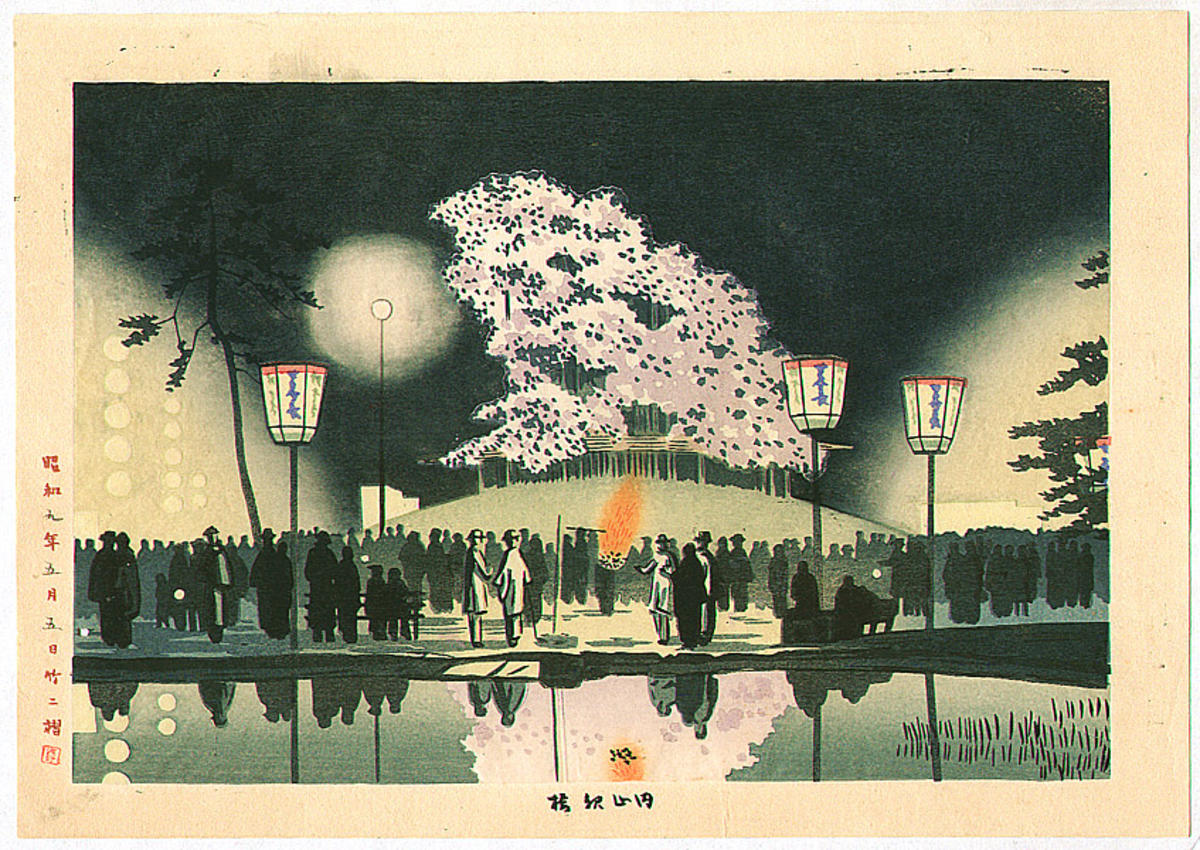
Maruyama Park is a Western-style public park in the Higashiyama district of central Kyoto, established in 1886 on land previously belonging to the Chion-in and Yasaka shrine complex, in present-day Higashiyama Ward, as one of the first Western-influenced public parks in Kyoto. The park occupies the wooded slope between Yasaka Shrine to the west and Chion-in to the east, and incorporates earlier teahouses, ponds, and walking paths from the temple landholdings into a Meiji-period public landscape design. The park is principally celebrated for its great weeping cherry tree (shidare-zakura), called the Gion shidare-zakura, an enormous specimen at the center of the park whose seasonal blossom in early April draws large evening crowds for hanami viewing, with the tree illuminated after dark in a tradition continuing from the late nineteenth century. The present tree is the second-generation tree planted in 1949 to replace the original specimen, which died in the mid-twentieth century, with the surrounding park also containing approximately 680 other cherry trees of various varieties. The park also includes a pond garden, lawns, traditional Japanese restaurants and teahouses, the small Chiyoshogen waterfall, and walking paths connecting to the surrounding Higashiyama temple district, including a steep path north to the Maruyama hill from which much of the eastern Kyoto skyline can be seen. The park's history is tightly tied to the early Meiji program of secularizing temple land and converting religious properties into public parks under the 1873 Public Park Law, with the area between Yasaka Shrine and Chion-in being among the earliest such conversions in Kyoto. For Japanese printmaking Maruyama Park appears almost exclusively in the shin-hanga revival of the early twentieth century, as a Meiji-founded site whose period of greatest pictorial currency falls after the close of the principal ukiyo-e era. Kawase Hasui produced multiple Maruyama compositions including the celebrated night view of the great weeping cherry under lantern light and snow views of the surrounding park, with his evening cherry blossom compositions among the most reproduced of his Kyoto sheets and one of the most recognized shin-hanga images of Kyoto cherry blossom viewing. Tsuchiya Koitsu, Asano Takeji, Yoshida Hiroshi, and Tokuriki Tomikichiro contributed further compositions of the cherry tree, the pond, and the park during cherry blossom season, with Yoshida Hiroshi's variant-impression cherry blossom prints often based on Kyoto and Yoshino subjects of which Maruyama figures as one example. The visual character of Maruyama Park in prints is built on the silhouette of the great weeping cherry against night sky, the pale blossom catching lantern light, the lantern-lit walks of the park, the reflective pond surface, the surrounding pine and maple, and the figures of evening hanami visitors gathered beneath the central tree. The park is most often depicted in spring at peak cherry blossom, though winter snow views and autumn compositions also occur. Contemporary Maruyama Park remains a principal cherry blossom viewing site in Kyoto and is connected via the standard Higashiyama walking circuit to the adjacent Yasaka Shrine, Chion-in, and Kiyomizu temple complex, with the night illumination of the central weeping cherry occurring annually during the brief blossom season in early to mid April.
Prints Depicting Maruyama Park (1)
Artists Who Depicted Maruyama Park (1)
Frequently Asked Questions
Maruyama Park is a Western-style public park in the Higashiyama district of central Kyoto, established in 1886 on land previously belonging to the Chion-in and Yasaka shrine complex, in present-day Higashiyama Ward, as one of the first Western-influenced public parks in Kyoto. The park occupies the wooded slope between Yasaka Shrine to the west and Chion-in to the east, and incorporates earlier teahouses, ponds, and walking paths from the temple landholdings into a Meiji-period public landscape design. The park is principally celebrated for its great weeping cherry tree (shidare-zakura), called the Gion shidare-zakura, an enormous specimen at the center of the park whose seasonal blossom in early April draws large evening crowds for hanami viewing, with the tree illuminated after dark in a tradition continuing from the late nineteenth century. The present tree is the second-generation tree planted in 1949 to replace the original specimen, which died in the mid-twentieth century, with the surrounding park also containing approximately 680 other cherry trees of various varieties. The park also includes a pond garden, lawns, traditional Japanese restaurants and teahouses, the small Chiyoshogen waterfall, and walking paths connecting to the surrounding Higashiyama temple district, including a steep path north to the Maruyama hill from which much of the eastern Kyoto skyline can be seen. The park's history is tightly tied to the early Meiji program of secularizing temple land and converting religious properties into public parks under the 1873 Public Park Law, with the area between Yasaka Shrine and Chion-in being among the earliest such conversions in Kyoto. For Japanese printmaking Maruyama Park appears almost exclusively in the shin-hanga revival of the early twentieth century, as a Meiji-founded site whose period of greatest pictorial currency falls after the close of the principal ukiyo-e era. Kawase Hasui produced multiple Maruyama compositions including the celebrated night view of the great weeping cherry under lantern light and snow views of the surrounding park, with his evening cherry blossom compositions among the most reproduced of his Kyoto sheets and one of the most recognized shin-hanga images of Kyoto cherry blossom viewing. Tsuchiya Koitsu, Asano Takeji, Yoshida Hiroshi, and Tokuriki Tomikichiro contributed further compositions of the cherry tree, the pond, and the park during cherry blossom season, with Yoshida Hiroshi's variant-impression cherry blossom prints often based on Kyoto and Yoshino subjects of which Maruyama figures as one example. The visual character of Maruyama Park in prints is built on the silhouette of the great weeping cherry against night sky, the pale blossom catching lantern light, the lantern-lit walks of the park, the reflective pond surface, the surrounding pine and maple, and the figures of evening hanami visitors gathered beneath the central tree. The park is most often depicted in spring at peak cherry blossom, though winter snow views and autumn compositions also occur. Contemporary Maruyama Park remains a principal cherry blossom viewing site in Kyoto and is connected via the standard Higashiyama walking circuit to the adjacent Yasaka Shrine, Chion-in, and Kiyomizu temple complex, with the night illumination of the central weeping cherry occurring annually during the brief blossom season in early to mid April.
Hanga catalogues 1 print depicting Maruyama Park (円山公園), by 1 artist.
Takeji Asano is among the 1 artist who depicted Maruyama Park in our collection.
Want to rate prints from Maruyama Park?
Sign up to start rating