Shinobazu Pond (不忍池)
5 prints by 3 artists
About Shinobazu Pond
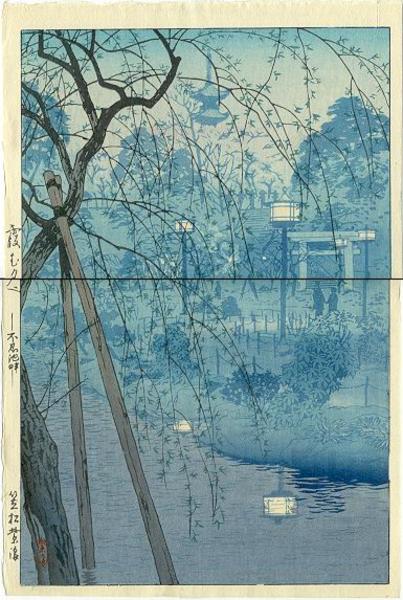
Shinobazu Pond is a natural pond on the southern edge of Ueno Park in central Tokyo, in present-day Taito Ward, formed in a low-lying area of the eastern Tokyo plain that was originally part of an inlet of Tokyo Bay before the long Holocene retreat of the bay shoreline. The pond is divided into three sections by the embankments of the Bentenjima island and the Ueno Zoo, with the central Bentenjima island connecting the lotus-covered northern section (Hasuike) to the open boat-pond southern section (Botto) and the smaller cormorant section (U no Ike) used as part of the Ueno Zoo. The small island of Bentenjima at the center of the pond is the location of the Bentendo, a small Buddhist temple dedicated to the goddess Benzaiten (one of the seven gods of fortune and associated with music, eloquence, and water), modeled on the Hogonji temple of Chikubushima island in Lake Biwa and dating in its present form from the seventeenth century within the Kan'ei-ji compound. The Bentendo was destroyed in 1945 and rebuilt in 1958. The northern section of the pond is celebrated for its summer lotus, which fills the water with broad green leaves and pink-and-white blossoms from late June through August, with the principal flowering peak in mid-July. The pond and the surrounding Ueno hill were developed across the Edo period as a popular leisure ground, with the great Kan'ei-ji temple complex established on the hill above by the priest Tenkai in 1625 and the surrounding teahouses, archery galleries, and entertainment establishments distributed along the pond. For Japanese printmaking Shinobazu Pond figures prominently in the late Edo meisho-e tradition. Utagawa Hiroshige treated the pond in his One Hundred Famous Views of Edo, including views of the Bentendo island, the cherry blossoms of the surrounding Ueno slope, and the surrounding district under varied seasonal conditions, and in his Famous Places in the Eastern Capital series, which included Shinobazu under autumn moon and other seasonal motifs. Hokusai included Shinobazu in his minor Edo prints and printed-book illustrations. The Meiji-period kaika-e treated the pond and the surrounding Ueno Park under its new identity as a Western-style public park established in 1873, with Inoue Yasuji and Kobayashi Kiyochika producing notable Shinobazu compositions, and the shin-hanga revival returned to the pond repeatedly. Kawase Hasui produced views of the Bentendo and the surrounding lotus in snow, rain, twilight, and summer conditions, with his evening lotus and snow Shinobazu sheets among the more reproduced of his Tokyo subjects, and Yoshida Hiroshi treated the pond in his individual Tokyo sheets. Onchi Koshiro and other members of the sosaku-hanga circle, including the participants in the One Hundred Views of New Tokyo project, treated the pond in their Tokyo compositions, and the postwar Tokyo sosaku-hanga circle including Sekino Junichiro and Saito Kiyoshi treated the pond in cityscape compositions. The visual character of Shinobazu in prints is built on the lotus mass of the northern section, with the broad pads and pink blossoms filling the surface, the Bentendo island with its small temple and surrounding trees set against the pond, the surrounding city and the slope of Ueno hill with the temple buildings of Kan'ei-ji and (after 1873) the Ueno museums above, and the seasonal phenomena of summer blossom, autumn migration of waterbirds, and winter snow on the bare pond surface. The lotus has functioned as one of the principal compositional motifs of Tokyo summer prints across the meisho-e and shin-hanga periods. Contemporary visitors find Shinobazu Pond at the southern edge of Ueno Park, reached most directly via the JR Yamanote Line or Tokyo Metro Hibiya Line to Ueno Station, with the Bentendo and the surrounding lotus pond preserving the principal motifs of the historical pictorial geography.
Prints Depicting Shinobazu Pond (5)


Artists Who Depicted Shinobazu Pond (3)

Frequently Asked Questions
Shinobazu Pond is a natural pond on the southern edge of Ueno Park in central Tokyo, in present-day Taito Ward, formed in a low-lying area of the eastern Tokyo plain that was originally part of an inlet of Tokyo Bay before the long Holocene retreat of the bay shoreline. The pond is divided into three sections by the embankments of the Bentenjima island and the Ueno Zoo, with the central Bentenjima island connecting the lotus-covered northern section (Hasuike) to the open boat-pond southern section (Botto) and the smaller cormorant section (U no Ike) used as part of the Ueno Zoo. The small island of Bentenjima at the center of the pond is the location of the Bentendo, a small Buddhist temple dedicated to the goddess Benzaiten (one of the seven gods of fortune and associated with music, eloquence, and water), modeled on the Hogonji temple of Chikubushima island in Lake Biwa and dating in its present form from the seventeenth century within the Kan'ei-ji compound. The Bentendo was destroyed in 1945 and rebuilt in 1958. The northern section of the pond is celebrated for its summer lotus, which fills the water with broad green leaves and pink-and-white blossoms from late June through August, with the principal flowering peak in mid-July. The pond and the surrounding Ueno hill were developed across the Edo period as a popular leisure ground, with the great Kan'ei-ji temple complex established on the hill above by the priest Tenkai in 1625 and the surrounding teahouses, archery galleries, and entertainment establishments distributed along the pond. For Japanese printmaking Shinobazu Pond figures prominently in the late Edo meisho-e tradition. Utagawa Hiroshige treated the pond in his One Hundred Famous Views of Edo, including views of the Bentendo island, the cherry blossoms of the surrounding Ueno slope, and the surrounding district under varied seasonal conditions, and in his Famous Places in the Eastern Capital series, which included Shinobazu under autumn moon and other seasonal motifs. Hokusai included Shinobazu in his minor Edo prints and printed-book illustrations. The Meiji-period kaika-e treated the pond and the surrounding Ueno Park under its new identity as a Western-style public park established in 1873, with Inoue Yasuji and Kobayashi Kiyochika producing notable Shinobazu compositions, and the shin-hanga revival returned to the pond repeatedly. Kawase Hasui produced views of the Bentendo and the surrounding lotus in snow, rain, twilight, and summer conditions, with his evening lotus and snow Shinobazu sheets among the more reproduced of his Tokyo subjects, and Yoshida Hiroshi treated the pond in his individual Tokyo sheets. Onchi Koshiro and other members of the sosaku-hanga circle, including the participants in the One Hundred Views of New Tokyo project, treated the pond in their Tokyo compositions, and the postwar Tokyo sosaku-hanga circle including Sekino Junichiro and Saito Kiyoshi treated the pond in cityscape compositions. The visual character of Shinobazu in prints is built on the lotus mass of the northern section, with the broad pads and pink blossoms filling the surface, the Bentendo island with its small temple and surrounding trees set against the pond, the surrounding city and the slope of Ueno hill with the temple buildings of Kan'ei-ji and (after 1873) the Ueno museums above, and the seasonal phenomena of summer blossom, autumn migration of waterbirds, and winter snow on the bare pond surface. The lotus has functioned as one of the principal compositional motifs of Tokyo summer prints across the meisho-e and shin-hanga periods. Contemporary visitors find Shinobazu Pond at the southern edge of Ueno Park, reached most directly via the JR Yamanote Line or Tokyo Metro Hibiya Line to Ueno Station, with the Bentendo and the surrounding lotus pond preserving the principal motifs of the historical pictorial geography.
Hanga catalogues 5 prints depicting Shinobazu Pond (不忍池), by 3 different artists.
Hiroshi Yoshida, Kawase Hasui, and Shiro Kasamatsu are among the 3 artists who depicted Shinobazu Pond in our collection.
Want to rate prints from Shinobazu Pond?
Sign up to start rating