At the Zoological Garden
About This Series
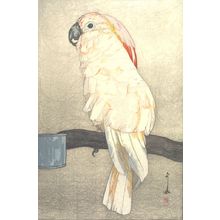
At the Zoological Garden (Dobutsuen nite, by the standard reading of the Japanese title) is the small cycle of zoo subjects through which Yoshida Hiroshi addressed one of the more unusual urban institutions of late Taisho and early Showa Tokyo, the public zoological garden whose collections of large mammals, birds, and reptiles had been a feature of Ueno Park since the Meiji period and which served the interwar Japanese audience as a site of family recreation and biological curiosity comparable to its European counterparts. The cycle, produced from Yoshida's independent jizuri workshop in the period after his break with Watanabe Shozaburo and his establishment of self-supervised production from 1925, treats the zoo subjects with the same observed naturalistic eye that the artist brought to his mountain landscapes and travel views, and the prints stand among the more idiosyncratic projects of his interwar output in their address to a contemporary urban institution rather than to the inherited topographical and natural subjects of the meisho-e and fukei-e traditions. Yoshida, who had built his early career through extended exhibition and travel in the United States and who had developed his own zoological interest through visits to the great Western zoos in New York, Philadelphia, and London, brought to the subject the trained eye of a yoga painter who had drawn animals from life across multiple continents, and the prints render their subjects with the credibility of Western animal painting rather than with the stylized vocabulary of the kacho-ga tradition. The jizuri production system, in which Yoshida personally supervised every stage of block cutting and printing, allowed the cycle to achieve subtle modeling of fur, feather, and scale that the standard publisher-led shin-hanga workshops did not generally attempt, and the prints belong to the broader project through which Yoshida demonstrated the expressive range of his independent method. Within the artist's career the zoo cycle stands as a record of the modern urban subjects that occupied a smaller share of his interwar output than his mountain and travel work, and modern scholarship treats it as evidence of his characteristically catholic range of subject. Representative impressions are held by the Art Institute of Chicago, the Museum of Fine Arts in Boston, the Toledo Museum of Art, and other major Western collections of twentieth-century Japanese print.
Prints in This Series (2)
Complete series — all 2 prints catalogued.
Frequently Asked Questions
At the Zoological Garden (Dobutsuen nite, by the standard reading of the Japanese title) is the small cycle of zoo subjects through which Yoshida Hiroshi addressed one of the more unusual urban institutions of late Taisho and early Showa Tokyo, the public zoological garden whose collections of large mammals, birds, and reptiles had been a feature of Ueno Park since the Meiji period and which served the interwar Japanese audience as a site of family recreation and biological curiosity comparable to its European counterparts. The cycle, produced from Yoshida's independent jizuri workshop in the period after his break with Watanabe Shozaburo and his establishment of self-supervised production from 1925, treats the zoo subjects with the same observed naturalistic eye that the artist brought to his mountain landscapes and travel views, and the prints stand among the more idiosyncratic projects of his interwar output in their address to a contemporary urban institution rather than to the inherited topographical and natural subjects of the meisho-e and fukei-e traditions. Yoshida, who had built his early career through extended exhibition and travel in the United States and who had developed his own zoological interest through visits to the great Western zoos in New York, Philadelphia, and London, brought to the subject the trained eye of a yoga painter who had drawn animals from life across multiple continents, and the prints render their subjects with the credibility of Western animal painting rather than with the stylized vocabulary of the kacho-ga tradition. The jizuri production system, in which Yoshida personally supervised every stage of block cutting and printing, allowed the cycle to achieve subtle modeling of fur, feather, and scale that the standard publisher-led shin-hanga workshops did not generally attempt, and the prints belong to the broader project through which Yoshida demonstrated the expressive range of his independent method. Within the artist's career the zoo cycle stands as a record of the modern urban subjects that occupied a smaller share of his interwar output than his mountain and travel work, and modern scholarship treats it as evidence of his characteristically catholic range of subject. Representative impressions are held by the Art Institute of Chicago, the Museum of Fine Arts in Boston, the Toledo Museum of Art, and other major Western collections of twentieth-century Japanese print.
The At the Zoological Garden series contains 2 prints, created by Hiroshi Yoshida.
The At the Zoological Garden series was created by Hiroshi Yoshida (吉田博).
We currently have 2 of 2 known prints from the At the Zoological Garden series indexed in our collection. Browse them all on this page.
Want to rate prints from At the Zoological Garden?
Sign up to start rating