Ten Nudes
About This Series
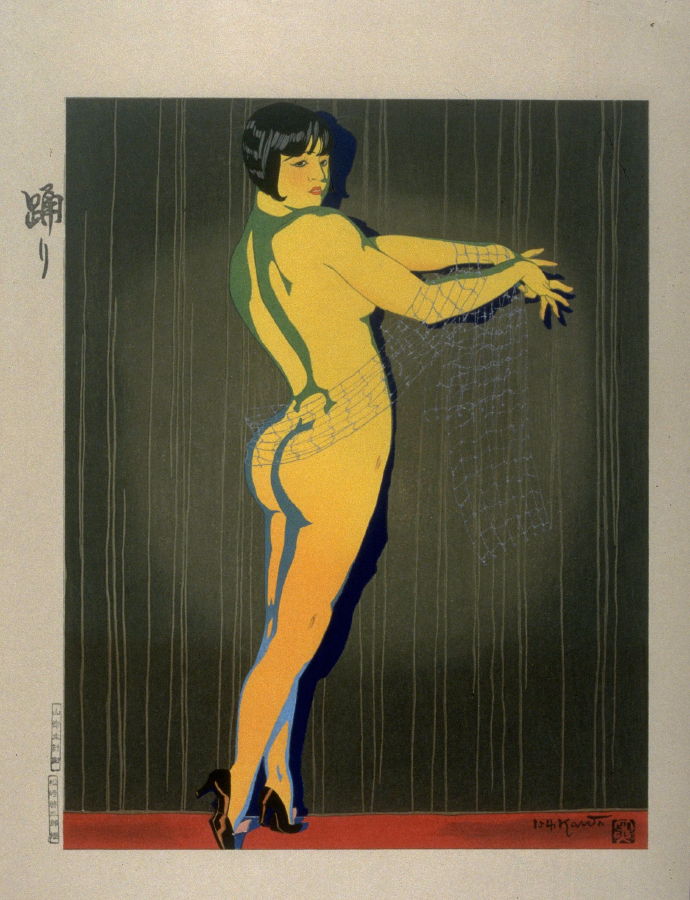
Ishikawa Toraji's Ten Nudes is the abbreviated English designation under which the artist's celebrated woodblock cycle of female nudes was catalogued in early Western collections, and refers to the same project recorded in full as the Ten Types of Female Nudes (Rajo jusshu) issued between 1934 and 1935. Ishikawa Toraji (1875-1964) was a yoga (Western-style oil) painter of the older generation, trained at the Hakubakai under Kuroda Seiki and a frequent traveler through Europe and the Americas during the 1900s and 1910s, whose return to the woodblock in the 1930s belongs to the wider yoga-to-hanga migration that brought figures such as Ishii Hakutei and Yamamura Toyonari to the print medium. The Ten Nudes were issued in self-published deluxe editions in oban tate-e and slightly larger formats, with carving by Maeda Kentaro and printing by Komatsu Wasakichi, and they represented an unusually candid engagement with the female nude in the medium that had largely confined nudity to bath-scene bijin-ga for the preceding two centuries. The compositions place each figure within a domestic Western interior furnished with the screens, carpets, fans, and decorative bric-a-brac of the cosmopolitan Tokyo upper-bourgeois household, and treat the body in the academic mode of Toraji's oil practice translated into the firm contour and flat graduated color of the woodblock. The series occasioned a brief moral controversy at the time of issue and was subsequently celebrated as one of the most accomplished engagements of the nude in twentieth-century Japanese printmaking. The complete sets are uncommon and impressions are held in the Art Institute of Chicago, the Honolulu Museum of Art, the British Museum, and the Museum of Fine Arts Boston, where the project figures prominently in modern accounts of the 1930s yoga-hanga.
Prints in This Series (1)
Complete series — all 1 prints catalogued.
Frequently Asked Questions
Ishikawa Toraji's Ten Nudes is the abbreviated English designation under which the artist's celebrated woodblock cycle of female nudes was catalogued in early Western collections, and refers to the same project recorded in full as the Ten Types of Female Nudes (Rajo jusshu) issued between 1934 and 1935. Ishikawa Toraji (1875-1964) was a yoga (Western-style oil) painter of the older generation, trained at the Hakubakai under Kuroda Seiki and a frequent traveler through Europe and the Americas during the 1900s and 1910s, whose return to the woodblock in the 1930s belongs to the wider yoga-to-hanga migration that brought figures such as Ishii Hakutei and Yamamura Toyonari to the print medium. The Ten Nudes were issued in self-published deluxe editions in oban tate-e and slightly larger formats, with carving by Maeda Kentaro and printing by Komatsu Wasakichi, and they represented an unusually candid engagement with the female nude in the medium that had largely confined nudity to bath-scene bijin-ga for the preceding two centuries. The compositions place each figure within a domestic Western interior furnished with the screens, carpets, fans, and decorative bric-a-brac of the cosmopolitan Tokyo upper-bourgeois household, and treat the body in the academic mode of Toraji's oil practice translated into the firm contour and flat graduated color of the woodblock. The series occasioned a brief moral controversy at the time of issue and was subsequently celebrated as one of the most accomplished engagements of the nude in twentieth-century Japanese printmaking. The complete sets are uncommon and impressions are held in the Art Institute of Chicago, the Honolulu Museum of Art, the British Museum, and the Museum of Fine Arts Boston, where the project figures prominently in modern accounts of the 1930s yoga-hanga.
The Ten Nudes series contains 1 prints, created by Ishikawa Toraji.
The Ten Nudes series was created by Ishikawa Toraji (石川寅治).
We currently have 1 of 1 known prints from the Ten Nudes series indexed in our collection. Browse them all on this page.
Want to rate prints from Ten Nudes?
Sign up to start rating