Twelve Figures of New Beauties
About This Series
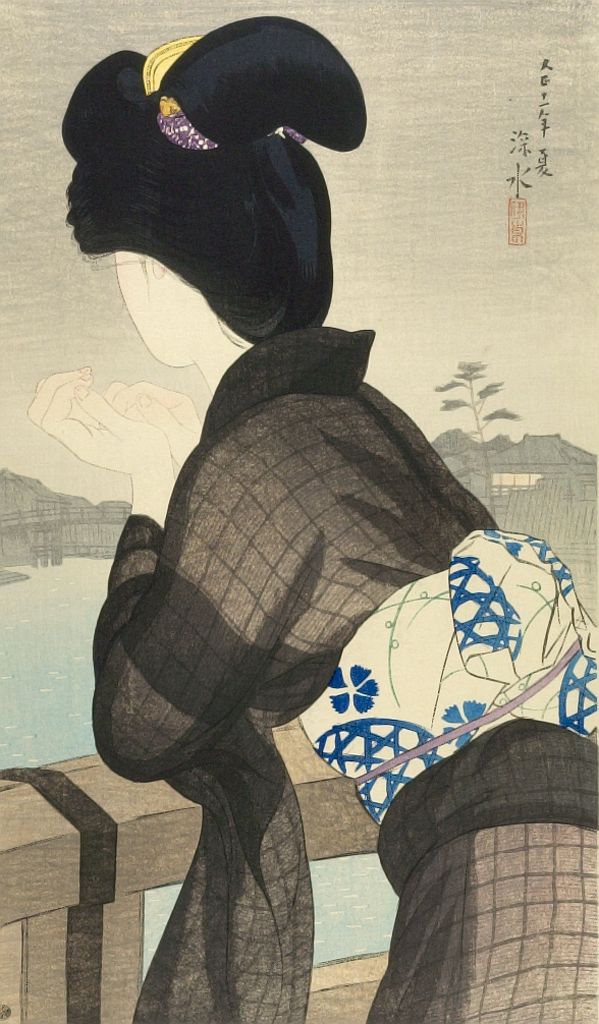
Twelve Figures of New Beauties is the English designation under which one of Ito Shinsui's bijin-ga cycles of the interwar period circulates in Western cataloguing, the title corresponding to the Japanese Shin bijin junisugata that Watanabe Shozaburo published from Shinsui's designs across the late 1910s. The series belongs to the foundational period of Shinsui's collaboration with Watanabe, in which the bijin-ga half of the shin-hanga program was elaborated through a sequence of twelve-print sets that distinguished themselves from the late-Edo licensed-quarter bijin-ga by relocating the subject from public entertainment to private interior, and from costume display to interior emotional register. Each design presents a single contemporary woman in a self-contained moment of thought, grooming, dressing, or seasonal observance, drawn from the early-twentieth-century middle-class life that the Taisho-era audience recognized as its own rather than from the historical iconography of the Yoshiwara that Utamaro and his successors had treated. The collaborative shin-hanga method allowed the prints to achieve the subtle facial modeling, complex kimono patterns, and atmospheric grounds that had been impossible in the cheaper commercial Edo bijin-ga, with Watanabe's separately trained block carvers and printers carrying through the artist's drawing under the publisher's coordinating direction. Shinsui, who had entered the studio of the Nihonga master Kaburaki Kiyokata as a teenager and was already a skilled figure painter when Watanabe began commissioning prints from him, brought to the cycle the linear contour and reserved emotional vocabulary of the Kiyokata-school bijin-ga lineage, translated through the medium of the woodblock into a form that the publisher could market through his international clientele. The relationship between this set, the Twelve Images of Modern Beauties, and the New Twelve Images of Modern Beauties of the late 1920s reflects Watanabe's practice of building Shinsui's bijin-ga program through related and partially overlapping twelve-print groupings whose cataloguing has occupied modern scholars working to disentangle their publication histories. Surviving early Watanabe impressions are prized for the fine register and pigment work that distinguishes them from postwar restrikes, and representative impressions are held by the Art Institute of Chicago, the Museum of Fine Arts in Boston, and the Honolulu Museum of Art among other major collections of twentieth-century Japanese print.
Prints in This Series (1)
Complete series — all 1 prints catalogued.
Frequently Asked Questions
Twelve Figures of New Beauties is the English designation under which one of Ito Shinsui's bijin-ga cycles of the interwar period circulates in Western cataloguing, the title corresponding to the Japanese Shin bijin junisugata that Watanabe Shozaburo published from Shinsui's designs across the late 1910s. The series belongs to the foundational period of Shinsui's collaboration with Watanabe, in which the bijin-ga half of the shin-hanga program was elaborated through a sequence of twelve-print sets that distinguished themselves from the late-Edo licensed-quarter bijin-ga by relocating the subject from public entertainment to private interior, and from costume display to interior emotional register. Each design presents a single contemporary woman in a self-contained moment of thought, grooming, dressing, or seasonal observance, drawn from the early-twentieth-century middle-class life that the Taisho-era audience recognized as its own rather than from the historical iconography of the Yoshiwara that Utamaro and his successors had treated. The collaborative shin-hanga method allowed the prints to achieve the subtle facial modeling, complex kimono patterns, and atmospheric grounds that had been impossible in the cheaper commercial Edo bijin-ga, with Watanabe's separately trained block carvers and printers carrying through the artist's drawing under the publisher's coordinating direction. Shinsui, who had entered the studio of the Nihonga master Kaburaki Kiyokata as a teenager and was already a skilled figure painter when Watanabe began commissioning prints from him, brought to the cycle the linear contour and reserved emotional vocabulary of the Kiyokata-school bijin-ga lineage, translated through the medium of the woodblock into a form that the publisher could market through his international clientele. The relationship between this set, the Twelve Images of Modern Beauties, and the New Twelve Images of Modern Beauties of the late 1920s reflects Watanabe's practice of building Shinsui's bijin-ga program through related and partially overlapping twelve-print groupings whose cataloguing has occupied modern scholars working to disentangle their publication histories. Surviving early Watanabe impressions are prized for the fine register and pigment work that distinguishes them from postwar restrikes, and representative impressions are held by the Art Institute of Chicago, the Museum of Fine Arts in Boston, and the Honolulu Museum of Art among other major collections of twentieth-century Japanese print.
The Twelve Figures of New Beauties series contains 1 prints, created by Ito Shinsui.
The Twelve Figures of New Beauties series was created by Ito Shinsui (伊東深水).
We currently have 1 of 1 known prints from the Twelve Figures of New Beauties series indexed in our collection. Browse them all on this page.
Want to rate prints from Twelve Figures of New Beauties?
Sign up to start rating