Twelve Images of Modern Beauties
About This Series
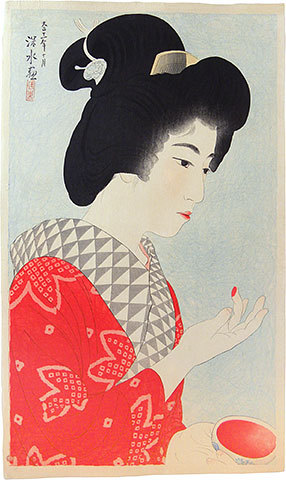
Twelve Images of Modern Beauties (Gendai bijin junisugata) is the foundational bijin-ga cycle of Ito Shinsui's early career, designed for the publisher Watanabe Shozaburo across the late 1910s and 1920s as one of the inaugural projects through which the shin-hanga movement defined its modern treatment of the beautiful woman. Conceived in conscious dialogue with the canonical late-Edo bijin-ga series of Utamaro, Eishi, and their successors, the set substituted the Yoshiwara courtesan and entertainer of the licensed quarters with the contemporary middle-class Japanese woman of the late Taisho and early Showa decades, a figure whose modernity was registered through subtle adjustments of hairstyle, kimono pattern, and contained domestic gesture rather than through the explicit costuming of the moga, the modern girl who occupied the parallel Western-dress bijin imagery of Hashiguchi Goyo and Kobayakawa Kiyoshi. Shinsui, who had entered the studio of the Nihonga master Kaburaki Kiyokata as a teenager and who was already an established figure painter when Watanabe began commissioning prints from him in the mid-1910s, brought to the cycle a draftsmanship grounded in the Kiyokata school's reformed bijin-ga lineage, with its emphasis on graceful linear contour and reserved emotional register. The collaborative shin-hanga production method, in which the artist's drawing was carried by Watanabe's separately trained block carvers and printers, allowed the set to achieve subtle skin gradations, complex woven and dyed kimono patterns, and the calibrated bokashi backgrounds that became Shinsui's signature, and the prints were marketed through Watanabe's expanding international clientele as exemplars of the revived woodblock medium's contemporary possibilities. Within Shinsui's career the Twelve Images stands as the project through which his bijin-ga manner first crystallized, and it served as the model for the later New Twelve Images of Modern Beauties of the late 1920s and for the Showa-era bijin-ga series through which he was identified internationally as the central figure of the genre. Modern scholarship treats the cycle as one of the defining shin-hanga statements of the interwar period, and surviving early Watanabe impressions are valued for the fine register and unstinted pigment work that distinguishes them from postwar restrikes; representative impressions are held by the Art Institute of Chicago, the Museum of Fine Arts in Boston, the Honolulu Museum of Art, and other major Western and Japanese collections of twentieth-century print.
Prints in This Series (2)
Complete series — all 1 prints catalogued.

Frequently Asked Questions
Twelve Images of Modern Beauties (Gendai bijin junisugata) is the foundational bijin-ga cycle of Ito Shinsui's early career, designed for the publisher Watanabe Shozaburo across the late 1910s and 1920s as one of the inaugural projects through which the shin-hanga movement defined its modern treatment of the beautiful woman. Conceived in conscious dialogue with the canonical late-Edo bijin-ga series of Utamaro, Eishi, and their successors, the set substituted the Yoshiwara courtesan and entertainer of the licensed quarters with the contemporary middle-class Japanese woman of the late Taisho and early Showa decades, a figure whose modernity was registered through subtle adjustments of hairstyle, kimono pattern, and contained domestic gesture rather than through the explicit costuming of the moga, the modern girl who occupied the parallel Western-dress bijin imagery of Hashiguchi Goyo and Kobayakawa Kiyoshi. Shinsui, who had entered the studio of the Nihonga master Kaburaki Kiyokata as a teenager and who was already an established figure painter when Watanabe began commissioning prints from him in the mid-1910s, brought to the cycle a draftsmanship grounded in the Kiyokata school's reformed bijin-ga lineage, with its emphasis on graceful linear contour and reserved emotional register. The collaborative shin-hanga production method, in which the artist's drawing was carried by Watanabe's separately trained block carvers and printers, allowed the set to achieve subtle skin gradations, complex woven and dyed kimono patterns, and the calibrated bokashi backgrounds that became Shinsui's signature, and the prints were marketed through Watanabe's expanding international clientele as exemplars of the revived woodblock medium's contemporary possibilities. Within Shinsui's career the Twelve Images stands as the project through which his bijin-ga manner first crystallized, and it served as the model for the later New Twelve Images of Modern Beauties of the late 1920s and for the Showa-era bijin-ga series through which he was identified internationally as the central figure of the genre. Modern scholarship treats the cycle as one of the defining shin-hanga statements of the interwar period, and surviving early Watanabe impressions are valued for the fine register and unstinted pigment work that distinguishes them from postwar restrikes; representative impressions are held by the Art Institute of Chicago, the Museum of Fine Arts in Boston, the Honolulu Museum of Art, and other major Western and Japanese collections of twentieth-century print.
The Twelve Images of Modern Beauties series contains 1 prints, created by Ito Shinsui.
The Twelve Images of Modern Beauties series was created by Ito Shinsui (伊東深水).
We currently have 2 of 1 known prints from the Twelve Images of Modern Beauties series indexed in our collection. Browse them all on this page.
Want to rate prints from Twelve Images of Modern Beauties?
Sign up to start rating